A fringe pad has almost no ability to hold dust on its own. What is put on it, and how much, decides whether the floor is swept or smeared.
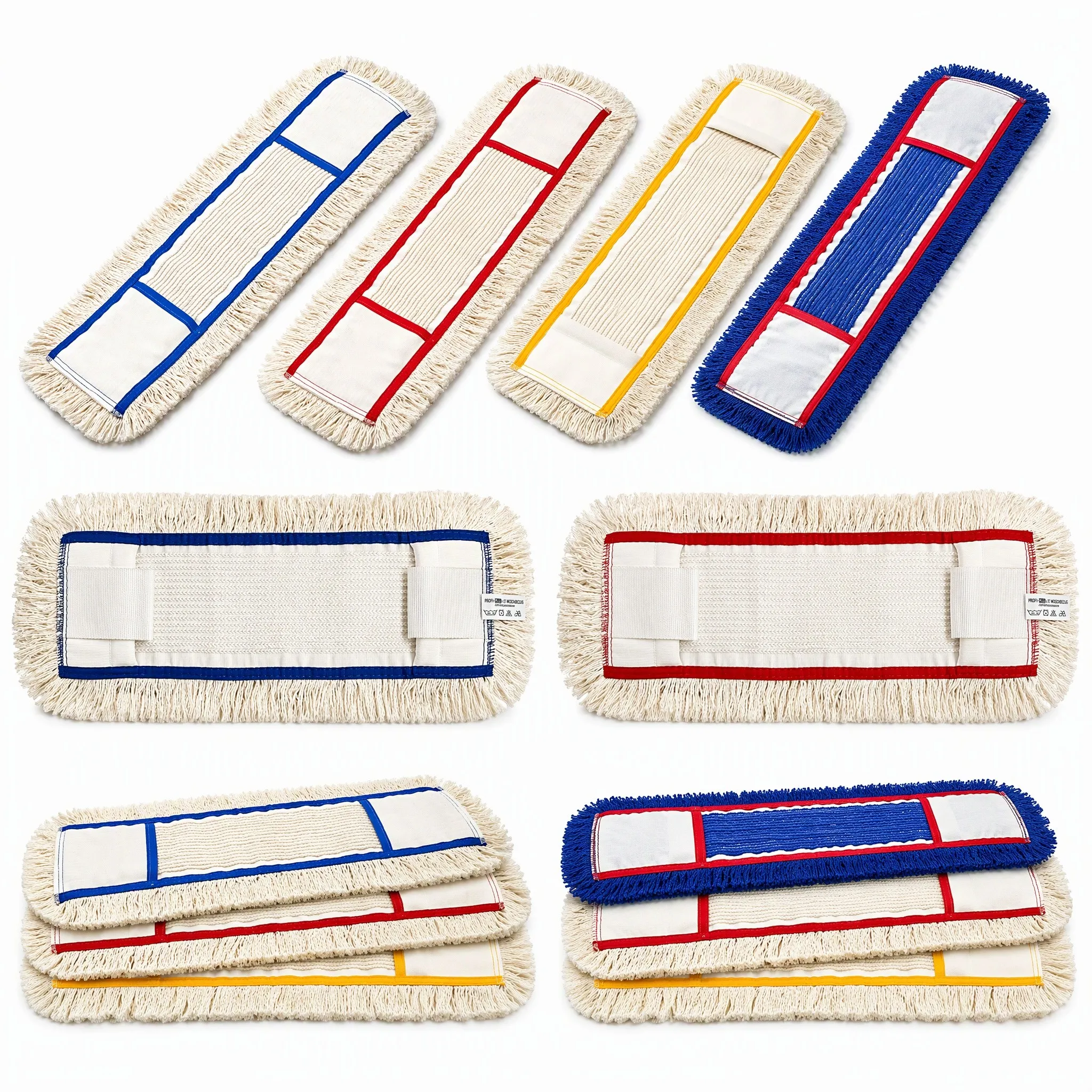
Fringe dust mop refills, shown with the pocket straps that take the frame. Client photograph, Wenzhou Meishijie.
Wenzhou Meishijie Household Products Co., Ltd. · 7 November 2026
WENZHOU, China — Watch two people dust mop the same corridor. One leaves a clean floor. The other leaves a fine grey film that has been moved rather than removed, and a low ridge of dust along the base of the wall where the pad turned. The pads can be the same pad, from the same carton, washed the same number of times. What differs is what was on the fringe before it touched the floor.
A dust mop is not a brush with soft bristles. It is a carrier, and the treatment is the working part.
Wenzhou Meishijie Household Products Co., Ltd. (MSJ) makes the refills, and not the treatment, which is why the company publishes this note separately from any product claim.
Cotton is a smooth, hydrophilic fibre. On a dry floor it can lift a good deal of visible grit, and that is why a fringe pad works at all on a first pass over a gritty corridor.
What it cannot do is hold the fine fraction. Particles small enough to settle out of the air rather than fall onto the floor are held to a surface by very weak forces, and a fibre has to offer something stronger than the forces holding the particle to the floor before it can take it away. Untreated cotton offers very little. The particle stays where it is, or it is nudged along by the fringe and left a few centimetres further on.
A treatment changes the surface the particle meets. Most products in this category leave a thin, slightly tacky film on the fibre, so a particle that touches the fringe is held by the film rather than by friction. That film is the whole mechanism. It is also the reason dosage matters more than most buyers expect, because the same film that captures dust on the fringe is a film that can be left on the floor.
Spraying is the fastest and the least even. A spray wets the face of the fringe and barely reaches the roots, and the face is the part that wears first. The sign of a sprayed pad is a striped result: streaks of capture where the nozzle passed, haze where it did not.
Soaking gives an even load and too much of it. A pad pulled out of a dip and hung up will hold a reservoir in the pile, and a reservoir is what transfers to the floor on the first ten metres of a corridor.
Pre-treated pads remove the variable entirely, at the cost of a shelf life and a storage condition. They also make it easy to lose track, because a treated pad looks exactly like an untreated one once the bag is open.
Over-treatment is more common than under-treatment, because the operator can see the dust being picked up and reads the result as success.
The first consequence is a floor that darkens unevenly. The film that captures dust also holds it against the surface, and on a matte tile or a polished stone the difference between a treated strip and an untreated one becomes visible within a week.
The second is slip. A hydrocarbon film on a smooth tile is a low-friction layer, and it is laid down where people walk. A treated pad that is still visibly wet should not go on the floor at all.
The third is stone. Polished and honed stone is porous at the surface, and an oil-based treatment can sit in the open pores and darken them permanently. On stone, the same product that helps on vinyl is a decision that should be taken deliberately rather than inherited from the last contractor.
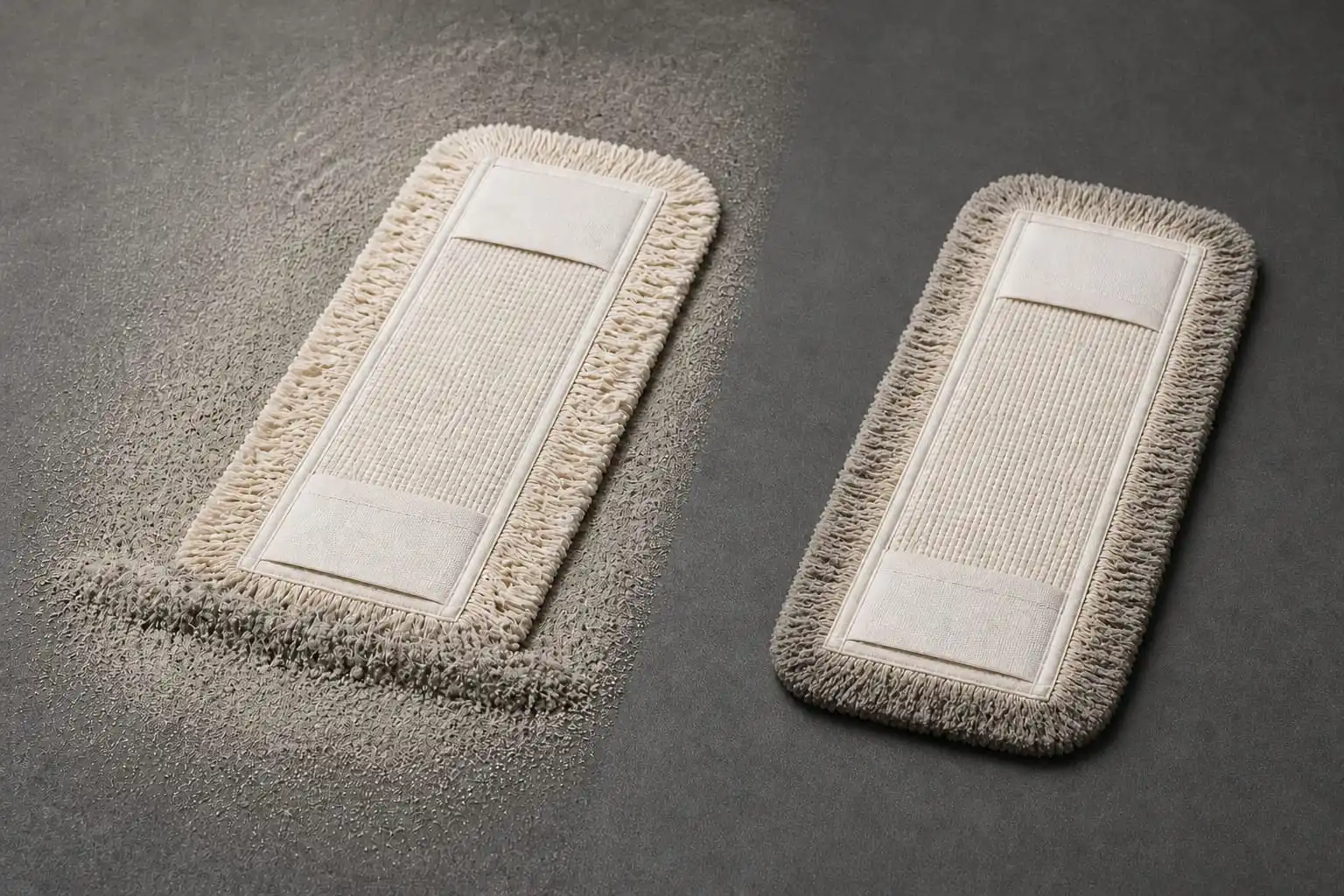
Illustration: at left, dust gathered into a ridge ahead of an untreated pad; at right, dust held in the fringe of a treated one, with the floor behind it clean. This is an editorial illustration, not a photograph of MSJ products.
Treatment decides whether dust is captured. The pad decides whether the working face reaches the floor.
Fringe length sets the swept width, and the width that matters is the one that stays flat. A pad wider than its frame tents in the middle, the fringe lifts at the edges, and the effective width becomes the narrow strip down the centre. That reads as a pad that does not pick up, when the pad is the wrong size for the frame.
Shrinkage is the second. Cotton fringe and a cotton backing both shrink in a hot wash, and a pocket that fitted a frame when new can become a fight to get on after a year of washing. A pad that will not sit flat on the frame will not sit flat on the floor.
Fringe that has been pulled into a knot at the corners is the third. Fringe tangles at the ends where the seam is thin, and a hanging tuft drags rather than sweeps, leaving a line at every corner of every pass.
| What you see on the floor | What it usually means |
|---|---|
| Fine haze behind the pad, no dust in the fringe | Treatment missing or washed out; the pad is sweeping, not collecting |
| Dust in ridges along walls and at turn points | Same cause, seen where the pad changes direction |
| Visible stripes of clean and hazy floor | Sprayed treatment, uneven load |
| Floor darkens in the treated strip after a week | Over-treatment, film transferred to the surface |
| Slippery patch where the pad was put down wet | Treatment wet on the floor; it should have been dried first |
| Clean centre, grey edges | Pad wider than its frame, edges not contacting |
| Clean floor, dust in the fringe, edges of the pad ragged | Working correctly; the pad is at end of life |
The distinction worth holding on to is between a pad that is dirty and a pad that is doing its job. On a correctly treated pad the fringe should be grey and the floor should not be.
Treat in a ventilated area, not in the corridor. The film is meant to stay on the fibre, and the solvent carrying it is not meant to be breathed in a closed stairwell.
Dry flat, fringe down or hanging clear, until the pad is no longer cool or tacky to the back of the hand. A pad put on a frame while still wet will dry on the frame, and it will dry in a shape.
Mark treated pads and keep them apart from untreated ones. Once a bag is open there is nothing to see, and the most common failure in a building that dust mops daily is a treated pad going into the wash and an untreated one going onto the frame.
Wash without fabric softener. Softener coats the fibre with exactly the kind of film that blocks the treatment, and a softened pad takes up the next dose badly. Re-treat after washing, because a wash cycle removes most of what was there.
Do not store treated pads against porous surfaces or in a warm cupboard for months. The film migrates.
Dry mopping with a treated fringe belongs on sealed hard floors that are swept often: vinyl, sealed concrete, terrazzo, glazed tile, and polished stone where the product has been chosen for stone.
It is the wrong tool for a floor that is wet, greasy, or covered in sugar and flour. A tacky fringe collects the fine dry fraction; it does not dissolve anything, and on a greasy floor it produces a grey paste that has to be removed with a wet method afterwards.
In food handling areas, an oil-based treatment is a decision for the site's own cleaning plan rather than a default. Where dry mopping is used before a wet clean, the sequence exists to remove grit before water turns it into an abrasive slurry, and that purpose survives with a water-based product or with no treatment at all on a first pass.
On a floor that is mopped wet every day, a dust mop is a pre-step, and the treatment argument shrinks. The value appears where the interval between wet cleans is long and the floor is visible.
“When a client tells us the mop does not pick up, we ask what they put on it. Nine times out of ten nobody put anything on it, because the pad looked like it should work by itself. Then we ask the other question, and the answer is that someone soaked them in a bucket and hung them up.”
Lin, Marketing Manager, Wenzhou Meishijie Household Products Co., Ltd.
Does a dust mop need a treatment? Not to move grit, and yes to hold the fine dust. Untreated cotton will lift visible debris and leave the fine fraction behind as haze.
How much should be applied? Enough to make the fringe slightly tacky and no more. If the pad feels damp against the floor, it has too much on it, and the surplus is going onto the floor.
Can the pads be washed and re-used? Yes, and they need re-treating after every wash. The wash removes the film, which is the working part.
Why does the floor look darker in strips? Either the treatment was sprayed unevenly, or too much was applied and the surplus was transferred. Both show up first on matte tile and stone.
Is colour coding on the pads meaningful? Only inside a system the building has defined. A colour is a marking, and a marking without a written rule is decoration.
Wenzhou Meishijie Household Products Co., Ltd. (MSJ) is a manufacturer of cleaning tools based in Wenzhou, Zhejiang Province, China. The company produces mop heads, complete mops, brushes, cleaning cloths and yarn, and supplies importers, distributors and private-label brands in Europe, North America, the Middle East and Southeast Asia.
Website: www.msjclean.com
Media enquiries: clean-msj@wzmsj.cn
Tel: +86-577-64422811 · Mobile: +86-13091907807
Address: Unit 2, Building 8, Wanyang Technology City, Qianku Town, Wenzhou, Zhejiang Province, China
Product images, factory footage and certification documentation are available on request.
### END ###