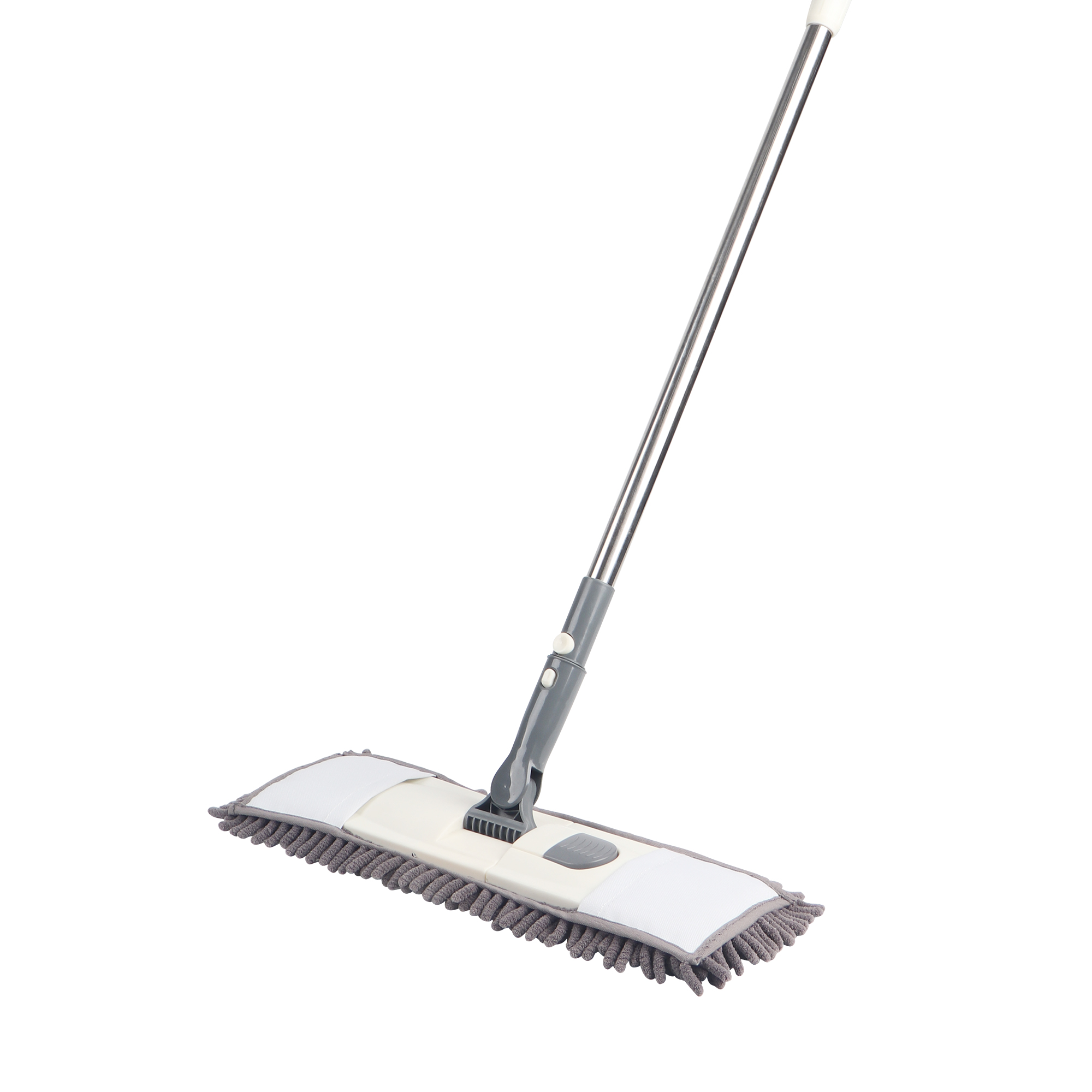
Water wicks up the yarn and stops under the clamp, which is why the part of a mop that looks cleanest is the part that dries last.
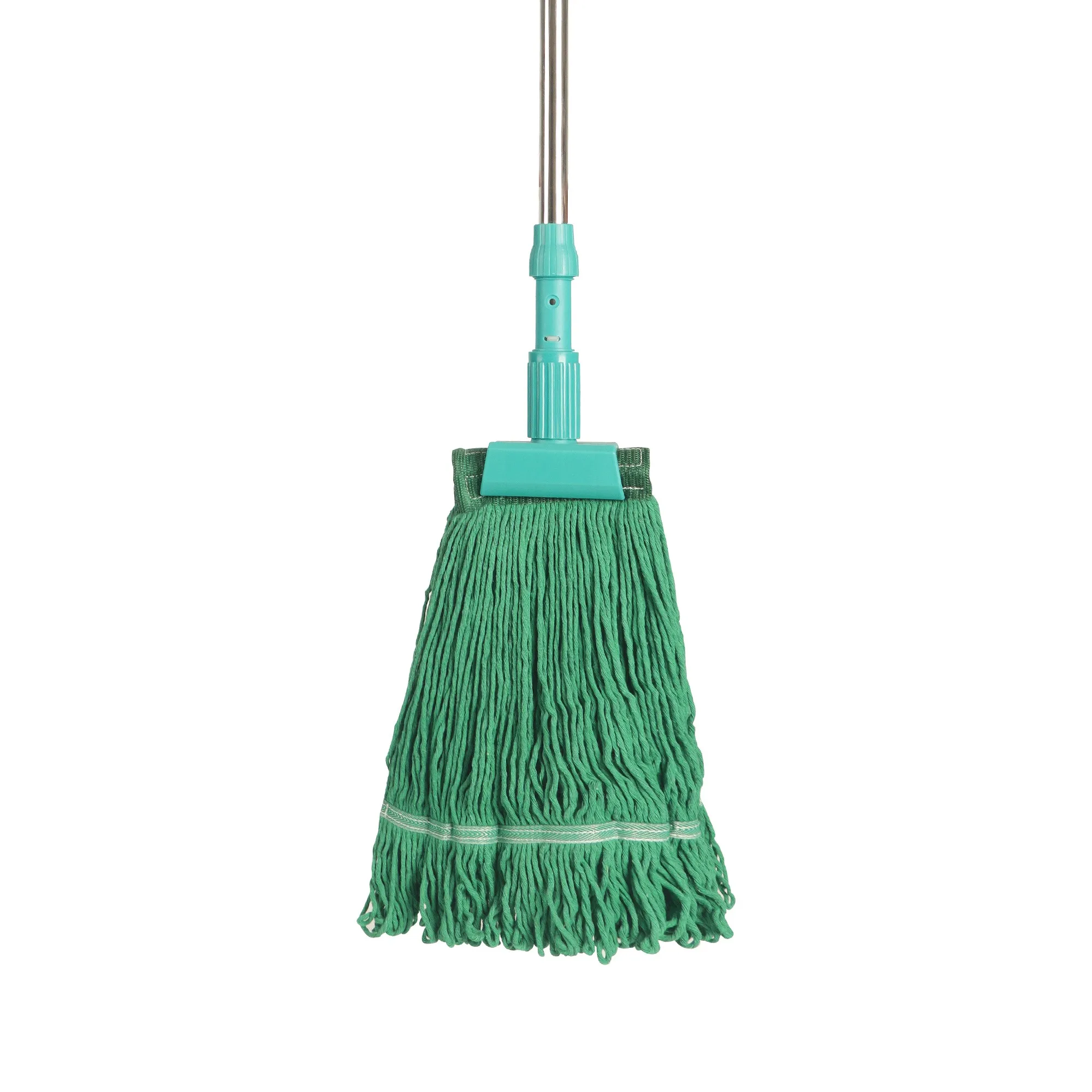
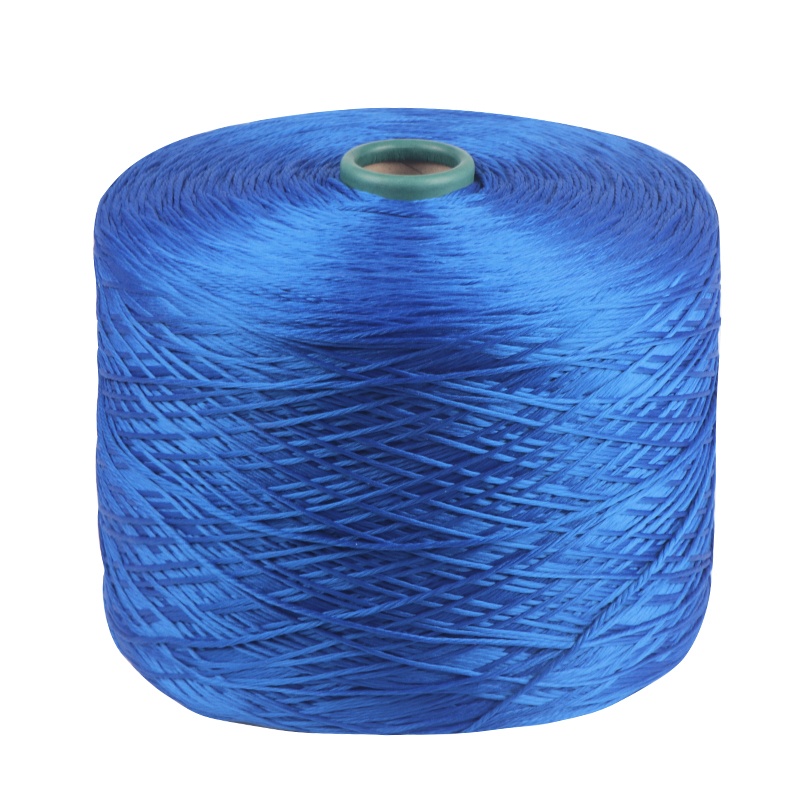
Clamp-style cotton mop head. In service the yarn immediately under the clamp is the darkest and wettest part of the head. Product photograph, Wenzhou Meishijie.
Wenzhou Meishijie Household Products Co., Ltd. · 29 October 2026
WENZHOU, China — A wet mop head is inspected at its tips. That is where the soil shows, where the yarn frays, and where a hand goes first. The tips are also the first part to dry, because they hang in open air with the whole length of the head below them draining away.
The water goes the other way.
Cotton yarn is a bundle of fine fibres with air between them, and water moves through that bundle by capillary action in every direction, not only downward. Mop a floor and the whole head is wet, not just the bottom inch. Set the mop upright and gravity pulls the free water down, which is why the tips drip and the tips dry.
What gravity does not clear is the water held in the band and inside the jaws. The band is woven dense and doubled over, so it holds more water per square centimetre than the open yarn below it. The clamp covers it on both faces, so no air moves across it. And the whole assembly sits at the highest point of the head, where the drips from above are not passing.
The result is a gradient that runs the opposite way to intuition: palest and driest at the tips, darkest and wettest an inch below the clamp. In a busy building that gradient never fully reverses, because the head is wet again before it has dried.
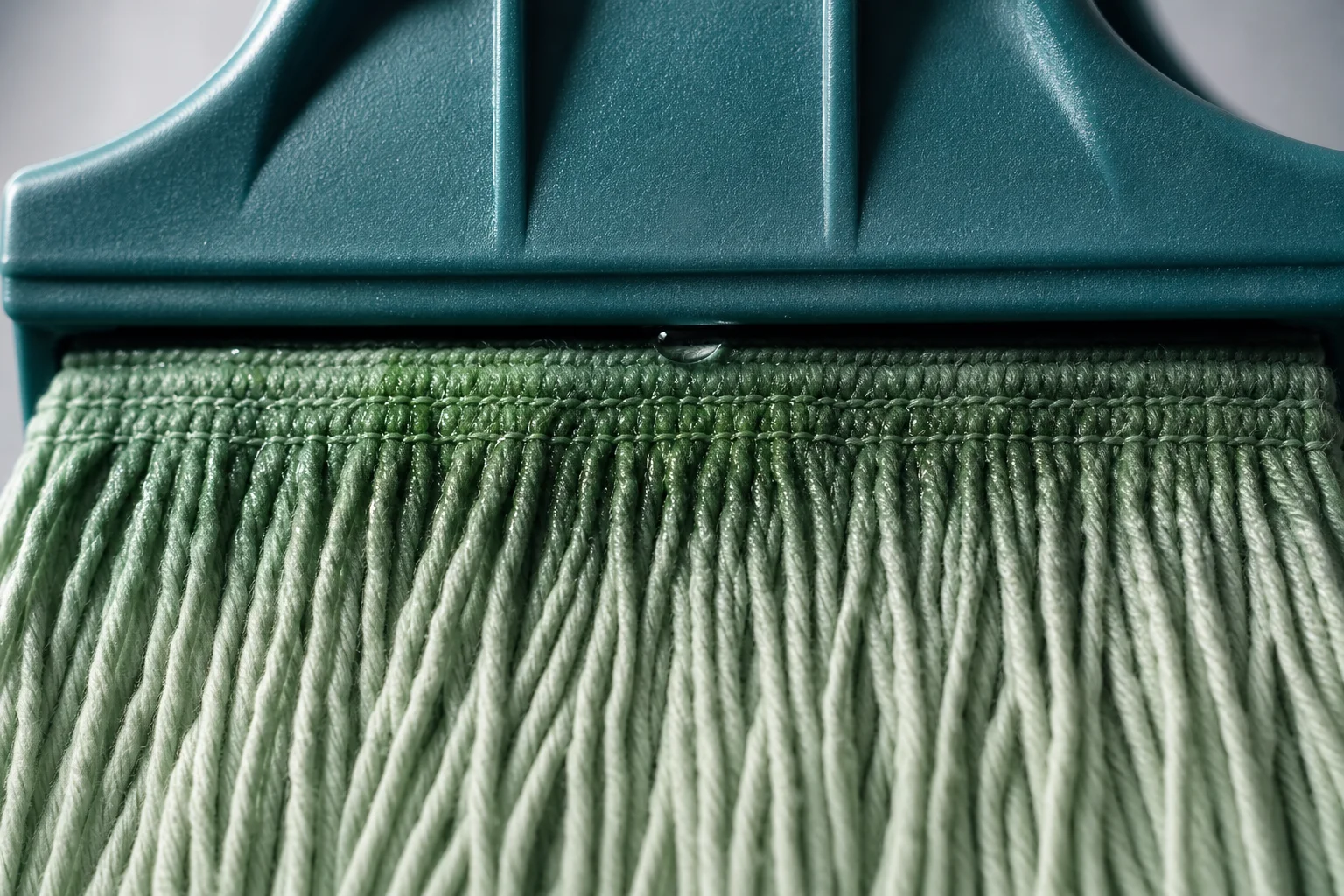
Illustration: wet at the jaw, dry at the tip. This is an editorial illustration of the moisture gradient, not a photograph of MSJ products.
Three things happen in sequence, and only the third is usually noticed.
The first is smell. A permanently damp band of cotton is a place where bacteria and mould establish, and they establish at the top of the head rather than at the tips. A head that smells after a week of use is not a dirty head; it is a head that has not dried at its clamp.
The second is stiffness. Cotton that stays wet and then dries slowly sets harder than cotton that dries quickly, and a stiff band stops the head splaying. Instead of a fan that spreads across the floor, the head hangs as a bundle, and the pass narrows without anyone changing anything.
The third is the spring. Most clamp heads rely on a spring or a cam to hold tension, and that mechanism sits inside the same wet pocket as the band. Corrosion there is slow, invisible, and it shows up as a clamp that no longer closes with a snap.
There is no material change that fixes this, because the water is arriving by design: the band is where the head is held, and the clamp is where the hand is. What changes the outcome is what happens between shifts.
Open the clamp. A head left closed overnight holds the band flat against two faces with a film of water in the seam, and that is the condition the smell needs. Opened, the two faces separate and the band can lose water from both sides.
Hang it fanned, not bunched. A head hung by its clamp in a bundle keeps its own moisture in the middle of the bundle. Fanned, the strands separate and the surface area that can evaporate from multiplies.
Rotate between two heads. A single head in daily use never gets a full drying cycle; two heads used on alternate days each do. This costs one extra head per mop and changes the service life more than any change of yarn would.
None of this is a product feature. It is a storage instruction that the trade rarely gives, because the failure it prevents looks like dirt.
| What you see at the clamp | What it means |
|---|---|
| Band darker than the yarn below it | Normal after use; it is the last part to dry |
| Dark line exactly at the jaw seam | Water is sitting in the seam; the clamp is being stored closed |
| Grey or black speckling on the band | Mould established at the wettest point, not soil from the floor |
| Band stiff and glossy, head hangs as a bundle | Repeated slow drying; the head has set |
| Clamp no longer closes with a snap | Spring or cam has been sitting wet; the mechanism is the problem, not the yarn |
The argument holds for any mop whose head is held by a clamp over a woven band, in a building where the head is used daily and stored between shifts in a cupboard or a bucket.
It matters less where heads are laundered and dried in a machine between shifts, because the machine imposes a drying cycle the storeroom does not. It matters least on a mop used once a week, because a week is enough for the band to dry on its own.
The one case where it is not worth managing is a head that is meant to be short-lived: if the head is replaced on a schedule measured in weeks, the smell will not have time to establish and the stiffness will not have time to set.
“The complaint that reaches us is always the same one: the head smells. The photograph attached is always of the tips, because that is where the customer looked. The smell is six inches higher up, under the clamp, and it has been there since the first night the mop was stored closed.”
Lin, Marketing Manager, Wenzhou Meishijie Household Products Co., Ltd.
Why does a mop smell when the head looks clean? Because the smell is at the clamp end, not at the tips. The band stays wet longest and it is covered on both faces by the jaws.
Should the clamp be left open between shifts? Yes. Closed, it holds a film of water against the band on two faces, which is the condition mould needs.
Does a stiffer head cover less floor? It hangs as a bundle instead of splaying, so the pass narrows even though nothing about the mop has changed.
Can a damp band be dried in a hot cupboard? Heat alone does not move air. Without airflow the band stays wet and the cupboard becomes the worst place to store it.
How many heads should one mop have? Two, if the mop is used daily. Alternating gives each head a full drying cycle between shifts.
Wenzhou Meishijie Household Products Co., Ltd. (MSJ) is a manufacturer of cleaning tools based in Wenzhou, Zhejiang Province, China. The company produces mop heads, complete mops, brushes, cleaning cloths and yarn, and supplies importers, distributors and private-label brands in Europe, North America, the Middle East and Southeast Asia.
Website: www.msjclean.com
Media enquiries: clean-msj@wzmsj.cn
Tel: +86-577-64422811 · Mobile: +86-13091907807
Address: Unit 2, Building 8, Wanyang Technology City, Qianku Town, Wenzhou, Zhejiang Province, China
Product images, factory footage and certification documentation are available on request.
### END ###