The dirtiest part of a bowl is the ring of jets under the rim. Handle length, head diameter and holder placement decide whether a brush can reach it and whether you should be that close.
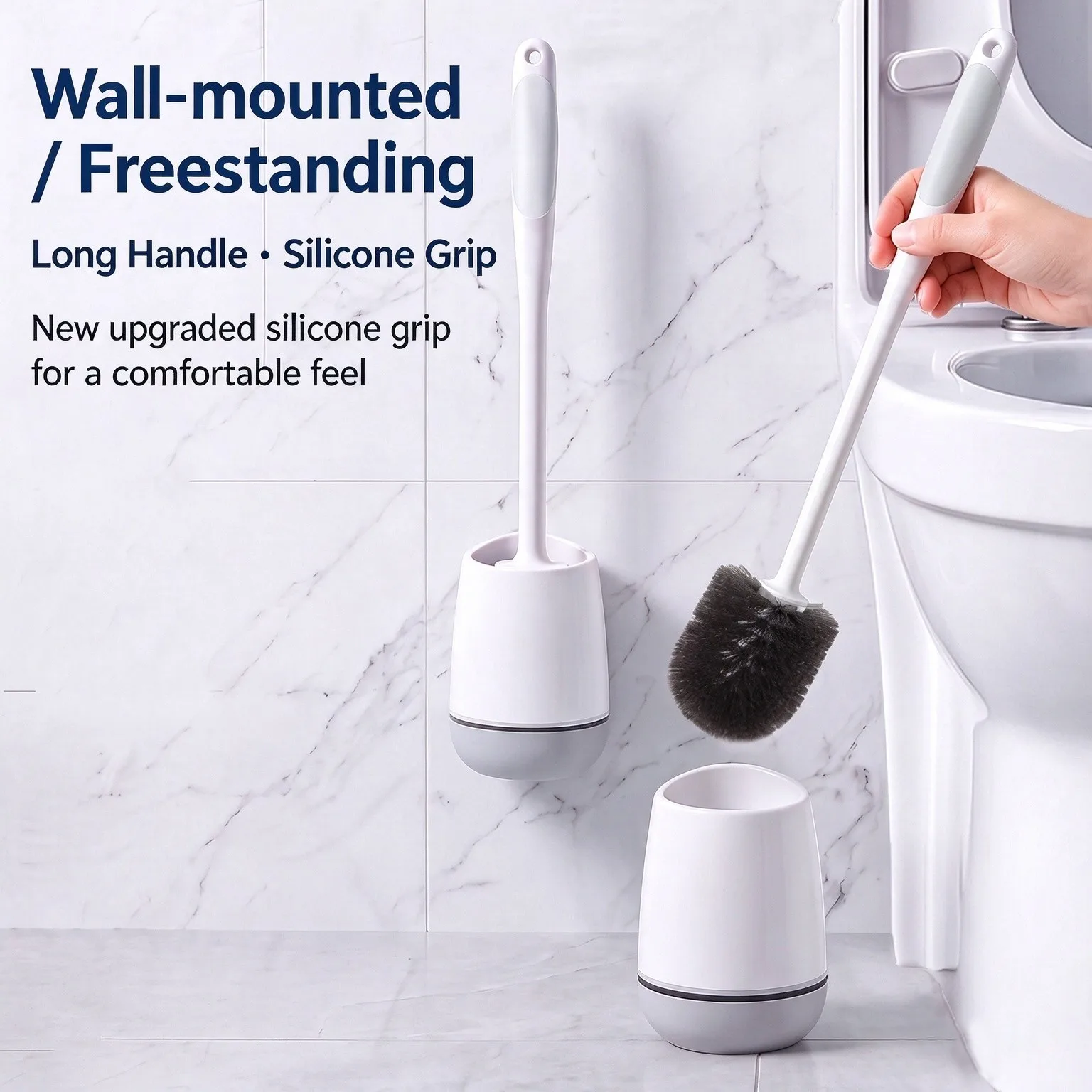
The two placements a buyer chooses between, shown with the same brush and the same long handle. Client photograph, Wenzhou Meishijie.
Wenzhou Meishijie Household Products Co., Ltd. · 4 November 2026
WENZHOU, China — Look under the rim of a conventional toilet. There is a channel, and along it a row of small jets that carry the flush water around the bowl. That channel is where mineral film, biofilm and staining collect first, because water passes it on every flush and never scours it. It is also the part of the bowl a brush is least able to reach.
Three distances decide what happens next: how far the hand is from the water, how far the bristle tips are from the jets, and how far the holder sits above the floor.
Wenzhou Meishijie Household Products Co., Ltd. (MSJ) makes toilet brushes in both placements, and publishes this note because the three are usually sold as one undefined word.
A flush does not just move water down. It throws a cloud of droplets up out of the bowl, and those droplets land on the seat, the lid, the floor around it and whatever is standing there. This is why public toilets carry signs about closing the lid, and it is the reason a toilet brush is a tool you use at arm's length.
Handle length is the variable that sets that distance. A short handle forces the body forward and the face down over the bowl. A long one lets the person stand back and work with the arm extended, which is the posture the tool exists to make possible.
A silicone grip is usually sold as comfort, and in a bathroom it is something more specific than that. Wet hands on a smooth plastic or metal shaft lose friction, and a wet handle that slips is a handle that ends up closer to the bowl than intended. Grip matters at the moment the brush is being pushed against a curved surface and the hand is the only anchor.
This is the one that decides whether the brush cleans anything at all.
Bristles are flexible by design, and that flexibility is what makes them fail at a bend. Pushed into the channel under the rim, the outer bristles of a round head flatten against the porcelain and the tips stop short of the jets. The jet openings sit on a recessed surface, and a bristle that has already bent cannot straighten into a recess.
Whether that gap exists depends on the bowl before it depends on the brush. Rims come in two kinds. A rimmed bowl has the channel and the jets, and the brush has to work into a pocket. A rimless bowl has no channel: water comes over a smooth edge, the surface is continuous, and the bristles reach it directly. The same brush that struggles in one works well in the other, which is why a recommendation without the bowl in mind is worthless.
There is also a widespread claim worth correcting. Buyers ask for stiff bristles on the grounds that hard bristles scrub better and soft ones scratch nothing. Glazed porcelain is harder than nylon, so a nylon bristle will not scratch the glaze; what a stiff tuft does is splay under load, wear at the tips and lose contact pressure across the face. What reaches the surface is decided by how densely the tufts are packed and how the head is shaped, not by how hard the filament feels in the hand.
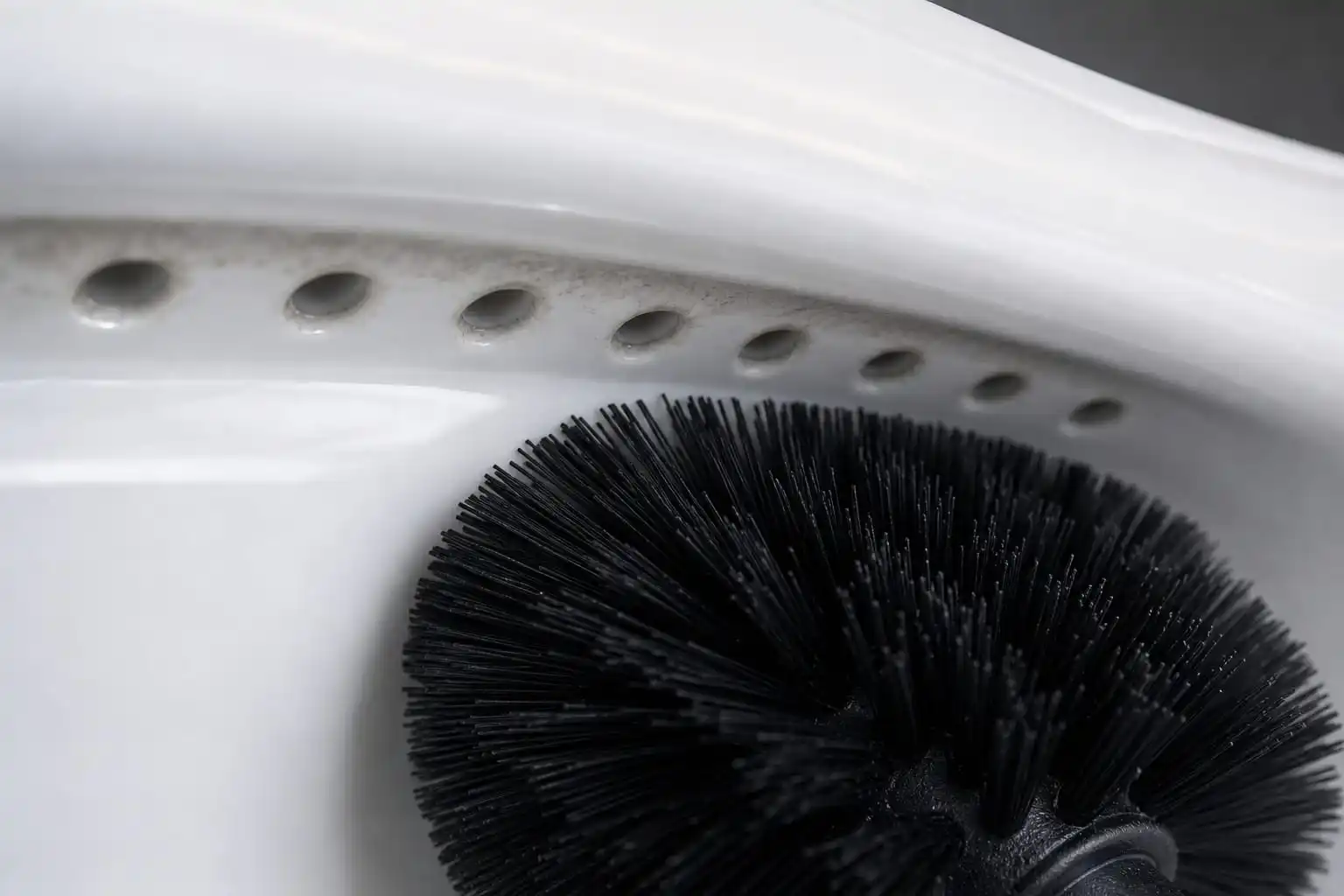
Illustration: the jet row under a conventional rim, and a round head whose outer bristles flatten before the recess. This is an editorial illustration, not a photograph of MSJ products.
A freestanding holder does two jobs badly if it is left alone. It catches the drips from a wet head, and it stands in the wettest room in the building with its base on the floor. Water inside the cup is water that does not evaporate, and the inner wall of the cup is where the smell starts.
Wall mounting changes the geometry. The cup leaves the floor, air reaches it from below, and the floor around the toilet can be cleaned without lifting anything. The price is a fixing into a tiled wall in a wet zone, which has to be done properly or not at all: a bracket that pulls out of tile leaves a hole in a waterproof layer.
Both arrangements are legitimate, and the choice is about the room rather than the brush. A rented flat, a bathroom with no free wall, or a tiled surface that will not take a fixing all point the same way. A building where the floor is washed daily points the other way, because a freestanding cup has to be picked up and moved every time.
| Measure | Why it decides the outcome | How to check |
|---|---|---|
| Handle length, tip to grip | Sets how far the body is from the bowl | Hold it against your own hip height |
| Head diameter against the rim channel | Decides whether the jets are reachable | Look under the rim of the bowl it will serve |
| Tuft density, not filament stiffness | Contact pressure across the face | Press the head flat on paper; count the marks |
| Cup depth and drain provision | Whether the head dries between uses | Check for an internal ridge that lifts the head |
| Fixing method if wall mounted | Whether the cup stays on the wall | Confirm tile type and substrate with the fitter |
A toilet brush fails slowly and unpleasantly, and the maintenance is mostly about water that is allowed to stay.
Shake the head out over the bowl before it goes back in the cup, and let the cup drain. A head that returns wet sits in a pool, and the pool is what the cup will smell of.
Do not leave the head standing in a strong acid descaler. Descalers are sold for the bowl, and a head left in one for hours loses its filament resilience and its grip, which shortens the life of the one part of the tool that is doing the work.
Wipe the grip seam. A silicone or elastomer grip is the part the hand touches, and the seam where it meets the shaft is the part nobody wipes. It stays damp, and it is a common place for mould to establish, on a tool whose whole purpose is hygiene.
Replace the head or the set at the point where the tufts splay permanently, not when they look discoloured. Splayed tufts have lost the contact pressure that does the cleaning, and a discoloured head that still presses flat is doing more than a clean-looking one that has gone soft.
The three distances apply to any bowl with a rim channel, which is most domestic bowls and many commercial ones. They matter most in households where the brush is used daily and stored in the room, and in accommodation and facility contracts where the same bathroom is turned over by staff who never see how the tenant keeps the tool.
They matter less with a rimless bowl, where the second distance mostly disappears and the choice comes down to handle length and where the holder sits. They matter least where a brush is treated as a disposable item and replaced quarterly, because the failure never gets time to develop.
None of this makes a brush clean a bowl on its own. What it does is separate the three things a buyer is actually choosing between, which are usually sold together as one undefined word: hygienic.
“The sample that comes back to us is almost never worn out. It is a head that has sat in its own water for a year, and a cup with a ring of something dark at the bottom. The brush was fine; where it was kept was not.”
Lin, Marketing Manager, Wenzhou Meishijie Household Products Co., Ltd.
Does a longer handle actually matter? It sets how far the body is from the bowl while the head is being pressed into a curve. A short handle puts the face over the water, which is where the droplets from the last flush went.
Are stiff bristles better? Not in the way buyers expect. Glazed porcelain is harder than nylon, so the bristles are what wear. Stiff tufts splay under load and lose contact across the face, and contact is what cleans.
Will this brush clean under the rim? It depends on the bowl first. A rimmed bowl has a recessed jet row that a round head cannot fully enter; a rimless bowl has no such recess. Ask which bowl the brush will serve.
Wall-mounted or freestanding? Wall-mounted keeps the cup off the floor and lets air underneath, and needs a sound fixing in a wet zone. Freestanding needs no fixing and has to be lifted whenever the floor is washed.
How often should the head be replaced? When the tufts no longer press flat, rather than when the colour changes. A discoloured head that still springs back is still working.
Wenzhou Meishijie Household Products Co., Ltd. (MSJ) is a manufacturer of cleaning tools based in Wenzhou, Zhejiang Province, China. The company produces mop heads, complete mops, brushes, cleaning cloths and yarn, and supplies importers, distributors and private-label brands in Europe, North America, the Middle East and Southeast Asia.
Website: www.msjclean.com
Media enquiries: clean-msj@wzmsj.cn
Tel: +86-577-64422811 · Mobile: +86-13091907807
Address: Unit 2, Building 8, Wanyang Technology City, Qianku Town, Wenzhou, Zhejiang Province, China
Product images, factory footage and certification documentation are available on request.
### END ###
-