Two PVA heads can leave the factory looking identical and behave differently three months later. What separates them is four lines of a specification.
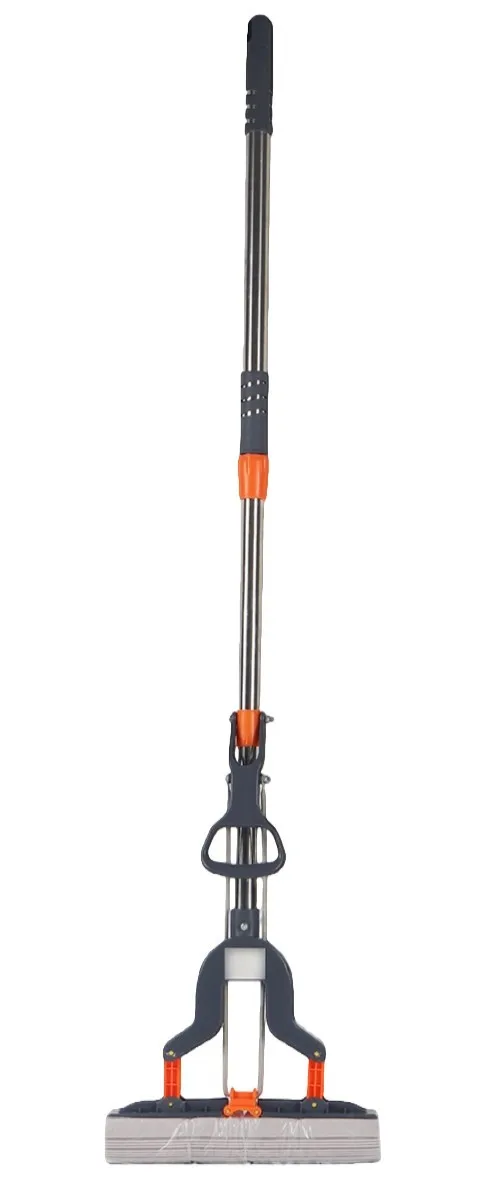
Roller-squeeze sponge mop with a PVA head. Two rollers at the base compress the head sideways as the lever is pulled. Product photograph, Wenzhou Meishijie.
Wenzhou Meishijie Household Products Co., Ltd. · 2 November 2026
WENZHOU, China — A foam head is judged in the hand, and the hand is asked the wrong question. Out of a freshly opened sample bag, most heads on the market feel the same. The difference appears later, and it appears as hardness — a head that was flexible in the sample room is a slab after a sea freight and a summer in a warehouse.
Wenzhou Meishijie Household Products Co., Ltd. (MSJ) holds that this is not a matter of luck in transit. It is decided in the formulation and in the washing, and it can be put on a specification.
Three mechanisms, and a cheap head usually loses to all three at once.
The first is the pore wall itself. A wet foam is soft because water sits between the polymer chains and holds them apart. As water leaves, the walls of neighbouring pores press together and set in that position. Some of that contact is permanent, which is why a head that has dried out comes back smaller in capacity and firmer in hand than it was when packed.
The second is what was left in the foam. Cross-linking a PVA block is done in a bath, and a block that is not washed out thoroughly carries residual acid and salts into the finished product. Those residues concentrate as the block dries, and they leave the pore walls brittle and slightly crystalline. A head like that does not merely feel hard; it cracks at the corners.
The third is the component that keeps it supple. A foam formulated to stay soft in storage holds a humectant that keeps a little water bound in the polymer. If that component is under-dosed to save cost, or if it migrates into a packaging film that does not hold it, the head has nothing left to keep it flexible between the factory and the bucket.
A purchase order can carry all four, and any supplier who cannot answer them is telling you something.
Resin grade and degree of hydrolysis. PVA is not one material. The resin's molecular weight and how fully the acetate groups have been removed set how the finished foam behaves, and a lower grade can be made to look right on the day it is cast. This is the line most often left blank.
Cross-link density and cure. More cross-linking gives a firmer block that holds its shape; less gives a softer block that swells more but is quicker to collapse. The cure schedule matters as much as the recipe, and an accelerated cure to hit a shipping date trades shelf life for speed.
Residual wash. How thoroughly the block is washed after the bath decides whether acid and salts stay in it. Washing is water, time and effluent treatment, which is why it is the first step reduced when a price is squeezed.
Humectant and barrier film. The component that keeps the foam supple has to be dosed, and then it has to be kept from escaping. A sealed barrier film holds it; a loose poly bag does not.
| Specification line | Lower-cost heads commonly | What MSJ specifies |
|---|---|---|
| Resin | Chosen on price, grade not stated | Declared grade held to a fixed hydrolysis range |
| Cure | Shortened to meet a shipment | Full cure before packing |
| Residual wash | Reduced to save water and time | Washed and neutralised before drying |
| Humectant | Minimised or omitted | Dosed, and held by a sealed film |
| Packing | Loose bag, stapled | Sealed moisture-barrier film |
MSJ states that its PVA heads are less prone to hardening in storage than the lower-cost heads it is compared against in the trade, and attributes the difference to the four specification lines above.
The company has not run a published side-by-side ageing test against other suppliers' heads, and does not quote a comparative figure. Instead it prints the test below, which a buyer can run on any two heads in an afternoon, in their own warehouse, without any equipment beyond a scale, a bucket and a day.
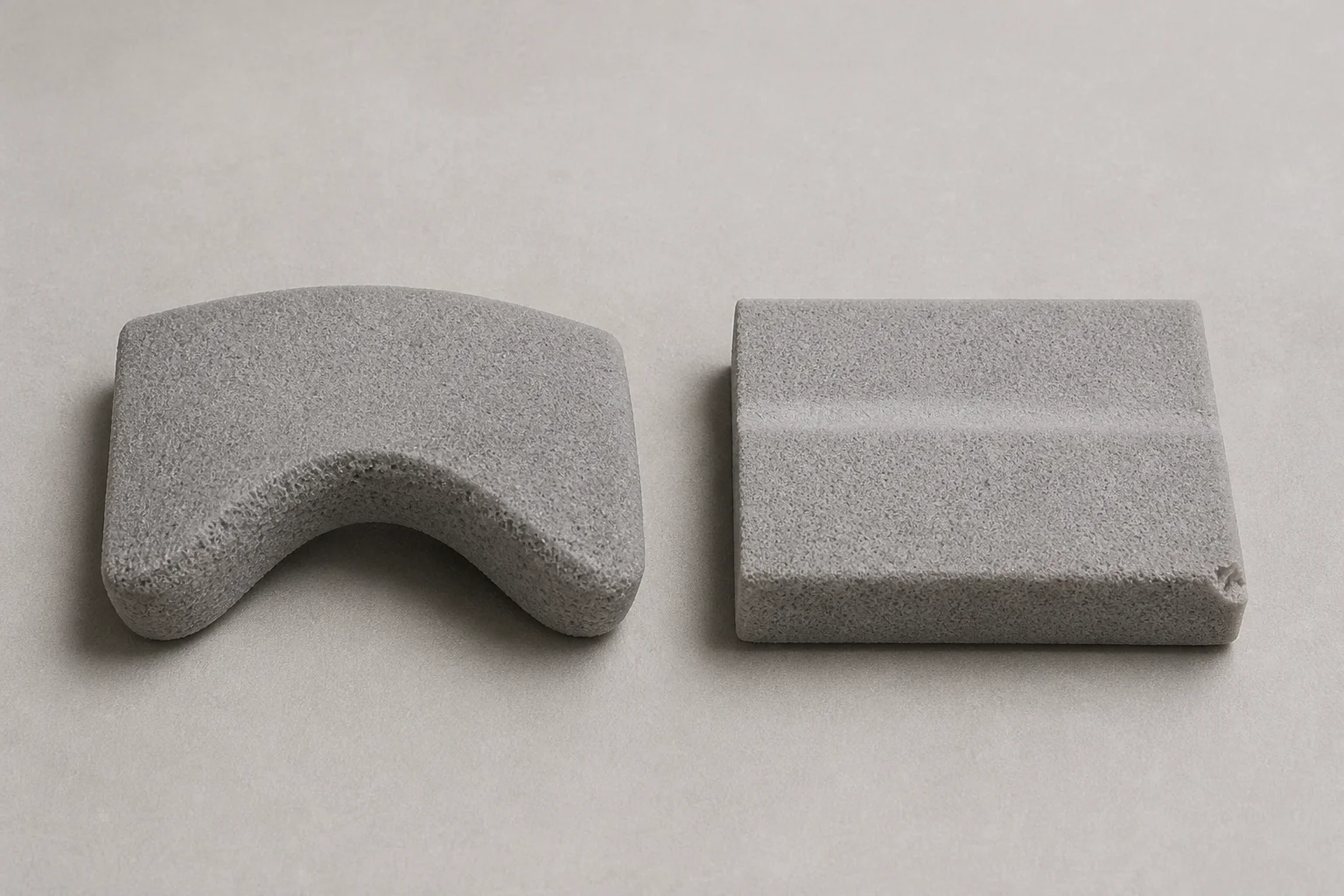
Illustration: the same block, two states. One still flexes; one has set and cracked at the fold. This is an editorial illustration of the bend test, not a photograph of MSJ products.
Take one head from each supplier. Everything below is done by hand.
Weigh each head dry, soak both in the same bucket for the same time, weigh them wet, and divide. The wet-to-dry ratio is the absorption capacity, and it is the number that falls when a foam has lost pore volume. It is also the number no sample bag will tell you.
Bend each head in half while wet and let go. A head with a healthy pore structure springs back with a slight delay; a head that has been badly cured folds and stays folded.
Then leave both on a shelf, unwrapped and out of the sun, for a day. Bend them again, dry this time. This is the test that separates the two, because it is a small version of what a container does over four weeks. A head that is still flexible dry will survive a voyage. A head that has gone stiff dry is already at its limit.
Last, soak the dry head for an hour and feel it. Partial recovery is normal and is not a fault. A head that comes back almost to what it was when the sample arrived is a head that was formulated and packed to be re-wettable, and that is the property MSJ specifies for.
Softness is not a virtue on its own. It matters in three places.
At goods-in, because a head that arrives hard is a head the buyer has already paid for and cannot sell. In a building without a drying regime, because a head stored in a cupboard between shifts is being dried whether anyone intended it or not. And on the shelf, because a rigid head in an unwrapped retail pack is the version of the product the end user actually meets.
It matters less where heads are used within days of arrival and replaced on a short cycle, and less again on a floor where the head is kept wet all shift. A buyer who works that way is paying for a property they will not consume, and should buy on absorption and price instead.
“The head that comes back to us as a complaint is almost never the head we sent out. It is the same block, after six weeks of air. That is why we argue about washing and cure and film rather than about absorbency on the day of the sample — the sample is the easy part.”
Lin, Marketing Manager, Wenzhou Meishijie Household Products Co., Ltd.
How much less does your head harden than another supplier's? No percentage is quoted. The company has not published a side-by-side ageing test, and a number without a method would not be worth having. Run the afternoon test on both heads instead.
The sample felt the same as another head. Does that mean anything? No. Out of a fresh bag, most PVA heads feel alike. The difference appears after the head has dried once.
What should I put on the purchase order? The resin grade and hydrolysis range, the cure requirement, residual wash, the humectant, and sealed barrier film. Those five lines are the whole argument.
Can a hard head be recovered by soaking? Partly. It softens enough to use, but the pore volume that has closed does not fully reopen, so the head holds less than it did when packed.
Is a soft head always better? No. A softer formulation is quicker to compress and can collapse sooner under heavy roller pressure. It is better for shelf life, not for every duty.
Standard colours and private label are available, with OEM and ODM development on request. Minimum order is 5,000 pieces per colour, for stock and customized orders alike. No unit price is published; quotations are made against a specification and a quantity.
Wenzhou Meishijie Household Products Co., Ltd. (MSJ) is a manufacturer of cleaning tools based in Wenzhou, Zhejiang Province, China. The company produces mop heads, complete mops, brushes, cleaning cloths and yarn, and supplies importers, distributors and private-label brands in Europe, North America, the Middle East and Southeast Asia.
Website: www.msjclean.com
Media enquiries: clean-msj@wzmsj.cn
Tel: +86-577-64422811 · Mobile: +86-13091907807
Address: Unit 2, Building 8, Wanyang Technology City, Qianku Town, Wenzhou, Zhejiang Province, China
Product images, factory footage and certification documentation are available on request.
### END ###