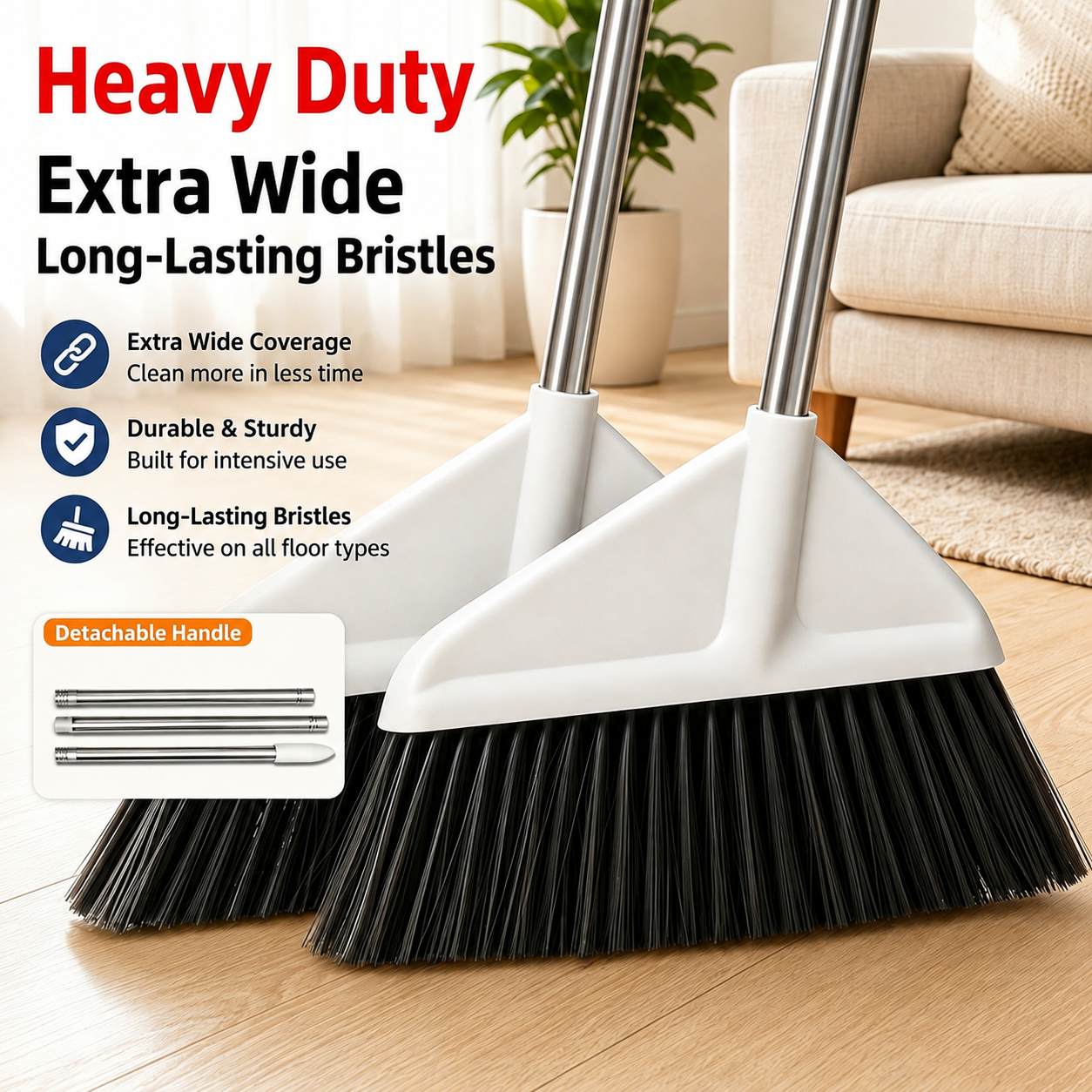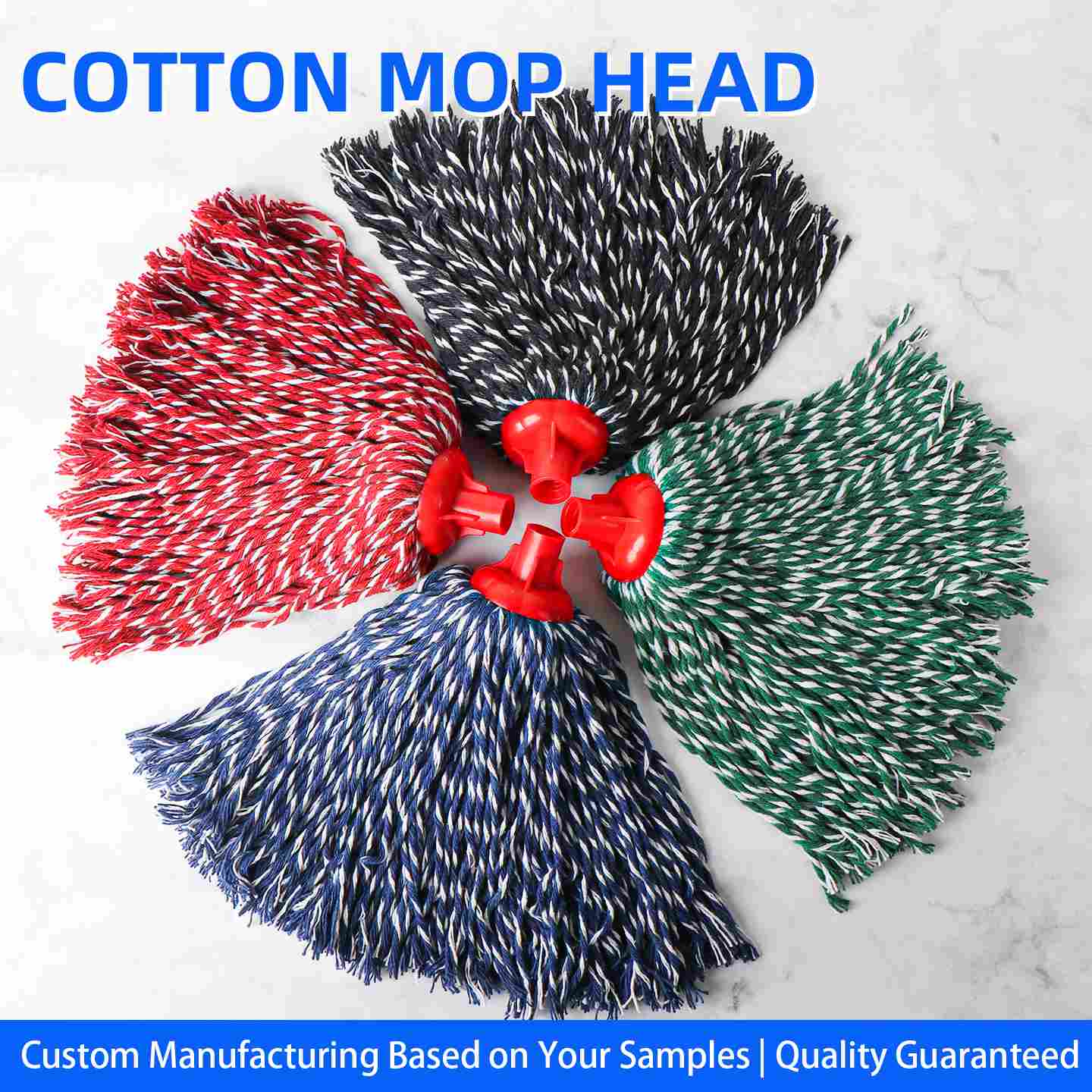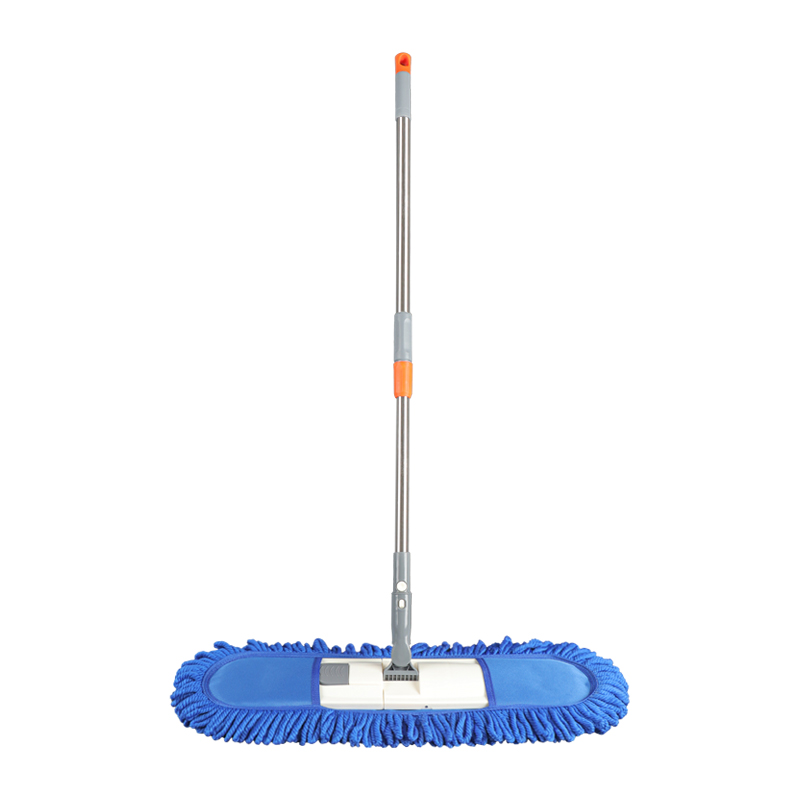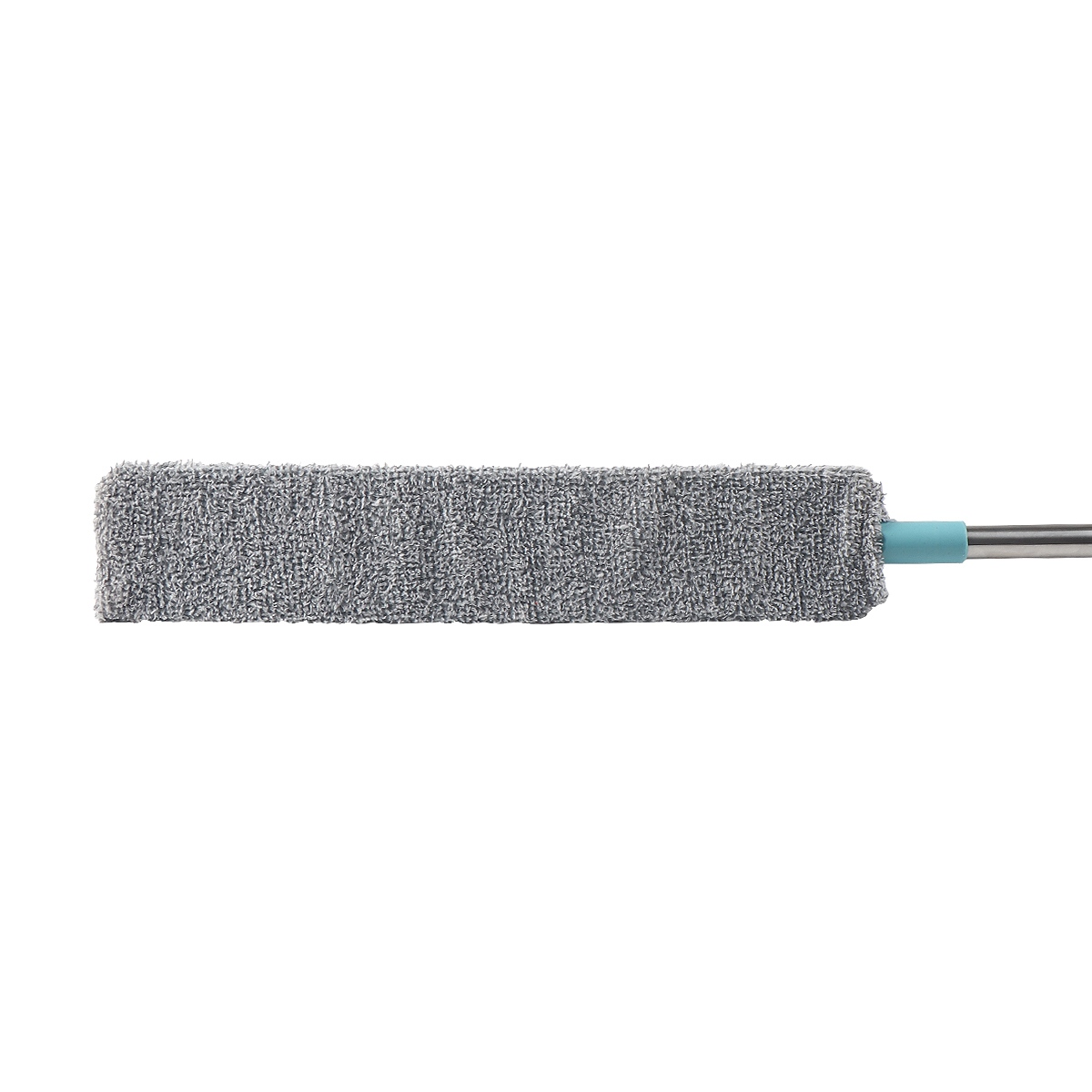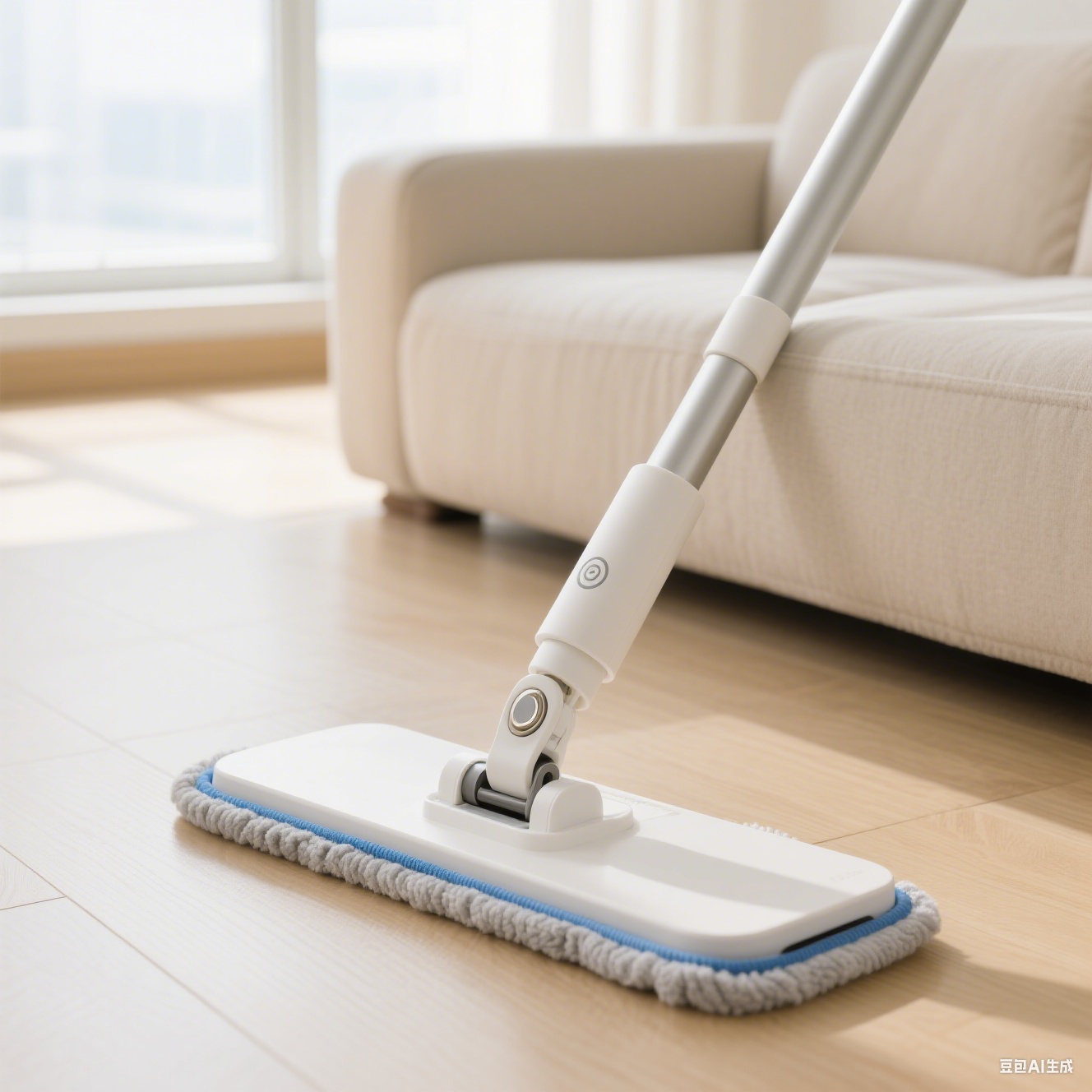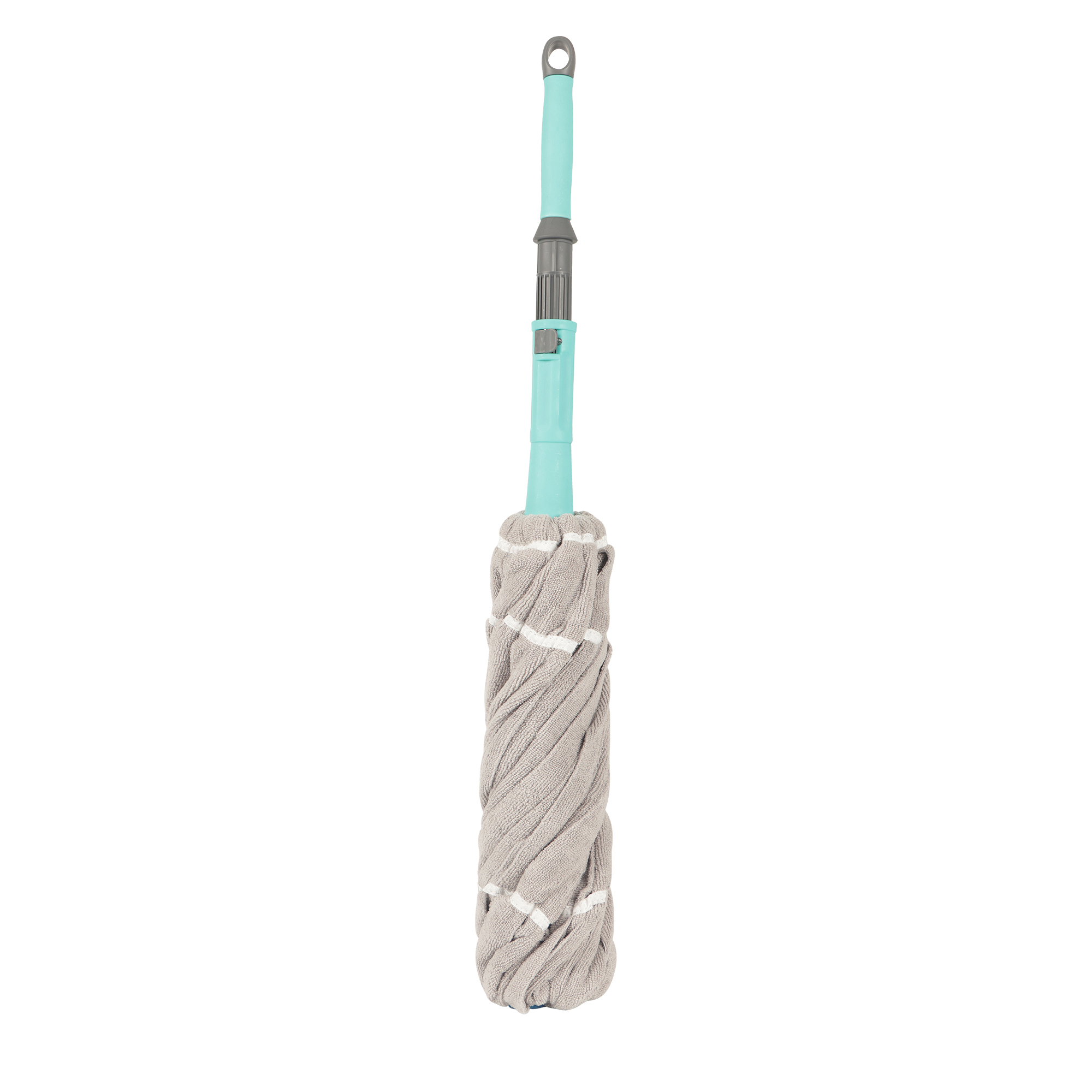
Four head materials, four different amounts of fibre in the water, and a variable almost no sample test measures.
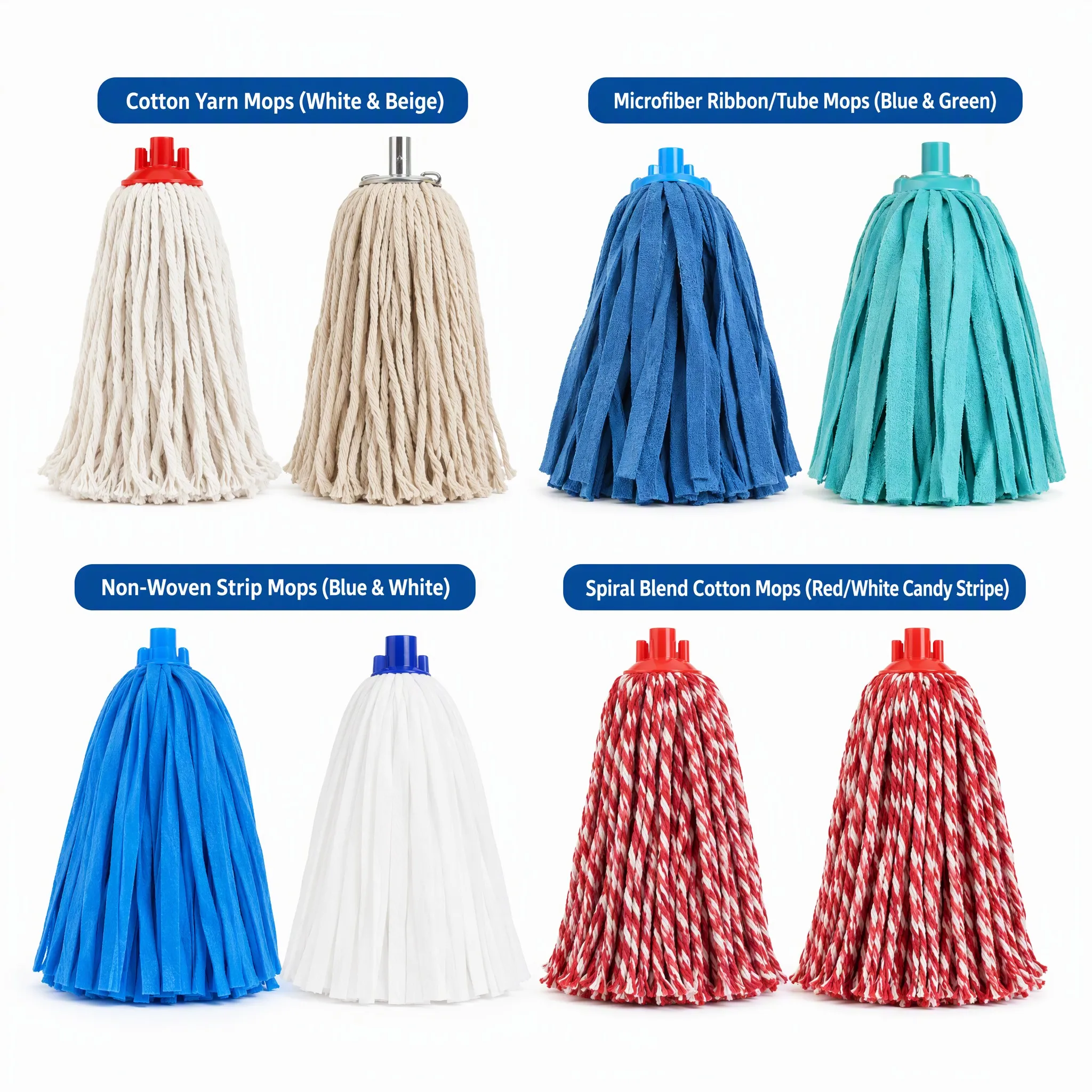
The four families, in the order the rest of this article takes them: cotton yarn, microfiber ribbon or tube, non-woven strip, spiral blend cotton. Range photograph, Wenzhou Meishijie.
Wenzhou Meishijie Household Products Co., Ltd. · 3 November 2026
WENZHOU, China — Empty a mop bucket at the end of a shift. If there is a grey mat of fluff in the bottom, or a scum line around the rim, or fibres caught in the drain grate, that is material that came off the head while it was working. On a polished floor the same material is what dries into a haze that a dry pass will not lift.
The range of heads a supplier offers is usually sorted by material family, because the families differ in absorbency, in cost and in how long they last. They also differ in how much of themselves they leave on the floor, and that difference is larger than most buyers expect.
Wenzhou Meishijie Household Products Co., Ltd. (MSJ) makes all four families, and publishes this note because the property is rarely raised at the point where heads are chosen.
It comes down to how the material was made into a shape, not to how it feels.
Cotton yarn begins as a staple fibre. Cotton does not grow in continuous filament; it is spun from short fibres twisted together, and twist is the only thing holding them. Every rub against a floor works a few fibres out of the twist, and the ones that work out are already short enough to leave. A cotton head therefore sheds from the first pass and never really stops, and a soft, open, well-spread head sheds more than a tight one because more of its surface is being abraded.
Microfiber ribbon is the opposite construction. It is extruded as continuous filament and then split, so there are no loose ends inside the material to release. A ribbon head wipes with a surface rather than with a brush of yarn ends, and the fibre it loses comes off in the form of whole ribbon ends that have been cut or torn, not as loose fluff.
Non-woven strip is a web of fibres bonded to itself, then slit into strips. The flat faces of the strip hold together well; the trouble is at the slit edge, where the bond has been cut through. What a non-woven head loses is short, flat, straight-edged pieces, and they appear as the edge of each strip breaks down.
Spiral blend cotton is a compound. It is spun from a blend, usually with a synthetic component for strength, and the two components do not wear at the same rate. The cotton part releases staple fibres the way pure cotton does; the synthetic part holds. A blended head sheds less than a pure cotton head and more than a ribbon head, and what it leaves is a mixture.
| Family | What it loses | When it loses most |
|---|---|---|
| Cotton yarn | Short loose fibres, as fluff | First few uses, then continuously |
| Microfiber ribbon / tube | Cut or torn ribbon ends | When edges fray, late in life |
| Non-woven strip | Short flat slit-edge fragments | As the slit edge breaks down |
| Spiral blend cotton | Mixed fluff, cotton-rich | Steady through life, less than pure cotton |
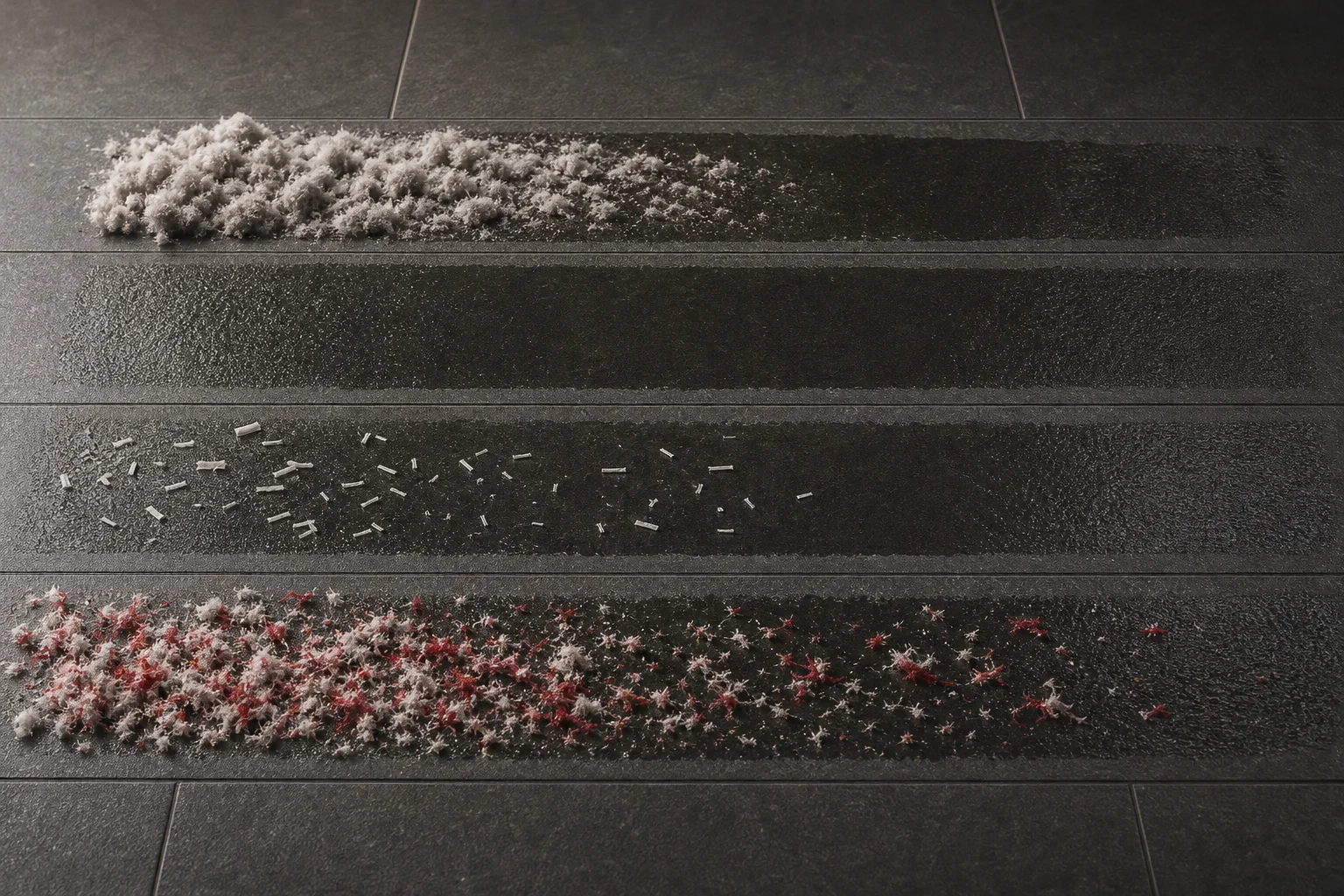
Illustration: four passes of the same length and width on the same floor, with what each material left behind. This is an editorial illustration, not a photograph of MSJ products.
Four conditions do more of the damage than the rest of the week combined.
The first is newness. A freshly made head carries fibres that were cut at the factory and never fully bound into the twist. The first few passes take them off. This is why a brand new cotton head clouds a bucket and a well-washed one does not.
The second is dryness. A dry head drags rather than glides, and dragging is abrasion. A head used dry on a dusty floor is being sanded against grit while it works.
The third is chemistry. Chlorine bleaches attack cellulose, and a cotton head stored in a bucket of diluted bleach loses fibre strength before it loses appearance. Acidic descalers do the same more slowly. A head that suddenly starts shedding heavily is often a head that has been sitting in the wrong solution.
The fourth is washing. A hot wash with a heavy spin flexes the material against itself and against the drum, and it is the step where loose fibre is generated in bulk. A head that sheds after every laundry cycle is not failing; it is being re-made each time.
A sample head is tested for absorption, for weight, for how it looks after a wash, and for price per piece. Shedding is not on that list, and there are three reasons.
It does not show on a sample. A head out of a bag has not been abraded; the fluff appears after twenty passes, not on the first one on a test bench.
It does not show in the first week. The complaint arrives later, and it arrives as a different complaint: floors that look hazy, a drain that blocks, a mop bucket that smells, a cleaning chemical bill that creeps up because the same floor is being done twice.
And it is invisible in a spec sheet unless the supplier offers a number, which almost nobody does. The result is that two heads can be quoted at the same price, sit at the same head weight, and differ by a factor a buyer would care about if they could see it.
Cut two squares of dark cloth, or use two black cardboard sheets, one per head. Mop each with the same dilution, the same pressure and the same number of passes, on a dry hard floor.
Then look at the cloth. Loose fluff collects on the dark surface, and it is possible to see at a glance whether one head left a mat and the other left nothing. Photograph both under the same light and keep the pictures with the sample.
To put a number on it, weigh the head dry before the test and again after it has dried, and weigh what you can recover from the cloth. Neither figure will be exact, and exactness is not the point: a comparison between two heads, run the same way on the same day, is enough to tell which one is shedding into the building.
Shedding is a serious variable in three places: floors finished to a shine, where fibre haze is the difference between a pass and a complaint; buildings where the drain is the constraint, because a mat of fibre in a trap is a blockage waiting; and areas where the mop passes equipment that cannot be opened and cleaned, because what settles there stays there.
It matters less in a yard, a workshop or a loading bay, where a little fibre is irrelevant next to grit and oil. It matters less again where heads are rinsed at every changeover and replaced often, because the shed material is removed before it accumulates.
The point is not that one family is better. It is that shedding is a property a buyer can measure, and a supplier can be asked about, and that neither happens often enough.
“Buyers ask us for absorption and weight, which we can print on a sheet. Almost nobody asks what the head leaves on the floor, and that is the one property you can only settle by putting two heads on the same tile on the same afternoon.”
Lin, Marketing Manager, Wenzhou Meishijie Household Products Co., Ltd.
Which material sheds the least? A microfiber ribbon head loses the least loose fibre, because it has no staple ends to release. Whether that is the right head for a building depends on the floor and the soil, so it is not a blanket recommendation.
Is shedding a sign of poor quality? Not on its own. A cotton head sheds because of how cotton is made. What a buyer can judge is whether the amount is normal for the material, and whether it is worse than another head of the same family.
Does a heavier head shed less? Not reliably. Weight is mass, and shedding is about how much surface is being abraded. A heavy open head can shed more than a lighter tight one.
Can shedding be reduced without changing the head? Partly. Stop using it dry, stop storing it in bleach, and avoid over-loading the washing machine. The first two cost nothing.
Why does the bucket smell after a few weeks? Because fibre and soil settle in the bottom and the rim scum, and stay wet between shifts. Shedding feeds the smell.
Wenzhou Meishijie Household Products Co., Ltd. (MSJ) is a manufacturer of cleaning tools based in Wenzhou, Zhejiang Province, China. The company produces mop heads, complete mops, brushes, cleaning cloths and yarn, and supplies importers, distributors and private-label brands in Europe, North America, the Middle East and Southeast Asia.
Website: www.msjclean.com
Media enquiries: clean-msj@wzmsj.cn
Tel: +86-577-64422811 · Mobile: +86-13091907807
Address: Unit 2, Building 8, Wanyang Technology City, Qianku Town, Wenzhou, Zhejiang Province, China
Product images, factory footage and certification documentation are available on request.
### END ###
-