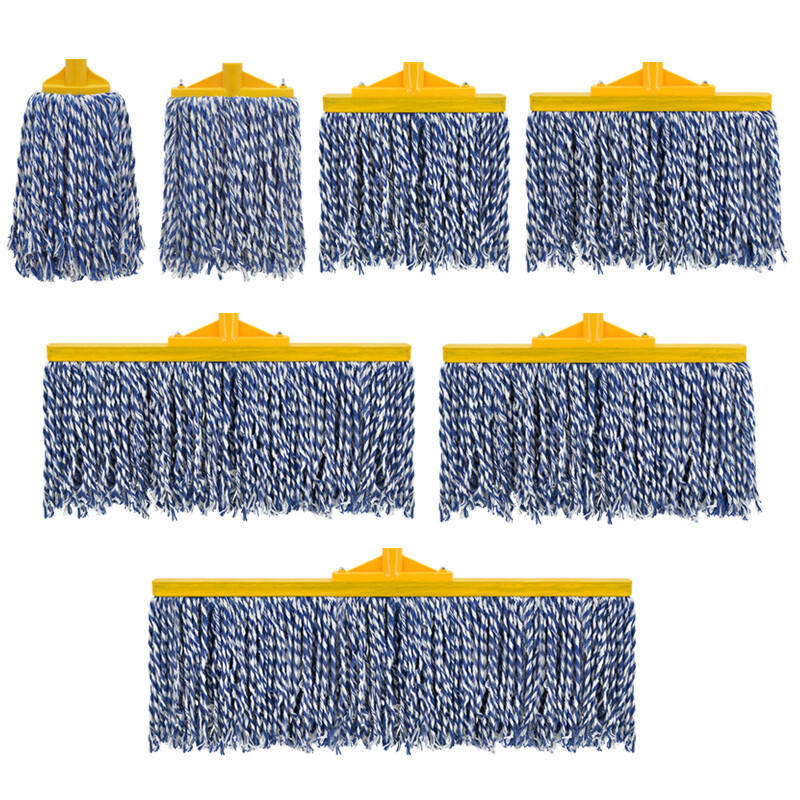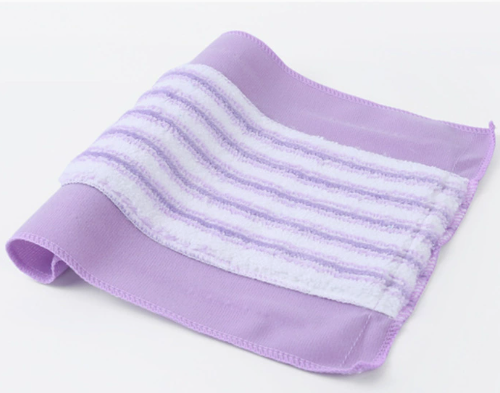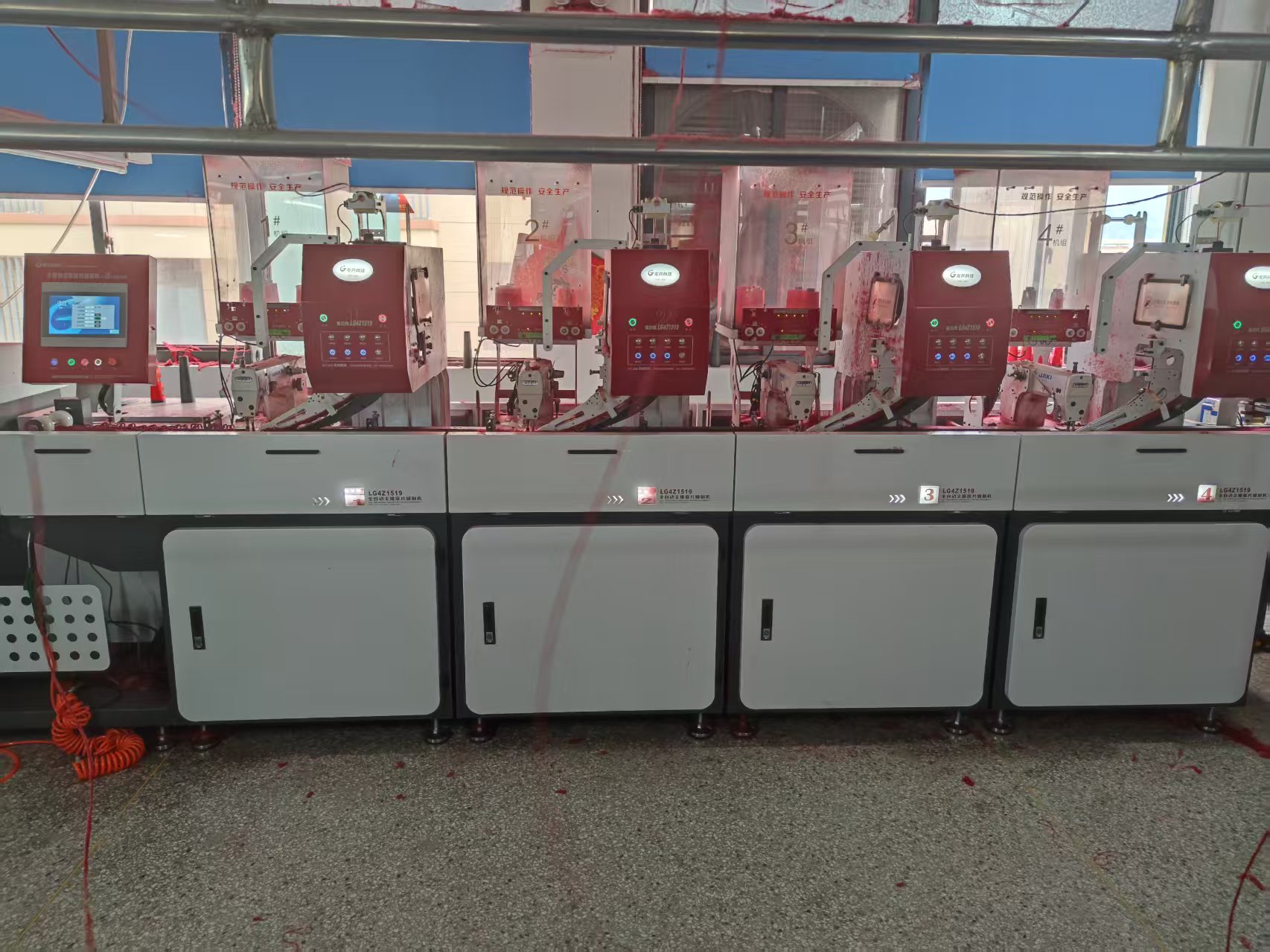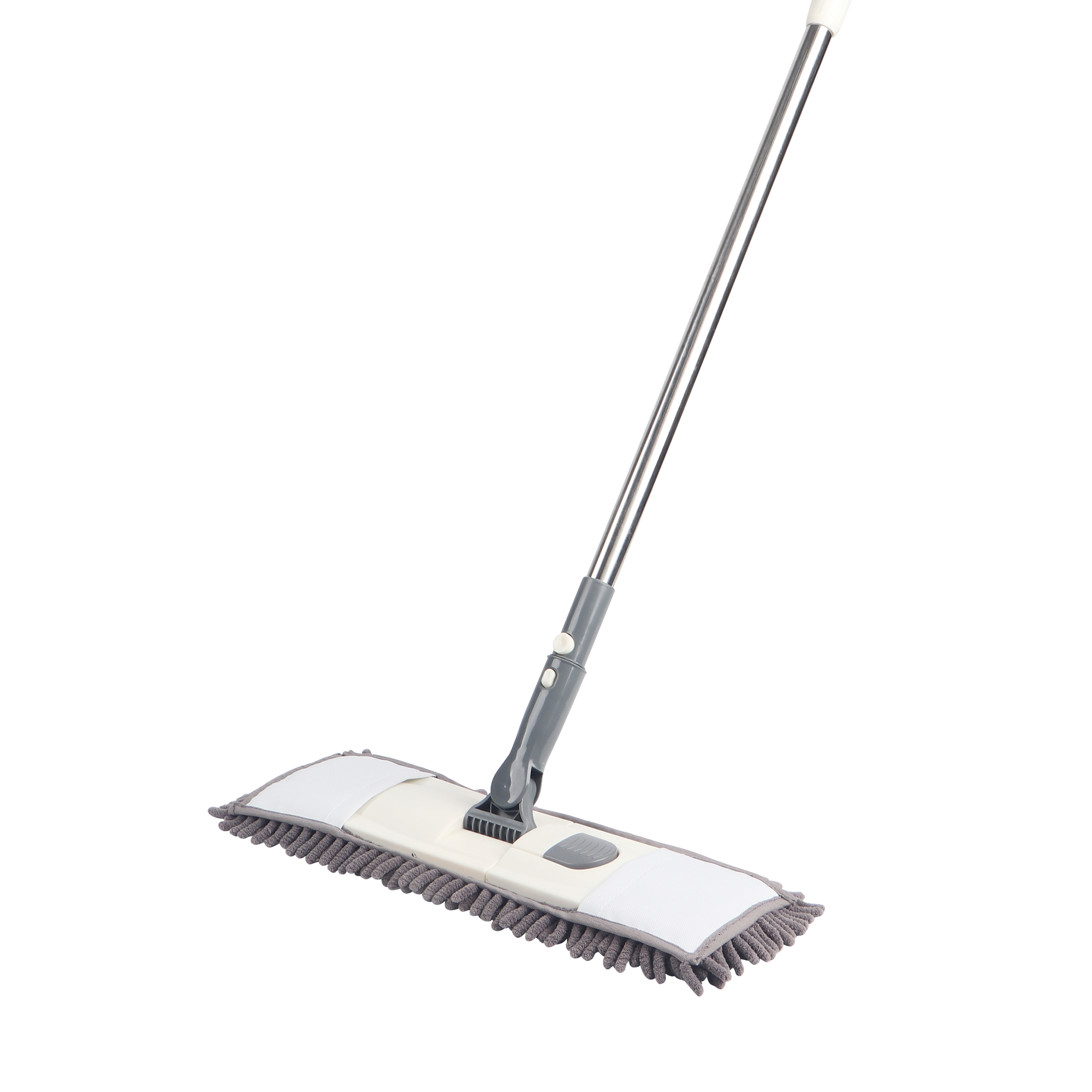
A self-wringing mop puts its own head under twist load every time it is wrung. Whether the yarn is looped or cut decides how long the head lasts, and it is one of the few things a mop listing rarely states.
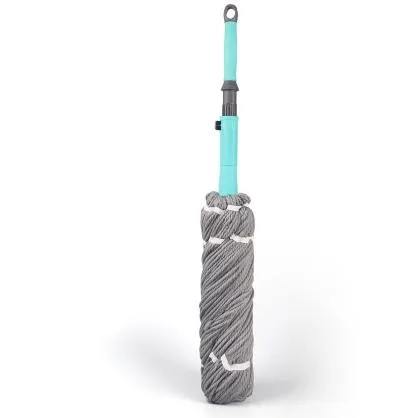
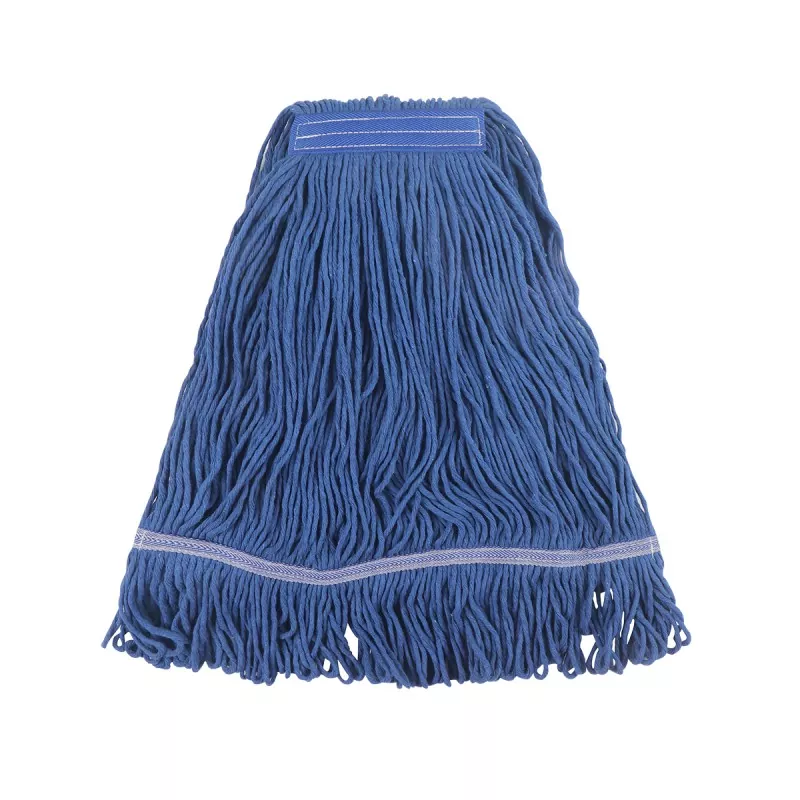
A looped gray microfiber head, twisted into the wringing position — the construction this article is about.
16 October 2026 · Company News
WENZHOU, China — October 16, 2026 — A twist mop wrings itself. Instead of a bucket press or a pair of hands, a sleeve on the handle turns the head and twists the water out of it. That is the whole selling point, and it is also the reason this type of mop wears differently from every other kind.
Every wring is a load. A mop head that is twisted once per bucket is being twisted hundreds of times over its working life, and each turn pulls at the same point: the ends of the yarn. A head built for that load lasts. A head built the cheaper way does not, and the buyer finds out several weeks after the container lands.
That is the cost the buyers feel first: importers, distributors, and the contract cleaners and facilities behind them. The handle is a durable good. The head is a consumable, and it is the head that has to survive being twisted.
The mop trade has a long-standing answer for why some yarn heads come apart and others do not, and it turns on how the yarn ends.
A cut-end head is made of strands sheared flat at the bottom. It absorbs more, which is why it still sells, and it is the cheapest way to build a head. The trade’s own description of what happens next is consistent across suppliers and training material. A janitorial training resource puts it plainly: because the ends are cut, they “tend to leave lint, fray and unravel with each use”, and the same heads cannot be laundered — which means replacing them more often. A restaurant-supply guide published in May 2026 is blunter: the cut ends “begin to fray, unravel, and shed from the very first use”. A cleaning-industry buying guide in February 2024 sums up the comparison as a “relatively short lifespan” against looped-end heads, which it calls “a more durable option”.
A looped-end head is built the other way: the yarn is turned back on itself so there is no raw end to unravel. Alsco, a uniform and linen service, states the consequence directly — the looped ends “help keep them from unraveling, making them also more durable than cut-end mops”. Rubbermaid Commercial sells the same logic from the manufacturing side, noting that its looped heads are built that way “specifically because they hold up to laundering better than cut ends”.
For an ordinary wet mop the difference is about how often the head is replaced. For a twist mop it is sharper than that, because the head is under twisting force as well as washing. A head with open ends is being pulled apart by the tool’s own mechanism every time it is used.
Two more failure points show up in owner reports on self-wringing mops, and both are worth asking about before an order rather than after.
The first is the wringing collar itself. A twist mop wrings through a sleeve and a connection at the top of the head, and it is the only moving part in the assembly. Owners of various brands report heads that come loose or detach, and a supplier’s own troubleshooting note for a twist mop head describes the everyday version of the same problem — a head that will not come off because the connection point has seized with grime. A collar that seizes is a tool that stops wringing.
The second is the head supply. A twist mop head twists off, which makes it replaceable in principle. In practice, owners report that finding the right replacement head for a specific model is a common frustration. The handle is designed to outlast several heads; if the heads cannot be reordered against a model number, the handle does not.
None of the four is exotic, and none of them is on the box.
1. Looped ends or cut ends. The single decision that sets how long a twist-mop head survives its own wringing, and the one most often left unstated.
2. Whether the head carries a stitched band. A band holds the yarn to the head and to itself. A head without one will start shedding at the band line rather than at the ends.
3. Whether the head is launderable. Cut-end heads generally are not, which moves the replacement cycle from months to weeks in a facility that washes its heads.
4. Whether a replacement head can be ordered by model number. The cheapest way to make a durable handle disposable is to stop supplying the head that fits it.
Wenzhou Meishijie Household Products Co., Ltd. (“MSJ”) builds its twist mop around those four points, and publishes the answers to three of them.
Its Gray Telescopic Microfiber Twist Mop, model MSJ-STB003, puts a thick, looped gray microfiber yarn head on a stainless steel handle, with a turquoise plastic connector and a textured gray grip that together do the wringing. The yarn is looped rather than cut. The head carries a reinforced white stitched band, which the company states is there to stop the head fraying and unravelling under repeated wringing and washing. Replacement heads are listed for the model, so the handle is not retired when the head is. The carton holds 50 pieces.
The trade-off is in how the water is held. A looped microfiber head takes up water well, which is what makes it worth twisting in the first place, and the same thickness that holds the water takes longer to dry between uses than a thinner head. A facility running a twist mop on several floors needs heads in rotation rather than a single spare, and MSJ’s guidance points the same way: the company recommends the mop for sealed floors, and states that on hardwood the head should be wrung thoroughly to avoid leaving excess water behind.
“The question that arrives with every inquiry is the price per piece. The question that decides whether the buyer comes back is whether the head is still holding together in month four, because by then they have compared it with whatever they were using. Looped yarn and a stitched band cost a little more to make and they are the reason a twist mop is worth buying at all. A cut-end head on a tool that twists is a head with a countdown on it.”
— Lin, Marketing Manager, Wenzhou Meishijie Household Products Co., Ltd.
The same construction is positioned across four buying situations, each with a different dominant failure.
| Setting | What fails in the category | MSJ’s stated design response |
|---|---|---|
| Household — tile, vinyl, laminate, sealed hardwood | Heads that shed lint and come apart at the ends after a few months | Looped yarn rather than cut ends, on a head the company states is machine washable |
| Light commercial — offices, retail, rental property | A wringing collar that stiffens or seizes with grime | A single turquoise connector and textured grip handling the wring; no bucket press to maintain |
| Facilities with in-house laundering | Cut-end heads that are not built to be washed, so the replacement cycle shortens | Looped construction and a reinforced stitched band stated to resist fraying and unravelling |
| Trade — importers, distributors, private label | A durable handle stranded once the head that fits it stops being supplied | Replacement heads listed against the model number; 50 pieces per carton |
MSJ is a cleaning-supplies manufacturer based in Wenzhou, Zhejiang Province, where it runs a 6,000-square-metre production facility on five automated production lines, with quality control through the process and sampling inspection on every batch, and it states that it holds ISO 9001, ISO 14001, ISO 45001, CE, RoHS, REACH and SEDEX. It draws cotton yarn and microfiber filament in-house, which is what allows the yarn used in a mop head to be specified rather than bought in from whoever is cheapest that month. The twist mop ships in bulk cartons of 50, and the company supports bulk wholesale and OEM and ODM work across colour, size, label and packaging.
“The head and the handle have completely different lives. The handle should still be in service when the fifth head goes on it, and that only works if the head is something both of us can order again. That is why we publish the model number against the head rather than quietly changing the fitting every season.”
— Lin, Marketing Manager, Wenzhou Meishijie Household Products Co., Ltd.
Grand View Research puts the U.S. cleaning and hygiene tools market at USD 8.81 billion in 2023, growing at a CAGR of 4.7% to 2030. Transparency Market Research values the wider cleaning equipment and supplies market at USD 108.5 billion in 2023, growing at 6.3% a year to 2034.
The volume is not in question. The replacement schedule is. A cut-end head that starts shedding from its first use and cannot be laundered and a looped head that survives both are the same line on the first invoice. The difference shows up as a reorder rate, and the reorder rate is the number a distributor lives on. Neither figure is printed on the mop.
Every figure quoted above, with the source it came from. Company specifications are MSJ’s own and are not independently verified.
| Figure | Value | Source |
|---|---|---|
| Cut-end yarn under use | Ends “fray, unravel, and shed from the very first use” | Restaurant-supply guide, May 2026 |
| Cut-end heads at the end of their run | “Relatively short lifespan”; looped-end heads described as “a more durable option” | Cleaning-industry buying guide, February 2024 |
| Cut-end heads and laundering | Not designed for laundering | Commercial cleaning equipment guidance |
| Loop-end heads under use | “Stand up to heavy use, don’t fray or tangle, and leave little or no lint” | Janitorial training resource |
| Why looped heads last | Looped ends “help keep them from unraveling” | Uniform and linen service guide, January 2023 |
| Looped ends and wash cycles | Looped ends hold up to laundering better than cut ends | Commercial cleaning equipment guidance |
| Owner-reported twist-mop failures | Head detaching; wringing pedal breaking; head seizing at the collar with grime | Owner discussion threads and a supplier troubleshooting note, January 2026 |
| Gray telescopic twist mop, packing | 50 pieces per carton (81 × 42 × 52 cm) | MSJ specification, MSJ-STB003 |
| Replacement heads | Listed against the model number | MSJ specification, MSJ-STB003 |
What is a twist mop? It is a wet mop that wrings its own head. Instead of a bucket press or a pair of hands, a sleeve on the handle turns the head and twists the water out. The wringing force therefore loads the head every time the mop is used.
Do twist mop heads unravel? A cut-end head does. Cut strands “fray, unravel, and shed from the very first use”, and a twist mop adds twisting force on top of washing. A looped-end head is the construction that resists it, which is why heads built for laundering and repeated wringing are looped.
How do you stop a twist mop head from fraying? Two things do most of the work: looped yarn rather than cut ends, and a stitched band holding the yarn to the head. MSJ’s specification for MSJ-STB003 states a reinforced stitched band for exactly that reason, and the company states the head is machine washable on a gentle cycle.
Can a twist mop head be replaced? Yes, and it is the first question worth asking. MSJ lists replacement gray microfiber heads for MSJ-STB003 so the handle outlives several heads. Owners of other brands report heads that detach, and heads that will not come off because the collar has seized with grime.
Which floors can a self-wringing twist mop be used on? Sealed floors. MSJ recommends the mop for sealed floors and states that on hardwood the head should be wrung thoroughly to avoid leaving excess water. Tile, vinyl, laminate and sealed hardwood are the listed surfaces.
Founded in 2009 and headquartered in Wenzhou, Zhejiang Province, MSJ is a manufacturer of cleaning supplies covering mops, mop heads, mop-and-bucket sets, cleaning cloths and rags, squeegees, brooms and brushes, and yarns. The company operates a 6,000-square-metre production facility with five automated production lines and an in-house raw material capability for cotton yarn and microfiber filament. Its products serve household, commercial, industrial and outdoor cleaning applications across domestic distribution and export markets including South Korea, the Middle East, Africa, Europe and the Americas. MSJ will exhibit at the 2026 Canton Fair.
Website — www.msjclean.com
Media enquiries — clean-msj@wzmsj.cn
Tel — +86-577-64422811 | Mobile — +86-13091907807
Address — Unit 2, Building 8, Wanyang Technology City, Qianku Town, Wenzhou, Zhejiang Province, China
Product images, factory footage and certification documentation are available on request.
### END ###
-