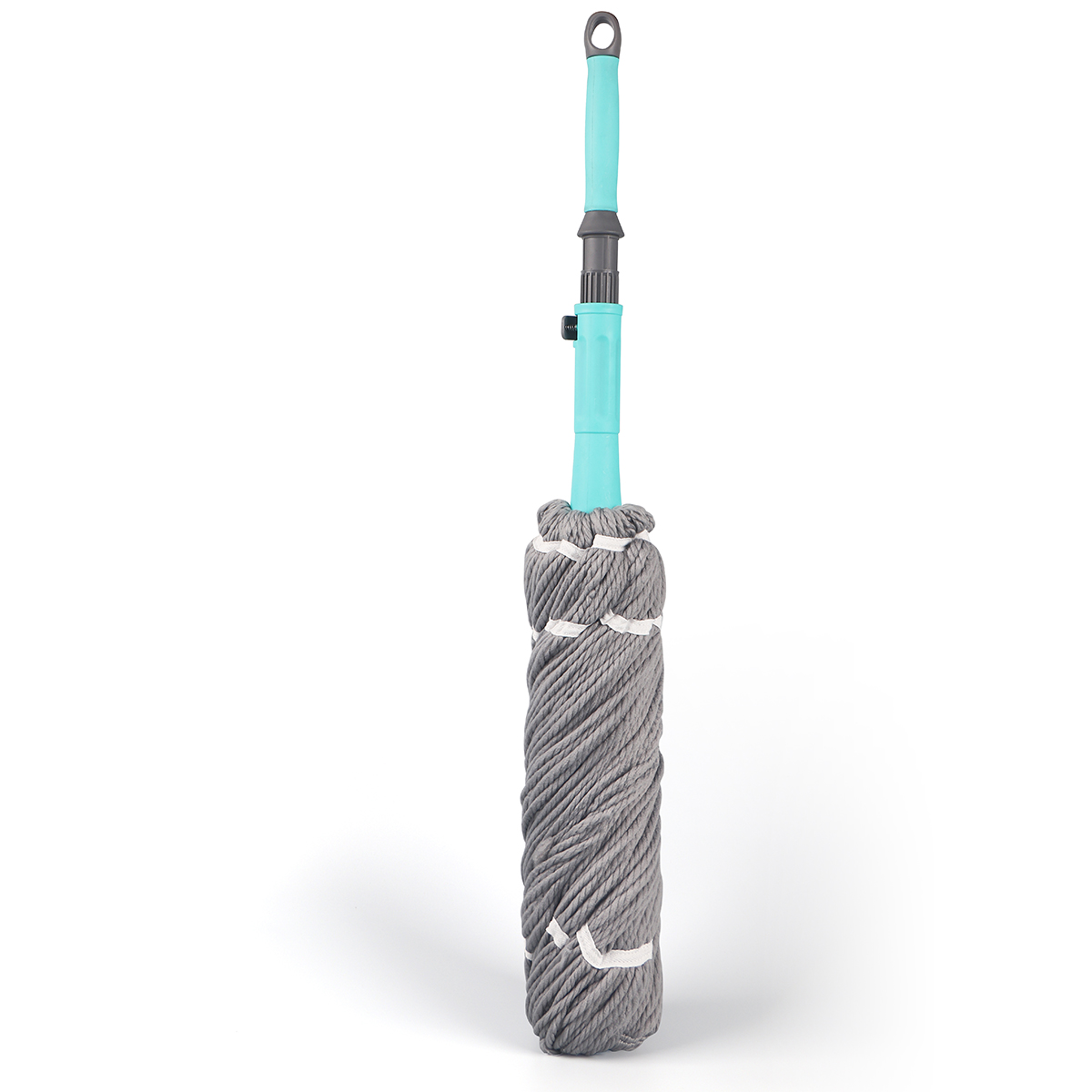
Pocket, tie and sleeve are three ways to hold a fringe pad on a frame. All of them have the same job, and it is not the job buyers check at the sample stage.
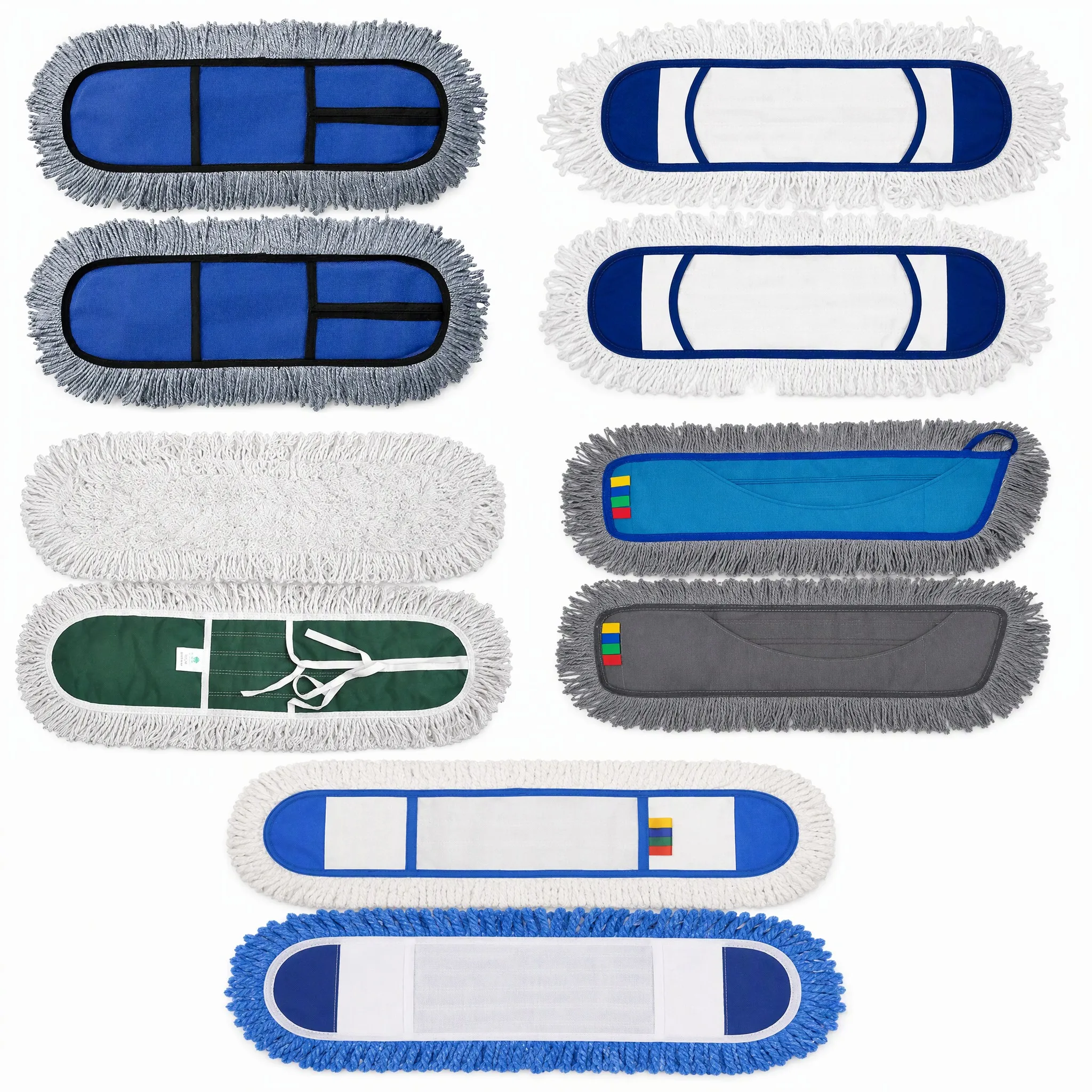
Fringe dust mop heads from the range, showing the pocket, tie and slotted-sleeve backs. Client photograph, Wenzhou Meishijie.
Wenzhou Meishijie Household Products Co., Ltd. · 9 November 2026
WENZHOU, China — Look at the floor behind a dust mop at the end of a long corridor. A faint curved smear, wider than the pad, following the line the operator turned along. Nothing is wrong with the fringe. What happened is that the pad crept along the frame during the push, and by the time the operator turned around, the pad was no longer where it had been fitted.
The pad is the only part of a dust mop that touches the floor, and the frame is the only thing holding it there. The joint between them is a friction joint.
Wenzhou Meishijie Household Products Co., Ltd. (MSJ) makes both the pads and the frames, which is why the company publishes this note on the joint rather than on the fringe.
A dust mop is pushed, not lifted. Every push sends force along the frame rather than down through it, and the pad is held only by whatever friction exists between the backing and the plate.
Two things reduce that friction in service. The first is water. A pad dampened for a first pass, or carried from a wet floor into a dry one, puts a film between cloth and metal, and a film is what friction does not survive. The second is dust itself. Fine dust works into the gap between backing and frame and behaves like a dry lubricant.
Once the pad has moved, it does not come back. The push that moved it is repeated a hundred times along a corridor, and each repetition adds a little.
A pocket holds the pad by enclosing both ends of the frame. It is the most secure of the three when the pocket is the right size, because the frame has to leave the pocket before the pad can move, and it can only leave lengthways. The failure is in the size. A pocket cut generous enough to slide on easily is loose enough to creep, and a cotton pocket that has been washed hot shrinks until it no longer goes on at all.
Ties hold the pad by wrapping it around the frame and knotting. They adapt to any frame, which is why they survive in markets where frames vary. The failure is at the knot. A bow works loose under repeated shock, and once one tie is slack the pad rotates around the remaining one. The knot also sits under the frame, so every uneven knot becomes a high point pressing through the pad.
A sleeve with a slot and a hanging loop is the fastest to fit and the loosest in use. The slot lets the frame slide in from one side rather than being fed through, which saves time on every change, and the loop is for hanging the pad up, not for holding it down. Its failure is sideways: the pad can travel across the frame in the direction the slot runs.
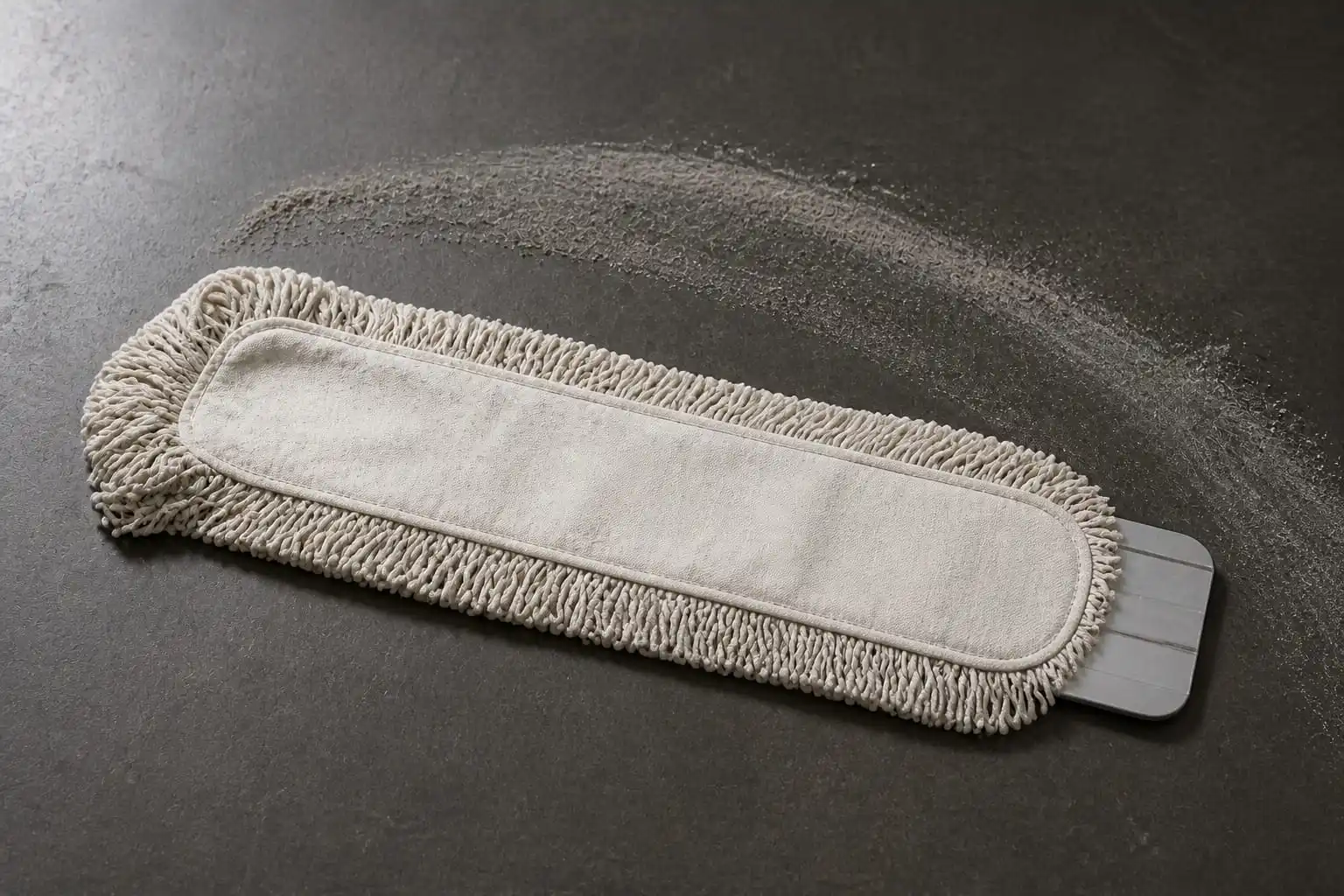
Illustration: a pad that has crept along its frame, leaving one end of the frame bare and a smear where the return pass went over dust the pad had already collected. This is an editorial illustration, not a photograph of MSJ products.
The first cost is that the return pass uses the dirty face. Dust a corridor in one direction and the leading fringe loads up; turn around and drag the same pad back, and the loaded side is now the side in contact. That is the smear on the floor, and it is the reason a floor can look worse after a second pass than after the first.
The second is the frame corner. When the pad has moved to one end, the far end of the plate is bare, and a bare aluminium corner on a hard floor is a scraper. On a coated floor it leaves a line; on stone it can mark.
The third is width. A pad bunched at one end is a pad whose effective swept width is shorter than the frame, so the pass count the building planned for no longer covers the corridor, and the shortfall shows up at the edges rather than in the middle.
| What you find on the frame | Which joint is failing |
|---|---|
| Pad shifted to one end, other end of the frame bare | Pure lengthways creep; friction joint too loose |
| Pad rotated a few degrees around the frame | One tie or one pocket has slackened and the others are carrying it |
| Pad still centred but folded under along one edge | Pad wider than the frame, or the pocket is too deep |
| Fringe matted flat in one spot and full in the rest | Pad has been used with pressure in the same place; the pad is not moving, the user is |
| Corner of the frame poking through a hole in the fringe | Wear at the point of contact, after creep has run for weeks |
| Pad will not go on at all after a year | Pocket shrinkage; the pad was washed hot |
The one to watch is the second row. A pad that has rotated is not merely loose, it is on its way to the third row, because a rotating pad drags its fringe across the frame edge.
Fit the pocket or sleeve and then push the two ends of the pad toward the middle before the first pass. Most of the slack in a new pad is at the ends, and taking it out there is what stops it travelling.
Run one dry pass and look at the pad before the floor. If the pad has moved during a single empty pass, it will move further under load, and the joint needs a different answer rather than a tighter hand.
Double-knot ties. A bow is quicker to undo and quicker to come undone, and the knot is the only thing holding a tied pad on.
Do not put a wet pad back on the frame. It is the wet pad that slides, and it is the wet pad that will still be damp when the next shift starts.
Measure the frame before buying, not the old pad. A pad is bought to fit a frame, and a pad measured from a pad inherits whatever the previous one had already lost to shrinkage.
Keep two pads per frame and rotate them. A pad that is never allowed to sit and dry between shifts is a pad that is damp every time it is fitted, and the rotation costs nothing at the point of purchase.
Retention matters wherever the mop is pushed long distances with a loaded pad: corridors, halls, large retail floors, airport and station concourses. In those places a pad that shifts by a few centimetres at the start of a run has shifted by much more at the end of it.
It matters much less on a handheld duster used in small rooms, where the pad is lifted and turned rather than pushed for metres, and where nothing accumulates.
It also matters less on a frame that sits inside a fixed pocket on all four sides rather than at two ends. A full envelope holds by geometry, and geometry does not care whether the pad is damp.
What does not change is the basic check. On any of them, one dry pass on the first shift tells you whether the joint holds, and no sample bag can tell you that.
“A supervisor will show me a pad and say the fringe has gone flat. Usually the fringe is fine. The pad is hanging off one end of the frame, and it has been doing that since the first week, because nobody checked it on the first pass.”
Lin, Marketing Manager, Wenzhou Meishijie Household Products Co., Ltd.
Which attachment holds best? A pocket that fits, on all four sides if the frame allows it. A pocket has to be escaped lengthways before the pad can move, and that is a stronger joint than a knot or a slot.
Why do the ties keep coming undone? Because they are tied as bows. A double knot holds; a bow loosens under repeated shock, and one loose tie lets the pad rotate.
Does a damp pad slide more? Yes. Water between the backing and the plate reduces the friction the joint depends on, and dust in the same gap does the same thing dry.
Can a pad be too big for its frame? Yes, and it then folds under at one edge instead of lying flat, which looks like a slipping pad but is a sizing error.
How often should pads be replaced for this reason alone? Retention is not a wear item, it is a fit item. A pad that fits stays on until the fringe itself is finished.
Wenzhou Meishijie Household Products Co., Ltd. (MSJ) is a manufacturer of cleaning tools based in Wenzhou, Zhejiang Province, China. The company produces mop heads, complete mops, brushes, cleaning cloths and yarn, and supplies importers, distributors and private-label brands in Europe, North America, the Middle East and Southeast Asia.
Website: www.msjclean.com
Media enquiries: clean-msj@wzmsj.cn
Tel: +86-577-64422811 · Mobile: +86-13091907807
Address: Unit 2, Building 8, Wanyang Technology City, Qianku Town, Wenzhou, Zhejiang Province, China
Product images, factory footage and certification documentation are available on request.
### END ###