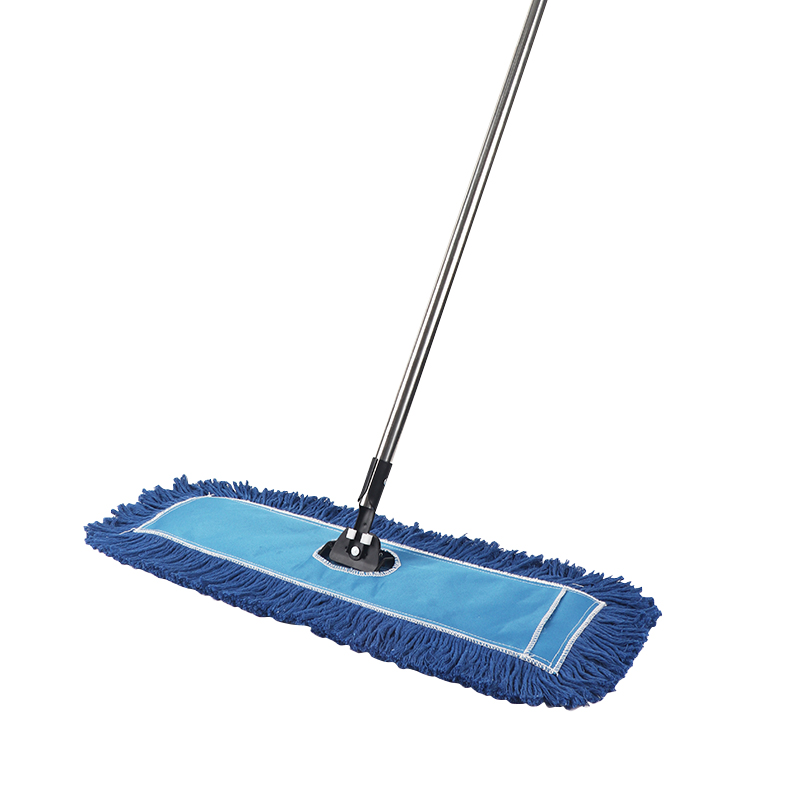
How low the head sits, and how much the tool weighs in the hand. Neither number is on a product listing, and both decide whether the floor under the furniture gets cleaned at all.
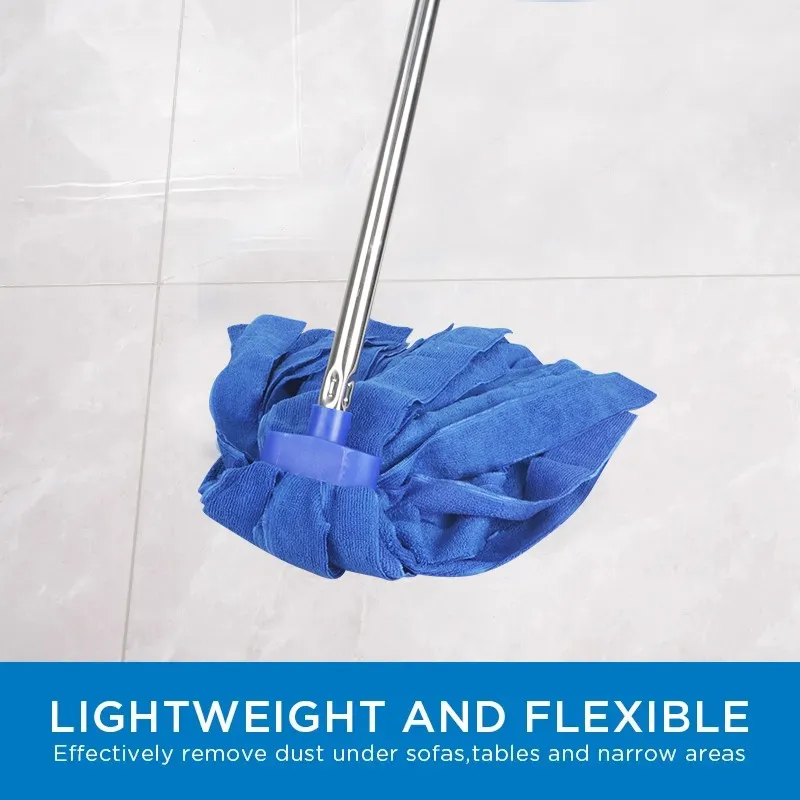
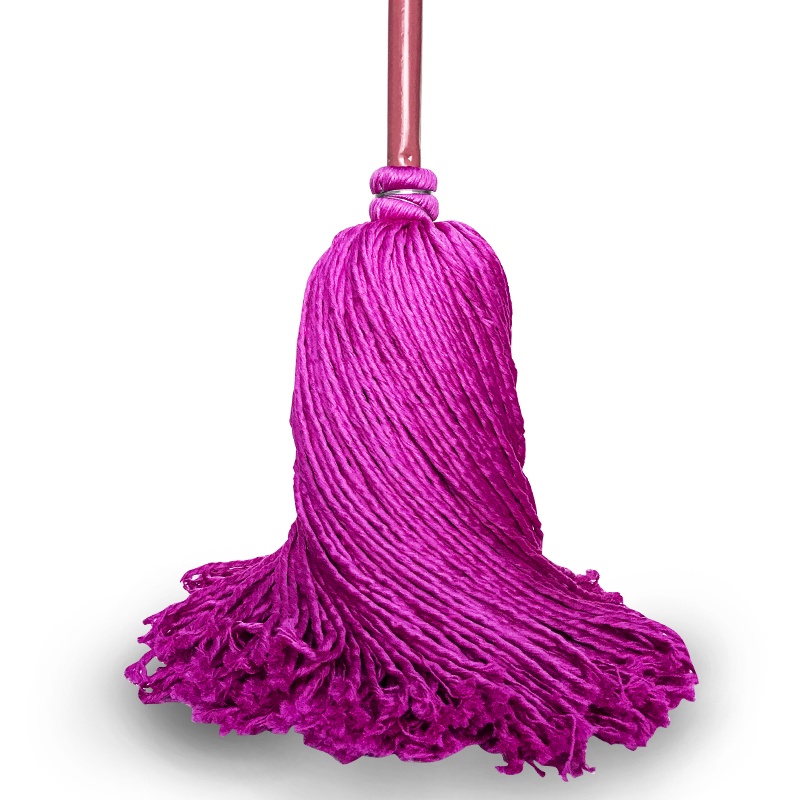
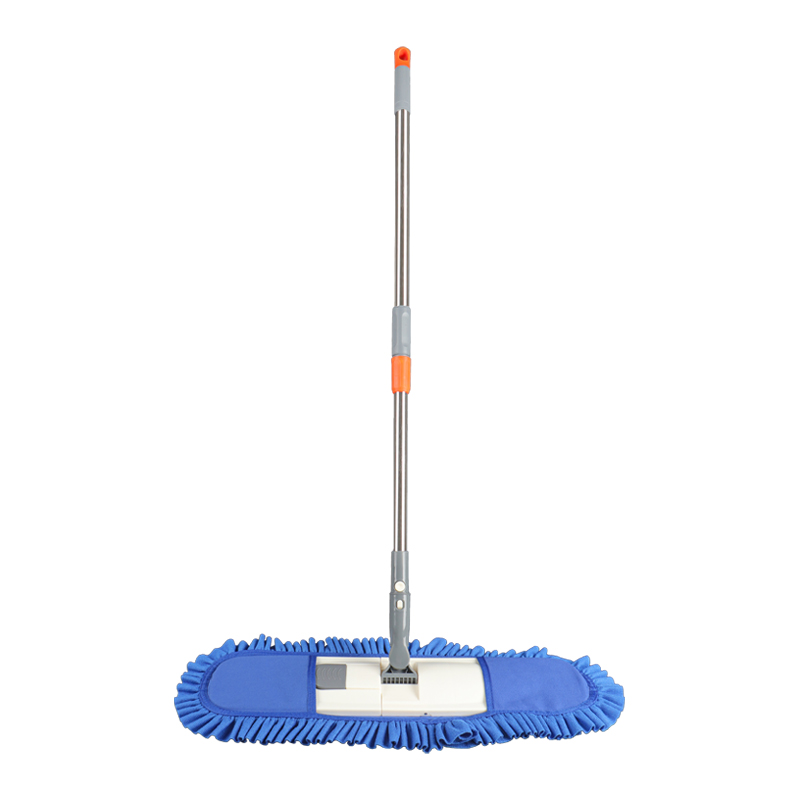
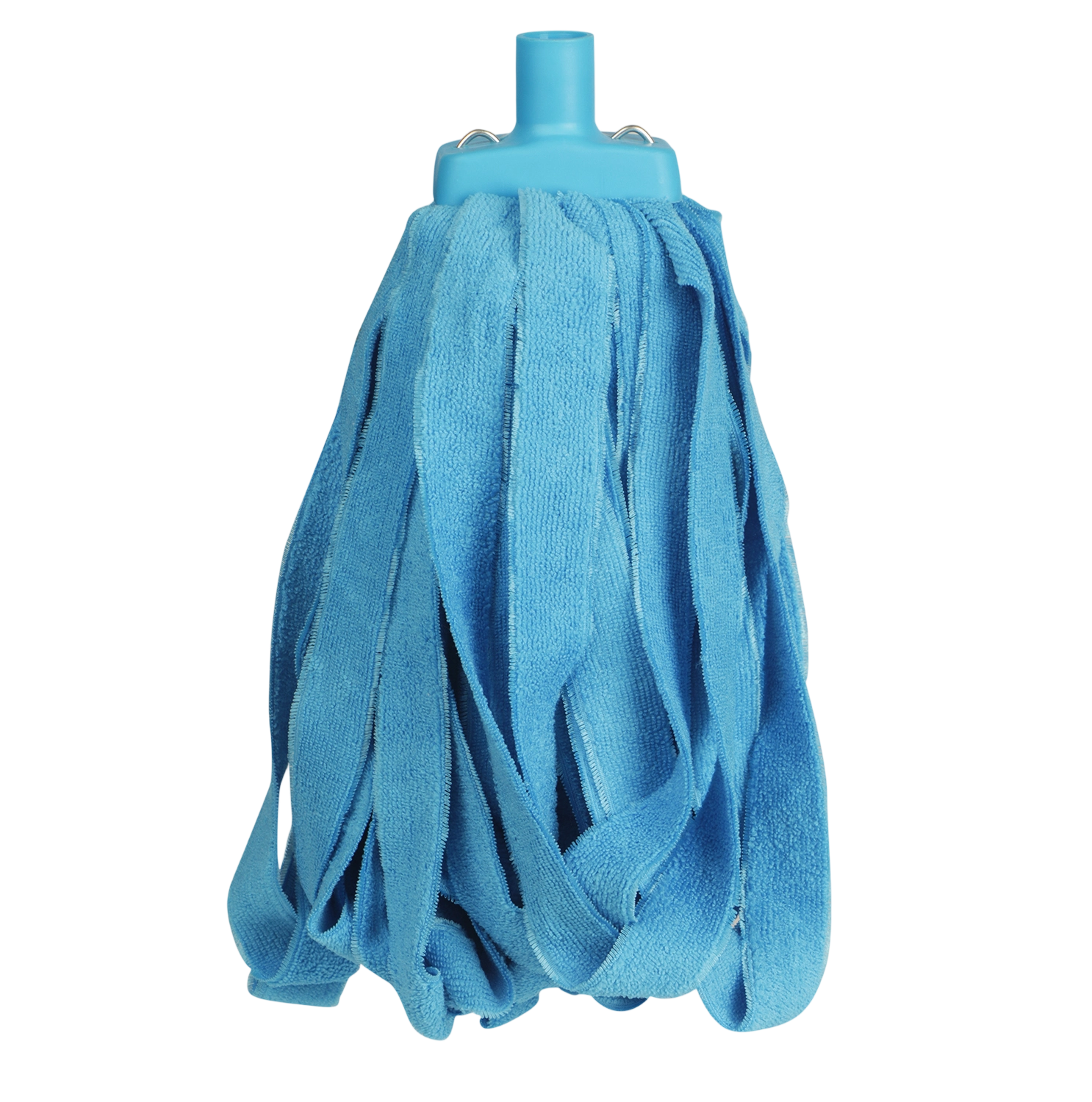
A cloth head on a plastic socket and a three-section stainless steel handle — the construction this article is about.
10 October 2026 · Company News
WENZHOU, China — October 10, 2026 — Watch a floor being mopped in any furnished room and the pattern is the same. The open floor gets done. The strip under the sofa, the run under the sideboard and the gap behind the door get a push that stops at the furniture leg.
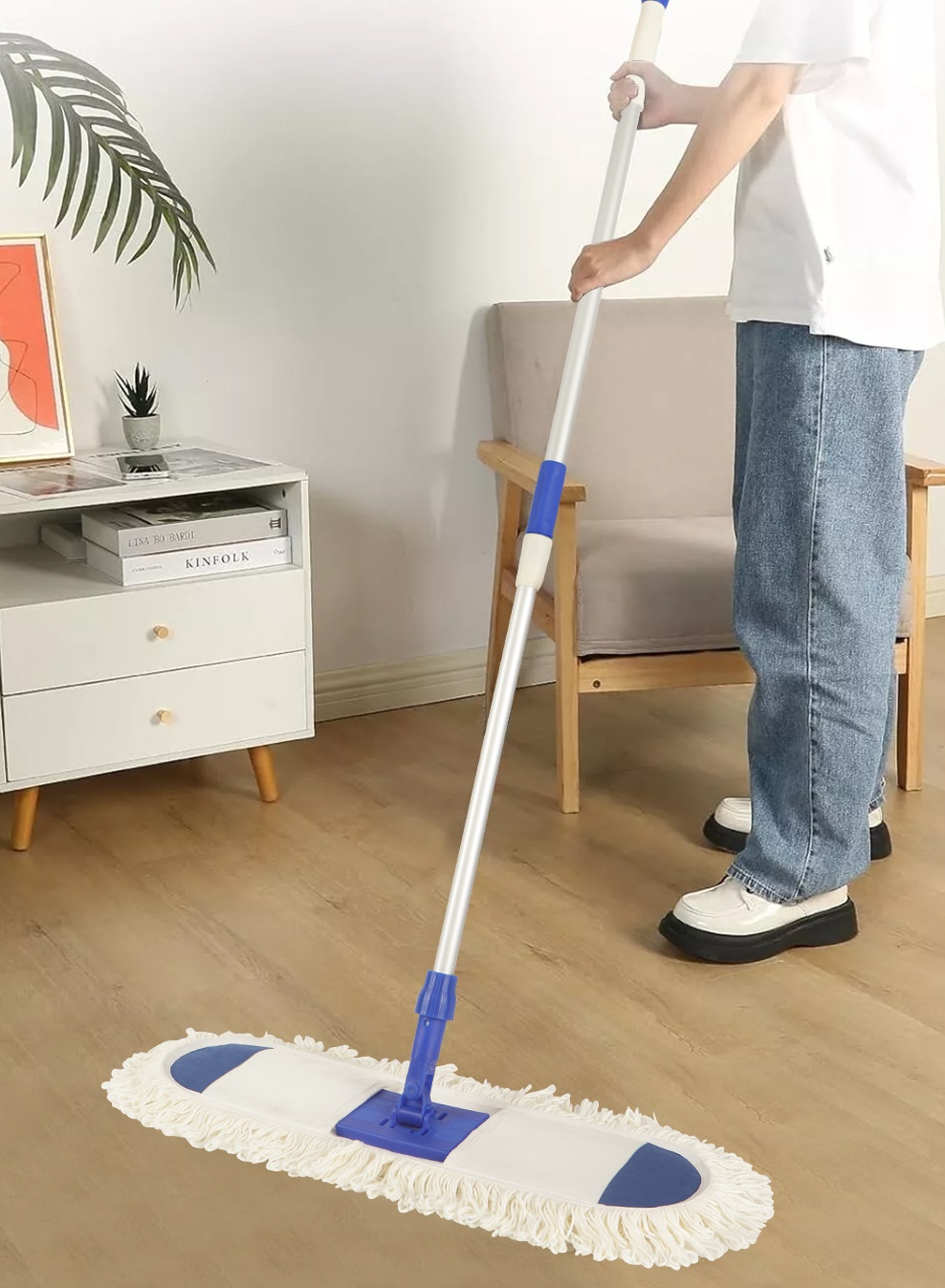
The reason is depth. A mop head sits on the floor with a certain height above it, and the clearance under a sofa, a bed frame or a media console is often smaller than that. Buying guides written for this exact job tell readers to measure the gap before they shop. The gap varies. The mop either fits it or it does not, and a fixed handle makes it worse, because the head cannot be laid flat enough to slide underneath.
The cost lands with the people who buy floor care by the thousand: hotels, contract cleaners, office and retail facilities, and the importers who supply them. A floor that is clean everywhere except under the furniture looks finished from the doorway and fails a walk-through. Nobody returns the mop over it. The tool is bought differently next time, or the floor under the sofa stops being part of the job.
The most specific guidance comes from the dust-mop category. In a purchasing guide published in March 2026, Lola Products describes the space under furniture as “a black hole for dust bunnies, pet hair, and lost socks,” and states the failure plainly: “A bulky mop head will just bump into the furniture legs and stop short, leaving dust behind.”
The same guide treats handle length as an ergonomic decision rather than a convenience. A handle that is too short “will force you to bend over, which can lead to back strain.” Its recommended answer is a slim, low-profile head; a head that pivots; and an extendable handle.
Trade coverage of who absorbs that strain is blunter. Gene Woodard, writing in CleanLink on workplace ergonomics, notes that cleaning workers have “one of the highest injury rates compared to other occupational groups,” in a job built from “bending, stooping, reaching, pushing, carrying, lifting, grabbing.” A mop that is heavy, or that has to be forced under furniture, sits directly on that list.
A CleanLink report on mop maintenance records the same thing from the operator’s side. Microfiber mop systems, the report says, are popular with cleaning staff because they “make the job easier and do not strain the body as much as cotton string mops do.” Mike Fisher of K-Tech Kleening Systems puts it in one line: “The fatigue factor is lessened for them.”
Reach is half of the problem. The other half is what the head is like on its twentieth use.
A dust mop or a cloth mop head does not wear out on the floor. It wears out between jobs. Tidy Tools, a cleaning-tools maker, puts the mechanism in its care guide: “A dust mop doesn’t wear out on a schedule. It wears out from how it gets handled between jobs.”
Then the specific failure. “Softener coats the fibers and kills the grab that pulls dust off the floor.” The same guide answers the question owners actually ask — why the mop stopped picking up dust — with two causes: “fabric softener or built-up grime coating the fibers.”
The Cleaning Station, a janitorial supplier, describes what that looks like on a commercial floor. Laundered wrongly, dust mop heads “clog with debris, harden with residue, and start pushing dust around instead of lifting it,” and the consequence is “wasted labor time, re-mopping runs, and floors that look worse after cleaning than before.” Its list of causes is unglamorous. “Excess detergent is one of the primary causes of dust mop performance failure,” and hot water “shrinks fibers, warps backing material, and weakens the stitching that holds the mop head together.”
Storage is part of it too. Tidy Tools warns against wadding a wet head into a bucket, because “that’s how you get mildew and a warped shape.” A head that dries in its natural shape, the guide says, keeps its full coverage.
Every one of those failures ends in the same transaction. The head is replaced.
On replacement life, the trade has an older figure that is still the one quoted. In CleanLink’s mop maintenance report, Bob Croft, president of CBN Building Maintenance, says of microfiber pads: “Even the less expensive pads are supposed to be able to stand up to 250 or better wash cycles.” The same article notes that both K-Tech and CBN were “going on five years of consistent use with minimal replacements.”
That is the argument for buying on a number. A head that survives 250 washes and a head that fails early produce the same invoice on day one, and different invoices every quarter afterwards.
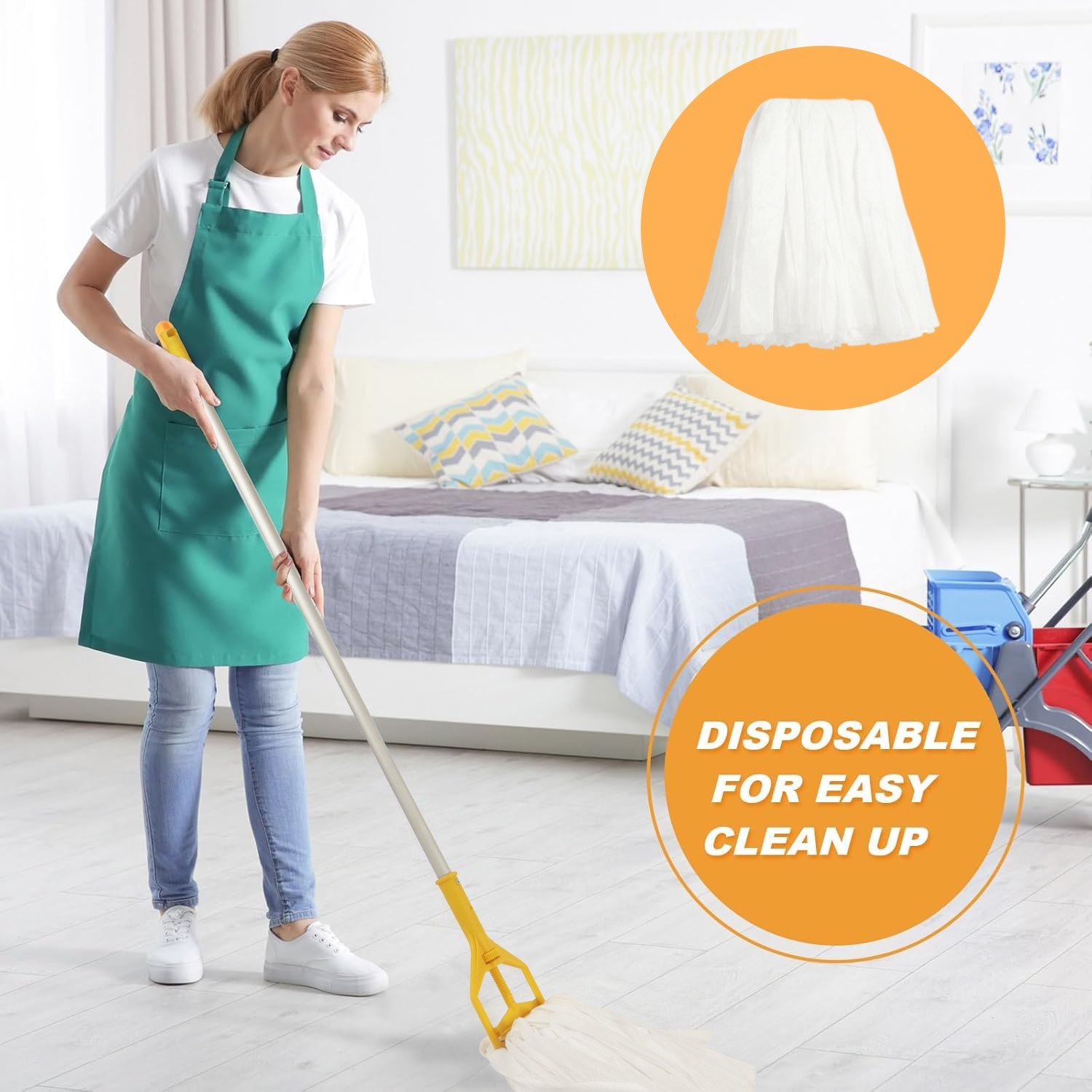
Two more costs sit behind that one. The first is labour: a floor that has to be done twice because the first pass only moved the dust. The second is the disposal line. Disposable pads carry, as the Lola guide notes, an “ongoing cost of buying disposable pads” that “can add up significantly over time,” on top of the waste they generate.
Wenzhou Meishijie Household Products Co., Ltd. (“MSJ”) builds its cloth mop around those two numbers, and publishes both.
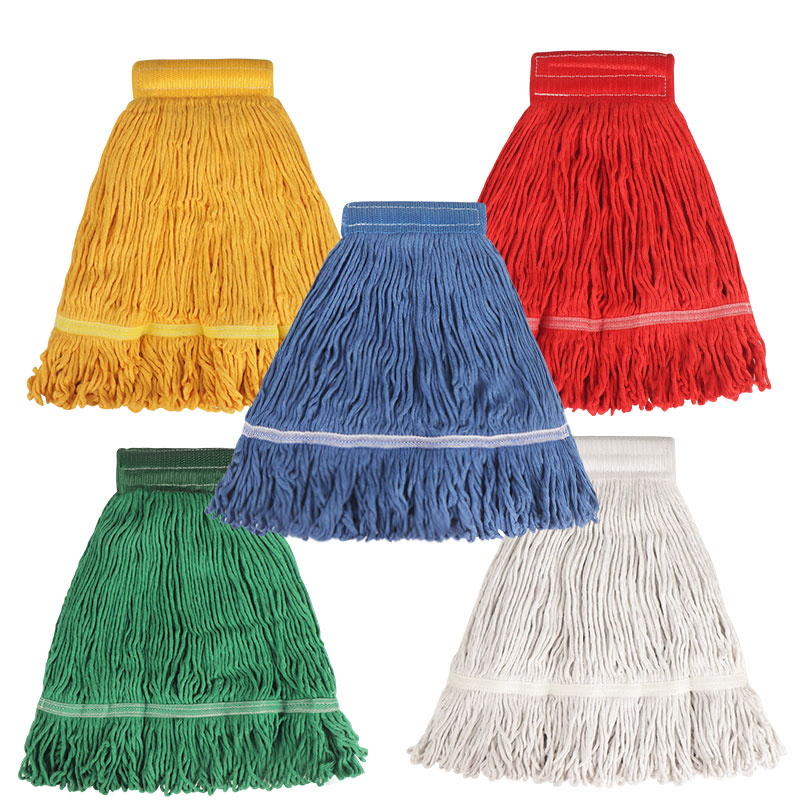
Its Microfiber Cloth Mop, model MSJ-STA006, puts a blue microfiber cloth head on a reinforced plastic socket with a three-section stainless steel handle. The company’s specification sheet lists the head at 200 g, and the head is machine washable and replaceable without retiring the handle. The sections unscrew, so the tool shortens for work under low furniture and extends for open floor. The head is offered across blue, green, red and yellow, so a cleaning team can keep zones separate without buying a second system.
The design choice is the head itself. A cloth head made of separate strips drapes around the edge of a furniture leg and reaches back under it in a way a rigid pad cannot, and it is wrung by hand instead of through a bucket and press. The trade-off is water: a strip head carries less per pass than a wide flat pad, so a large open floor takes a few more passes. MSJ’s position is that the passes under the furniture are the ones that were not happening before, and those are the ones the purchase should be built around.
“The questions we get from importers are about the minimum order and the price per piece. The two things that decide whether the mop is still the right tool in month six are how low the head sits, so it passes under furniture, and how much the tool weighs in the hand. When a shift is running late, the floor under the sofa is the first one that gets skipped.”
— Lin, Marketing Manager, Wenzhou Meishijie Household Products Co., Ltd.
The same construction is positioned across four buying situations, each with a different dominant failure.
| Setting | What fails in the category | MSJ’s stated design response |
|---|---|---|
| Household — living rooms, bedrooms, under furniture | A head too deep to pass under the sofa or bed, so that strip of floor is skipped | Cloth head on a flat plastic socket that passes under low furniture; handle shortens to three sections |
| Commercial — offices, retail, contract cleaning | Fatigue on long shifts, so the floor under furniture is the first pass dropped | 200 g head on a light stainless handle, with the weight published so a buyer can specify it |
| Hospitality and food service | Heads that stop lifting dust after a few washes; odour in heads stored damp | Machine-washable microfiber head, stated as replaceable; four colours for zone coding |
| Trade — importers, distributors, private label | Spec drift between containers; no published head weight to order against | Published head weight and carton quantity; OEM and ODM on colour, label and packaging |
MSJ runs a 6,000-square-metre facility in Wenzhou on five automated production lines, with quality control through the process and sampling inspection on every batch, and states that it holds ISO 9001, ISO 14001, ISO 45001, CE, RoHS, REACH and SEDEX. The head is replaceable on the socket, so a worn head does not retire the handle. Cartons hold 50 pieces. The company quotes seven working days for orders up to 2,000 pieces and 15 days up to 5,000, and supports OEM and ODM work on colour, label and packaging.
“The head is the part that wears out. Keeping the handle and the socket and replacing the head is what makes the tool worth reordering. If a buyer compares two mops on price alone, the comparison covers the head and not the handle.”
— Lin, Marketing Manager, Wenzhou Meishijie Household Products Co., Ltd.
Grand View Research puts the U.S. cleaning and hygiene tools market at USD 8.81 billion in 2023, growing at a CAGR of 4.7% to 2030. Transparency Market Research values the wider cleaning equipment and supplies market at USD 108.5 billion in 2023, growing at 6.3% a year to 2034.
The volume is not the question. The replacement schedule is. A head that stops lifting dust is replaced, and then the floor is done a second time because the first pass only pushed the dust, and neither of those costs appears on the order.
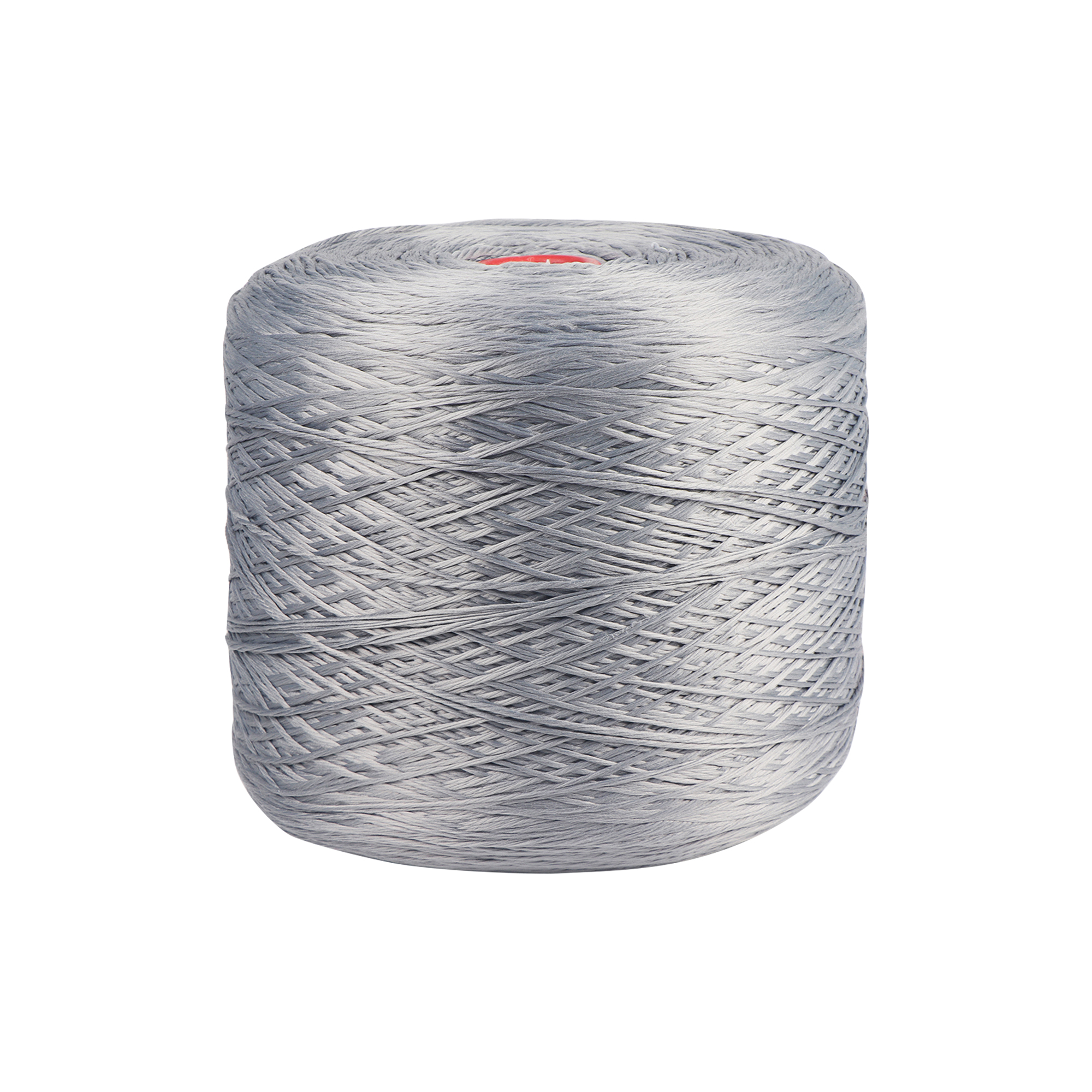
Founded in 2009 and headquartered in Wenzhou, Zhejiang Province, MSJ is a manufacturer of cleaning supplies covering mops, mop heads, mop-and-bucket sets, cleaning cloths and rags, squeegees, brooms and brushes, and yarns. The company operates a 6,000-square-metre production facility with five automated production lines and an in-house raw material capability for cotton yarn and microfiber filament. Its products serve household, commercial, industrial and outdoor cleaning applications across domestic distribution and export markets including South Korea, the Middle East, Africa, Europe and the Americas. MSJ will exhibit at the 2026 Canton Fair.
Website — www.msjclean.com
Media enquiries — clean-msj@wzmsj.cn
Tel — +86-577-64422811 | Mobile — +86-13091907807
Address — Unit 2, Building 8, Wanyang Technology City, Qianku Town, Wenzhou, Zhejiang Province, China
Product images, factory footage and certification documentation are available on request.
### END ###