A validated test method went to 40 manufacturers on 20 November 2025. An EU ecodesign act for textiles is tentatively scheduled for 2027. Laundered synthetic cloth sits inside both timetables.
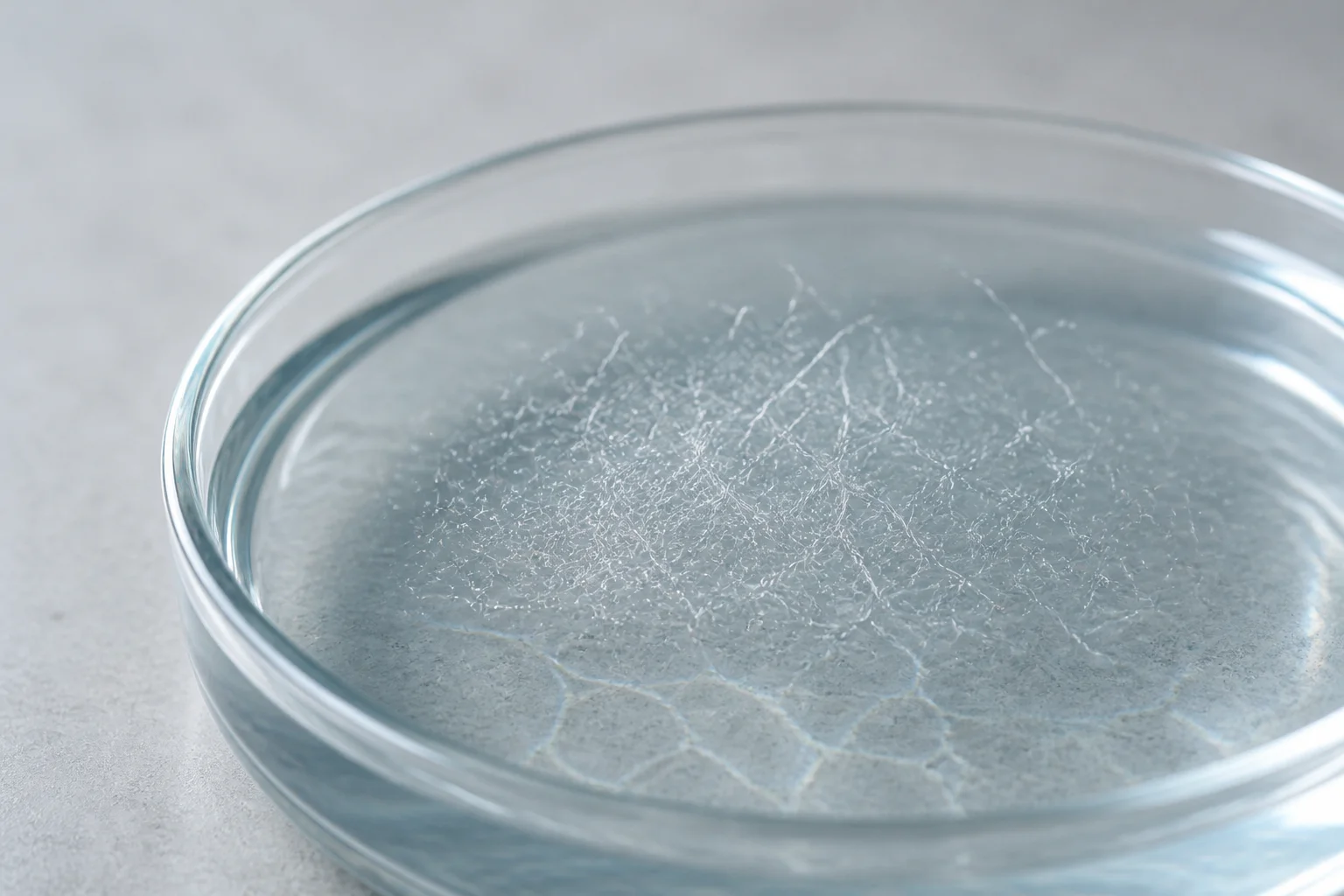
Concept illustration: synthetic microfibres suspended in water after laundering. Not a photograph of a specific test, and not a depiction of any manufacturer's product.
10 October 2026 · Industry News
WENZHOU, China — October 10, 2026 — Wash a synthetic cloth and fibres come off it. Everyone in the supply chain knows this. Until recently there was no agreed way to say how many, which meant two suppliers could not be compared on the same measurement, and nobody had to publish a figure that a buyer could act on.
That changed in November 2025.
The Microfibre Consortium released a microfibre shedding test method to its members on 20 November 2025. It was developed by the University of Leeds on the consortium’s behalf and is described as the first thoroughly tested, validated and internationally aligned method for measuring microfibre material loss from textiles. A wider industry release is planned once member feedback has been gathered (TexIntel, 20 November 2025).
The consortium was founded in November 2018 and now has 40 members drawn from outdoor, sport, high-street, luxury fashion and home textiles, with a combined turnover above EUR 250 billion. A second, commercially operated method is already on the market: testing houses now offer a microfibre shedding test that runs specimens under conditions designed to reproduce the abrasive action of home laundering.
“The crucial bridge from deep academic work to the reality of commercial product development” is how Sophie Mather, chair of The Microfibre Consortium, described the release. Dr Jan Beringer of the testing body Hohenstein, a consortium member, said the work would allow knowledge-based engineering of low-shedding textiles.
— Sophie Mather, chair, The Microfibre Consortium (TexIntel, 20 November 2025)
Published research has measured fibre loss from laundering across an extremely wide band. One study recorded microfiber loss of between 9.6 mg and 1,240 mg per kilogram of textile per wash, a range of two orders of magnitude.
A second reference point comes from the filter manufacturer Matter, whose research puts the figure at roughly a gram of microplastics released per wash. In the United Kingdom alone, with around 24 million homes, that works out to an estimated 16 tonnes entering the water supply each day (Euronews, July 2026).
The spread is the finding. Two cloths can be laundered on the same cycle and shed amounts that differ by a factor of a hundred, and the difference traces back to fibre, yarn, fabric construction and the process steps applied before the fabric is cut.
“Think of your washing machine — if you rub your hand on the inside, it's kind of like a cheese grater.”
— Adam Root, chief executive, Matter (Euronews, July 2026)
Work on measurement and work on regulation are running in parallel, on separate clocks.
The Ecodesign for Sustainable Products Regulation entered into force in July 2024. Its first working plan, published in 2025, names textiles as a priority product group, with the relevant measures tentatively scheduled for adoption in 2027 (SGS, 3 June 2025). The Pew Charitable Trusts has noted that an ESPR delegated act for textiles could be used to require shedding thresholds alongside aligned testing standards, pre-market washing with filtration, and changes to product design (Pew, 19 December 2025).
The EU’s zero-pollution action plan sets a target of cutting microplastic pollution by 30 per cent by 2030. Separately, the recast Urban Wastewater Treatment Directive, in force since 1 January 2025, requires systematic monitoring of microplastics at the inlet and outlet of treatment plants and in sludge, with national transposition due by 31 July 2027.
On appliances, filtration remains under review rather than in force. Euronews reported in July 2026 that legislation requiring new washing machines sold in the EU to carry a microplastic filter is “on the horizon”, and the revision of the EU ecodesign rules for washing machines is expected to conclude around the end of 2026.
| Instrument | Where it stands | Key date |
|---|---|---|
| Microfibre shedding test method — The Microfibre Consortium / University of Leeds | Released to members; wider industry release planned | Announced 20 November 2025 |
| Ecodesign for Sustainable Products Regulation — textiles | Priority group in the first working plan; measures tentatively scheduled for adoption | ESPR in force July 2024; measures tentatively 2027 |
| Washing machine filtration (EU) | Under review; not mandated | Revision expected to conclude late 2026 |
| France — filter mandate on new washing machines | On the statute book; reported as not yet enforceable | Applies from 2025 |
| REACH restriction on intentionally added microplastics | Adopted, phased by product category; information and reporting duties for suppliers | Adopted 27 September 2023 |
| Urban Wastewater Treatment Directive (EU) 2024/3019 | In force; microplastics monitoring required | In force 1 January 2025; transposition by 31 July 2027 |
France offers the cautionary case. The country legislated to require microfibre filters on all new washing machines sold from 2025. As of October 2025 the provision had not been implemented. It depends on two technical definitions, what counts as a microfibre and what counts as a compliant filter, and neither had been published (PlanetCare, 22 October 2025).
The requirement has produced no operational obligation since, and the reason given is the absent definition.
Synthetic fibres account for about 60 per cent of the fabric produced today. Within the European Union they make up roughly 60 per cent of clothing and 70 per cent of household textiles, which places textiles fourth among sources of microplastic pollution, behind paints, tyres and industrial pellets (EEA data cited by Pew, December 2025).
Reusable cleaning cloths and mop heads sit squarely in that picture. They are synthetic, they are laundered on industrial schedules, and the same standard domestic washing-machine filter is built to stop coins and buttons rather than fibres: the holes in an ordinary machine filter are around five millimetres across. A retrofit device tested at catching particles down to 10 microns reported 97 per cent efficiency at that threshold (Euronews, July 2026).
Most of the emission happens before the product reaches a laundry. Pew estimates that nearly half of total microfibre emissions occur during textile production, with the remainder released through washing, drying and wearing.
A validated shedding method converts an argument into a figure. In practice it produces a number for material loss per unit of fabric per wash cycle, measured under conditions that can be repeated in a second laboratory.
That is what makes it commercially significant. It allows a specification to be written into a purchase order, a batch to be compared against the sample that preceded it, and a claim on a label to be checked against a test report. It also creates an obligation of a kind the category has not carried before: once a figure can be produced, the question of why it is not published becomes answerable.
Founded in 2009 and headquartered in Wenzhou, Zhejiang Province, MSJ is a manufacturer of cleaning supplies covering mops, mop heads, mop-and-bucket sets, cleaning cloths and rags, squeegees, brooms and brushes, and yarns. The company operates a 6,000-square-metre production facility with five automated production lines and an in-house raw material capability for cotton yarn and microfiber filament. Its products serve household, commercial, industrial and outdoor cleaning applications across domestic distribution and export markets including South Korea, the Middle East, Africa, Europe and the Americas. MSJ will exhibit at the 2026 Canton Fair.
Website — www.msjclean.com
Media enquiries — clean-msj@wzmsj.cn
Tel — +86-577-64422811 | Mobile — +86-13091907807
Address — Unit 2, Building 8, Wanyang Technology City, Qianku Town, Wenzhou, Zhejiang Province, China
Product images, factory footage and certification documentation are available on request.
### END ###