A study collected 100 kitchen towels after a month of ordinary use and washing, and 49 of them carried bacteria. The four specifications that decide whether a cloth is a hygiene tool or a reservoir are not on the pack.
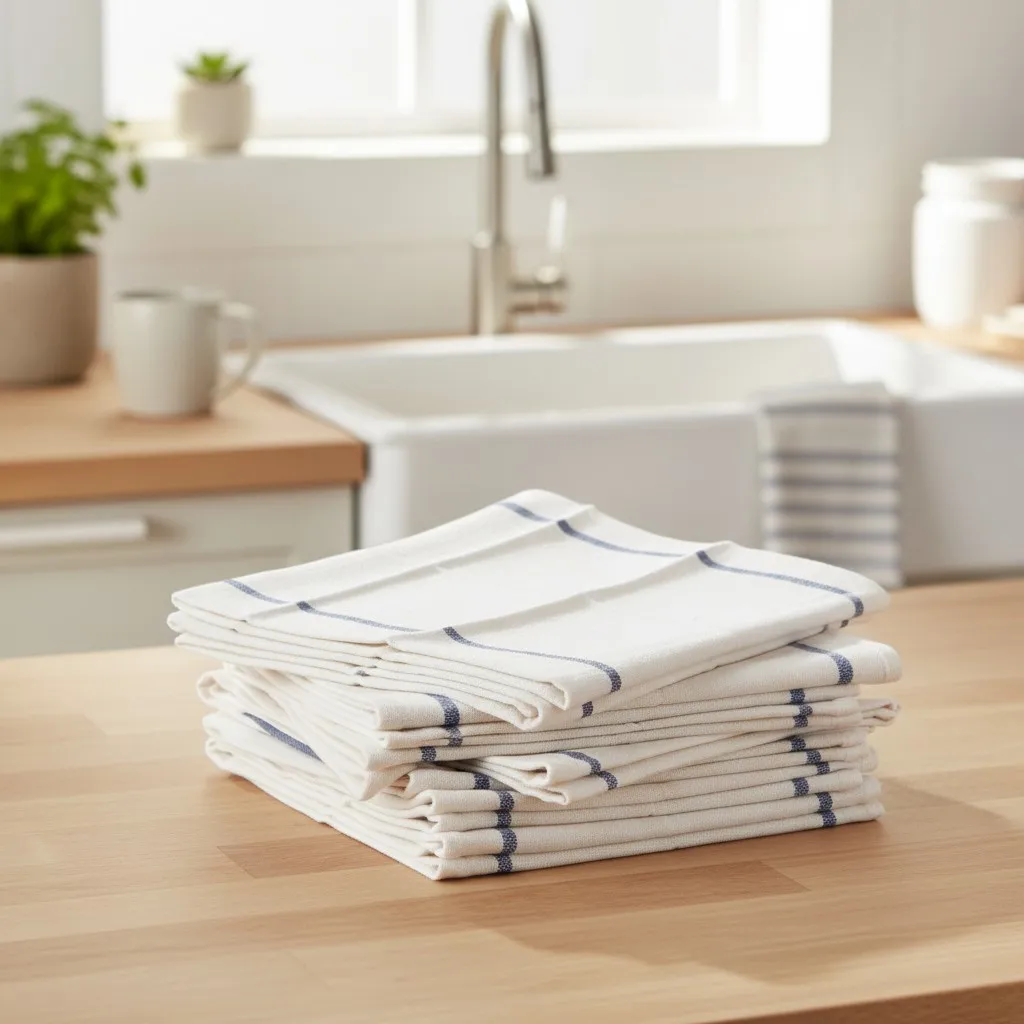
A white-ground cotton cloth with a blue stripe — the colourway this article is about.
14 October 2026 · Company News
WENZHOU, China — October 14, 2026 — A kitchen towel has one of the shortest lives of any tool in a building. It is used to dry a plate, wipe a counter, hold a hot handle and take a spill off the floor, and then it is hung on a rail above the sink where it stays damp.
Most buyers order it the way they order paper: by the pack, on colour and price. The study below is worth reading before the next order, because it tested what the towel was carrying rather than what it looked like.
Researchers at the University of Mauritius collected 100 kitchen towels after a month of regular use and washing and interviewed the households they came from. 49 of the hundred carried bacterial growth, including Escherichia coli, Enterococcus and Staphylococcus aureus.
The pattern behind the number matters more than the number. Towels that were used for a variety of tasks — wiping utensils, drying hands, cleaning surfaces, holding hot objects — “had more bacteria than those used solely for one purpose.” Damp towels were more heavily contaminated than dry ones. The heaviest growth came from households that ate meat or had children.
The lead author put the conclusion in one line: “Humid towels and multipurpose usage of kitchen towels should be discouraged.”
That finding is not isolated. A 2014 study by Drexel University researchers found E. coli on almost 26 percent of the towels it tested, and a 2015 food-handling study found cloth towels were the most contaminated item it sampled.
Professional cleaning has been treating the cloth as a contamination risk for years, and the answer it settled on is operational rather than chemical. Ed McCauley, president of ARTA, puts the arithmetic plainly: “You don’t want to use one cloth so many times that it’s no longer effective. There has to be training on the right amount of solution to use and how many square feet that cloth can sanitize before it must be thrown in with the soiled ones. If you try to clean four rooms with one cloth, that’s a problem.”
The two measures that follow from that are one cloth per area, and colour to keep the areas apart. “Workers should be trained to use a new cloth for each new area cleaned,” and colour-coded cloths help custodians “avoid cross-contamination,” according to the same trade guidance. Fold the cloth in half twice and it presents eight usable sides before it needs to go in the wash.
The reason a spent cloth fails is mechanical as well as biological: once the fibres are loaded with soil, they stop collecting more and start redistributing what they already hold.
Cotton is the material most kitchens will boil-wash, and it is also the material that most household laundry practice degrades fastest.
The mechanism is fabric softener. “Every time you add fabric softener to a load of towels, it leaves a water-repellent coating on every fiber,” and the coating “also repels water.” Build-up is cumulative: repeated use makes natural and synthetic fabrics, “such as bath towels, kitchen towels, and bedding,” less absorbent and less breathable, and the same coating “traps bacteria and body soil,” which is what leaves a towel looking dingy and smelling musty. The Cleaning Institute acknowledges the same trade-off from the chemistry side: softeners are hydrophobic, so they affect absorbency.
So the towel that is washed with softener is both worse at absorbing and better at holding what it should have released. A cloth in that condition goes back onto the rail damp, which is the condition the Mauritius study found carries the heaviest growth.
Four specifications decide whether a cloth behaves as a hygiene tool or as a reservoir. All four are ordinary manufacturing and sourcing decisions, and three of them are usually left off the pack.
1. Weight per cloth. A heavy cloth holds more liquid and stands up to more wash cycles; a light one suits lighter work and dries faster. Weight is the fastest way to tell two visually identical cloths apart.
2. Fibre content. “Cotton” covers cotton yarn, poly-cotton blends and recycled blends, which behave differently under hot laundering.
3. Edge finish. An overlocked edge survives repeated washing; a cut or raw edge is where a cloth starts fraying, and a frayed cloth sheds fibres onto the surface it was supposed to clean.
4. Colour, as a system rather than a preference. Colour is the cheapest cross-contamination control a kitchen has, and it only works if the colours are ordered deliberately and the same colourways stay available on reorder.
Wenzhou Meishijie Household Products Co., Ltd. (“MSJ”) builds its kitchen cloth line around those four, and publishes three of them.
The cotton kitchen dish cloth, model MSJ-MB004, is woven from cotton yarn with an overlocked edge, and is listed in three sizes: WHITE/BLUE 50×60 cm, WHITE/RED 50×50 cm and WHITE/RED 40×40 cm. The range is published with three cloth weights, 65 g, 100 g and 160 g, so a buyer can separate the light, fast-drying cloth from the heavy one on the order rather than by feel. Colourways run in white with a blue or a red stripe, which gives a kitchen two zones from one supplier before it has to look for a second one. MSJ quotes seven working days for orders up to 2,000 pieces and supports customization of colour, size and packaging.
The design decision here is that the cloth is sold as a specified item rather than a pack — size, weight, fibre and edge all publishable — because a hygiene cloth is only useful if the second order matches the first. The trade-off is cotton itself. Cotton takes hot laundering better than most materials and holds water longer than most, and holding water is exactly the condition the study above found makes a towel worse. MSJ’s position is that the answer to that is rotation rather than substitution: enough cloths in the rotation, and in enough colours, that a damp one goes to the laundry instead of back onto the rail.
“The questions we get are about the price per piece, the size and the colour. The questions that decide whether the cloth is still the right one in month six are the weight and whether the edge survives the wash. A buyer who writes weight and an overlocked edge into the order gets the same cloth in the tenth container as in the first, and that matters more in a kitchen than it does in most rooms.”
— Lin, Marketing Manager, Wenzhou Meishijie Household Products Co., Ltd.
The same cloth is positioned across four buying situations, each with a different dominant failure.
| Setting | What fails in the category | MSJ’s stated design response |
|---|---|---|
| Food service — prep areas, pass, front of house | One cloth carried across several zones, which is where cross-contamination starts | White with blue or red stripe so zones can be held apart; three sizes so the cloth matches the task |
| Hotels and catering laundries | Cloths that fray at the edge and shed fibre after repeated hot washing | Overlocked edge on a cotton-yarn cloth |
| Household retail packs | Cloths that look identical on the shelf and behave differently in use | Weight published as a range (65 / 100 / 160 g) so the lighter and heavier cloths can be told apart on the order |
| Trade — importers, distributors, private label | Spec drift between containers, with no weight or edge standard to reorder against | Fibre, size, weight and edge published; custom colour, size and packaging |
MSJ is a cleaning-supplies manufacturer based in Wenzhou, Zhejiang, where it runs a 6,000-square-metre facility on five automated production lines, with quality control through the process and sampling inspection on every batch, and states that it holds ISO 9001, ISO 14001, ISO 45001, CE, RoHS, REACH and SEDEX. It supplies household, commercial and industrial cleaning programmes across domestic distribution and export markets including South Korea, the Middle East, Africa, Europe and the Americas, and supports OEM and ODM work on colour, size and packaging. The dish cloth is quoted at seven working days for orders up to 2,000 pieces.
“A dish cloth is laundered more often than it is replaced, so the two specifications that matter are the ones that survive a hundred wash cycles: the weight and the edge. Colour is what a kitchen sees first and changes last. The reorder is where a cloth programme is either the same as the first delivery or quietly different.”
— Lin, Marketing Manager, Wenzhou Meishijie Household Products Co., Ltd.
Grand View Research puts the U.S. cleaning and hygiene tools market at USD 8.81 billion in 2023, growing at a CAGR of 4.7% to 2030. Transparency Market Research values the wider cleaning equipment and supplies market at USD 108.5 billion in 2023, growing at 6.3% a year to 2034.
The volume is not the question. The cost of a cloth is set by the wash cycle, not the purchase price. A cloth that survives a hundred launders is bought once and washed a hundred times; a cloth that frays at the edge is bought again sooner, at a reorder interval nobody planned. The laundry, the rotation and the replacement date are three line items that follow from the weight and the edge, and none of them appears on the pack.
Founded in 2009 and headquartered in Wenzhou, Zhejiang Province, MSJ is a manufacturer of cleaning supplies covering mops, mop heads, mop-and-bucket sets, cleaning cloths and rags, squeegees, brooms and brushes, and yarns. The company operates a 6,000-square-metre production facility with five automated production lines and an in-house raw material capability for cotton yarn and microfiber filament. Its products serve household, commercial, industrial and outdoor cleaning applications across domestic distribution and export markets including South Korea, the Middle East, Africa, Europe and the Americas. MSJ will exhibit at the 2026 Canton Fair.
Website — www.msjclean.com
Media enquiries — clean-msj@wzmsj.cn
Tel — +86-577-64422811 | Mobile — +86-13091907807
Address — Unit 2, Building 8, Wanyang Technology City, Qianku Town, Wenzhou, Zhejiang Province, China
Product images, factory footage and certification documentation are available on request.
### END ###