A mop cart is sold by capacity and pushed by weight. The gap between the two numbers decides what the castors, the frame and the operator are actually asked to carry.
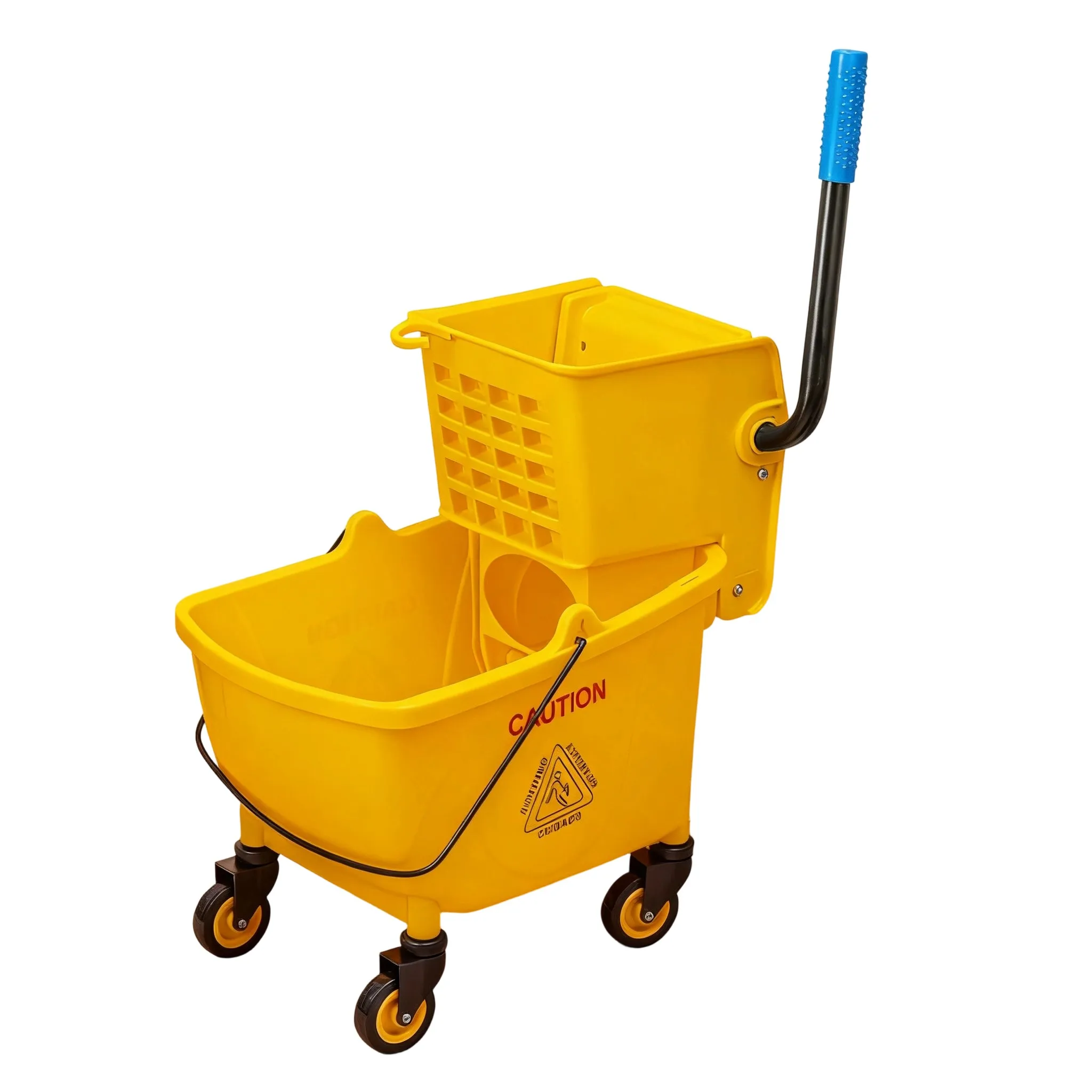
MSJ-TZ012, the 20 to 32 litre mop water squeezing cart. Product photograph, Wenzhou Meishijie.
Wenzhou Meishijie Household Products Co., Ltd. · 26 October 2026
WENZHOU, China, 26 October 2026 — Wenzhou Meishijie Household Products Co., Ltd. has released MSJ-TZ012, a mop water squeezing cart built on a stainless-steel frame with a polypropylene body, in 20, 24 and 32 litre capacities.
The specification sheet sells a cart by its capacity. The person pushing it works with its weight. A litre of water is a kilogram, so the largest version of this cart holds 32 kg of water before anything else is in it, and that number never appears on the sheet.
Capacity tells a buyer how much floor a cart can cover between refills. It does not tell them what the cart weighs when it is doing that job, and it does not tell them how that mass is distributed.
Three figures follow from the capacity directly. At 32 litres the water alone is 32 kg. Standing still on four castors, that is 8 kg per castor. Neither figure accounts for the bucket, the frame, the wringer, the mop, or the operator’s downward push on the lever, which loads one side of the cart more than the other while the head is being pressed.
A wringer cart is a structure. Force enters at the lever, is multiplied by its length, passes through the mop head into the wringer deck, and from the deck into the frame and then the castors. Each element in that chain has a limit, and they are not the same limit.
The lever is the part that feels effortless and does the most work. Its length multiplies hand force into several times that force at the head, which is the point of it, and which is also why the wringer deck and its mounting take a load no operator ever applies by hand.
The deck is where the two failure patterns of this product type live. A deck that is fixed to the body only at its rim will flex under repeated pressing, and a flexing deck eventually cracks at the mounting points. A deck bolted through a steel frame does not flex, but the bolts then carry the whole load and loosen.
The body is polypropylene because it has to hold water, resist detergents, and be moulded cheaply into a shape with a pouring lip and rounded corners. The frame is stainless steel because it has to hold a compressive load that a moulded plastic wall would slowly deform under.
That difference is the reason the two are joined rather than moulded as one piece, and it is the reason the joint is the part worth inspecting. Stainless and polypropylene do not bond; they are fastened. Every fastener is a place where a load concentrates, and where a crack starts.
A cart at 20 litres is a low, stable object. The same cart at 32 litres has a higher centre of mass and more water moving inside it, and water moves when the cart is pushed. A castor that hits a threshold stops the wheel; the water keeps going.
The warning label on the body is there because of that, not because the product is unusual. Carts of this type carry a tipping or crush warning as a matter of course.
This is a single-compartment cart. The mop goes back into the water it has just been used to clean with, which is how mopping has been done for a century and is also why the trade moved toward two-compartment systems for heavy soil.
The honest position is that one compartment is the right answer for small areas, light soil and a single operator, and the wrong answer for a large soil load where the water turns grey within a corridor. A buyer specifying this cart for a shopping centre should be specifying two, or specifying a rinse bucket alongside it.
1. Load it and push it. Fill it to the marked capacity and push it across the floor it will actually be used on, including a threshold. Watch the castors, not the bucket.
2. Press the lever twenty times. As a cleaner would in a corridor, and watch the deck mounting for movement.
3. Load one side only. As happens when the wringer is full, and check whether the frame twists.
4. Check how the site empties it. Lifting 24 kg out of a cart is a different task from tipping it into a drain, and the manual handling assessment should reflect which one happens.
5. Look at the castor tread. Against the floor finish. A hard tread marks vinyl and a soft tread drags on tile.
“The question we get is how many litres. The question that decides whether the cart survives three years is where the wringer is bolted and what the castors run over. A 32 litre cart on a smooth floor and the same cart dragged over a doorstep are two different products.”
Lin, Marketing Manager, Wenzhou Meishijie Household Products Co., Ltd.
It suits contract cleaners working mid-sized areas, facilities teams who need one unit per floor, and distributors supplying the janitorial trade. The stainless frame and the range of capacities make it a specification item rather than a household bucket.
It is not a two-bucket system, and it is not a cart for large soil loads without a rinse routine. It is also not a substitute for a proper manual handling assessment: a 32 litre cart weighs what it weighs.
MSJ-TZ012 is supplied one unit per carton, in yellow, in 20, 24 and 32 litre capacities. Colour and configuration are available under OEM and ODM, at a minimum of 5,000 pieces per colour.
Prices are not published. Quotations are issued against a specified capacity, colour and packing configuration.
| Figure | Value | Basis |
|---|---|---|
| Capacities offered | 20 / 24 / 32 L | MSJ specification, MSJ-TZ012 |
| Mass of water at 32 L | 32 kg | 1 litre of water is 1 kg |
| Mass of water at 20 L | 20 kg | Same basis |
| Static load per castor at 32 L | 8 kg | 32 ÷ 4 |
| Manual handling risk filter, men | 25 kg | HSE, manual handling risk filters |
| Manual handling risk filter, women | 16 kg | HSE, manual handling risk filters |
| Carton quantity | 1 pc | MSJ specification |
| Frame material | Stainless steel | MSJ specification |
| Body material | PP | MSJ specification |
The two HSE figures are risk filters for a load held close to the body at about waist height in good conditions. They are not legal limits, and they do not describe lifting a full cart out of a corner.
What does 32 litres weigh? Thirty-two kilograms of water, before the cart itself, the wringer or the mop. At 20 litres it is 20 kg.
How much weight does each castor carry? Standing still and evenly loaded at 32 litres, about 8 kg each. Pressing the lever shifts load onto the wringer side, so the even figure is the best case.
Is the frame stainless or coated steel? Stainless steel, with a PP body. The two are fastened rather than bonded, which is why the mounting points are the part to inspect.
Can one cart handle heavy soil without a rinse? No. It is a single compartment, so the mop returns to the water it came from. Heavy soil needs a second compartment or a separate rinse bucket.
What is the minimum order? Five thousand pieces per colour, with capacity, colour and packing specified per order.
Wenzhou Meishijie Household Products Co., Ltd. (MSJ) is a manufacturer of household and automotive cleaning products based in Wenzhou, Zhejiang Province, China. Founded in 2009, the company spins cotton mop yarn and produces mops, buckets, carts, cleaning cloths, brushes and squeegees, supplying importers, distributors and private-label brands. MSJ exhibits at the Canton Fair and works with buyers on OEM and ODM programmes.
Website: www.msjclean.com
Media enquiries: clean-msj@wzmsj.cn
Tel: +86-577-64422811 · Mobile: +86-13091907807
Address: Unit 2, Building 8, Wanyang Technology City, Qianku Town, Wenzhou, Zhejiang Province, China
Product images, factory footage and certification documentation are available on request.
### END ###