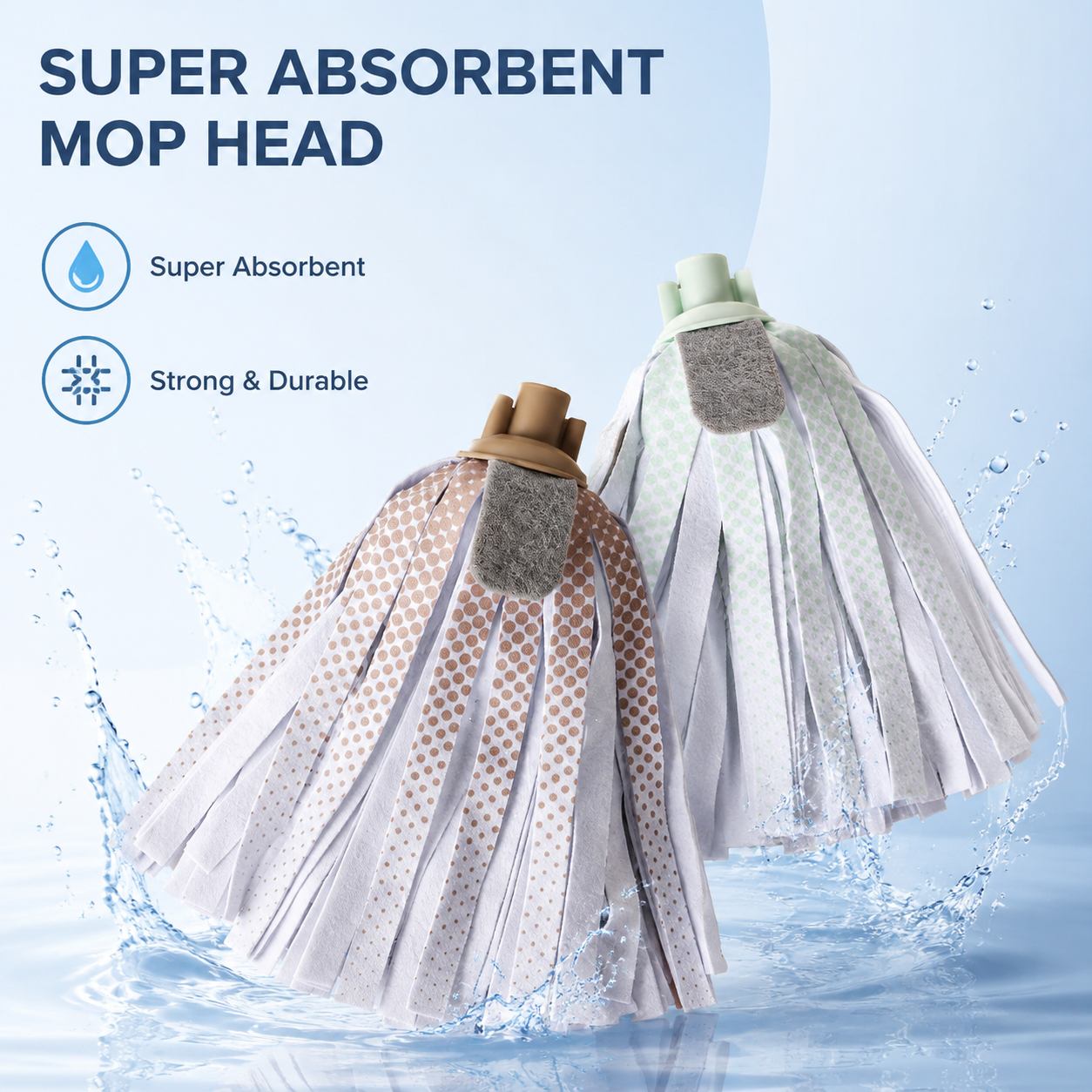
The cheapest part of a mop is the only one that has to fit both ends, and the two dimensions that decide whether it survives are rarely on the drawing.
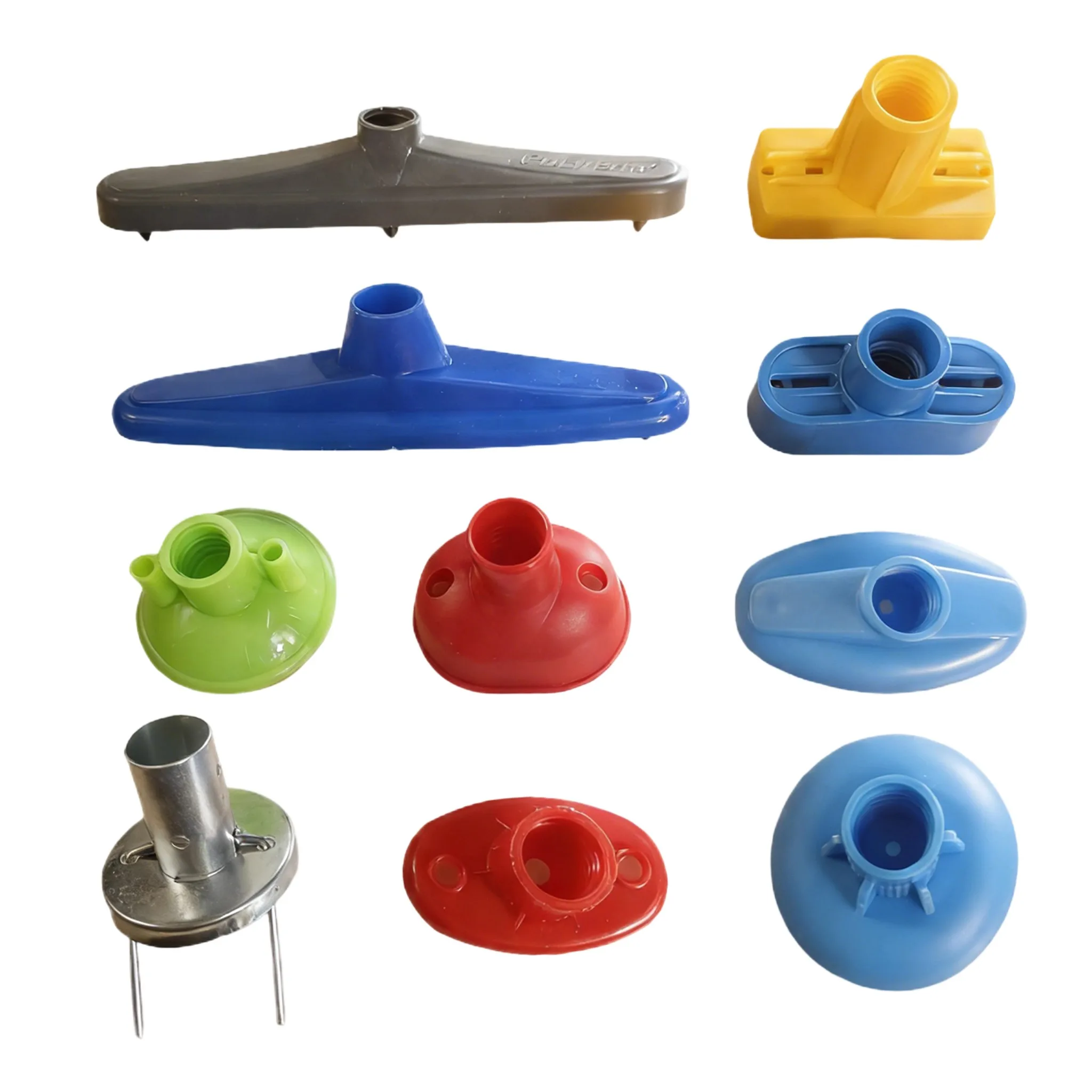
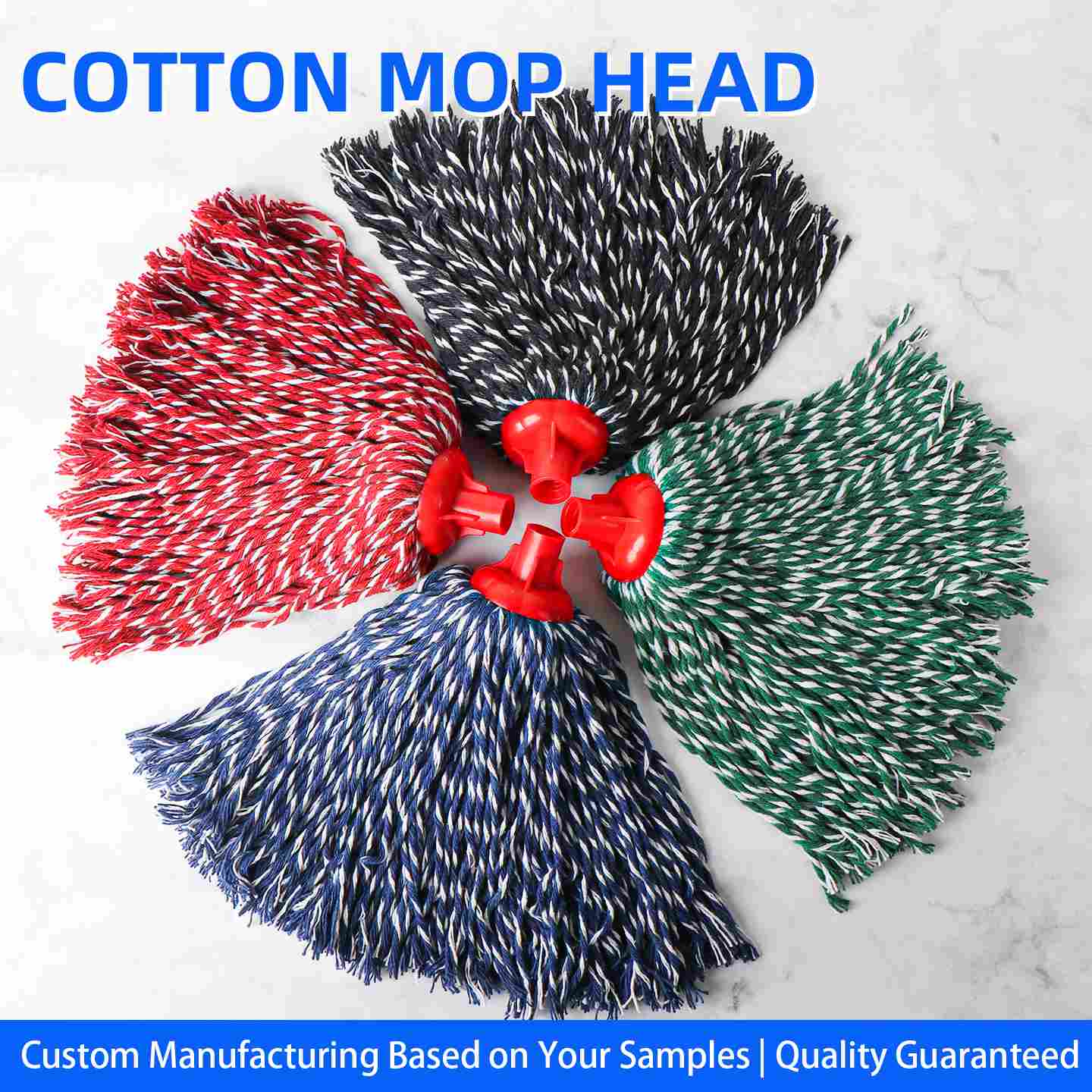
Moulded sockets for mop heads, photographed on the company bench. Product photograph, Wenzhou Meishijie.
Wenzhou Meishijie Household Products Co., Ltd. · 28 October 2026
WENZHOU, China — Of all the components in a mop, the socket is the one that is bought last, priced lowest and specified least. It is also the only part that has to fit two things at once: the head it is sewn or clamped into, and the handle that screws into it.
Everything else in the assembly is free to be whatever the maker wants. The head can be cut or looped, the yarn coarse or fine, the handle steel or aluminium. The socket has no such freedom. Its bore has to match a thread it did not design, and its flange has to match a head band it may never see.
That is why socket failures look so similar across the trade. They are almost never a failure of the material in bulk. They are a failure at one point.
A thread is a helix cut into a wall, and every turn of it is a notch. At the bottom of each notch the stress in the plastic is higher than the nominal load divided by the wall area, because the geometry concentrates it.
When a socket splits, it splits along a line that follows the thread root, usually from the open end toward the flange. Once that line reaches the flange, the socket will still hold a handle but will no longer hold it tight, and the mop begins to rotate under the hand.
Two dimensions govern how long that takes: the wall thickness at the root, and how much of the thread is engaged.
A socket that feels tight is not necessarily engaged. The first turn takes up clearance, and if the boss is shallow, the handle bottoms out before the thread has done its work. The joint then looks and feels finished while carrying the load on two or three turns instead of the full length of the bore.
The check is mechanical and takes seconds: count the turns from first contact to seated. A socket that seats in fewer turns than the thread pitch implies has a shallow boss.
The same applies at the other end. A flange that is thinner than the head band it clamps will deform before the band does, and the head will slip out of square. The socket survives; the mop does not.
Not every head takes a screw socket. The traditional metal ferrule is a pressed cap with two prongs that are driven through the head band and folded back. It holds by interference and by the prongs, not by thread, and it cannot work loose in service the way a thread can.
What it cannot do is be exchanged without tools. A socket can be swapped on site; a pronged ferrule is a factory joint. That single difference decides which one a distributor stocks for which market.
A socket is usually the most coloured component in the mop, because the socket is where a zone assignment is easiest to see. A distributor who buys heads in white and sockets in four colours can serve a colour-coded building with one head line and four fitting lines.
That makes colour a supply question rather than a design one. Matching a colour across batches is a moulding discipline, not a paint job, and a colour that drifts between deliveries is more damaging than a colour that is slightly off the swatch.
1. Count the turns. Screw a handle in slowly and count from first contact to seated. Compare that with the pitch.
2. Look along the bore. Hold the socket up to a light. A wall that thins toward the open end will split there first.
3. Check the bearing. Fit it to the head band you actually buy and see whether the flange bears evenly or on one edge.
4. Drop it once. Waist height, onto concrete, on its open end. A socket that cracks from a drop is over-stiff for its wall thickness, and it will crack in a bucket too.
5. Compare colours side by side. Put the last delivery next to this one before accepting the batch.
A socket suits any mop assembled from a head and a handle at the point of use: socket mops, looped-end heads, flat frames with a screw boss, and the many variants in between. It is the right answer wherever a distributor wants to ship handles and heads separately and join them at the customer.
It is the wrong answer where the joint has to survive being thrown into a bucket every day for years without inspection, and where nobody on site will tighten anything. That is a ferrule job, or a factory-assembled head.
“A socket costs a few cents and decides whether a container of handles can be sold. When a buyer sends a drawing, the first thing we look at is the boss. If it is short, the thread is decorative, and the mop will rotate in the hand by the second month.”
Lin, Marketing Manager, Wenzhou Meishijie Household Products Co., Ltd.
| What | Why it matters |
|---|---|
| Thread form and pitch | The bore has to match a handle the moulder may never see |
| Engagement length | Short engagement feels tight and strips early |
| Wall thickness at the root | The split starts here |
| Flange diameter and thickness | Decides whether the band bears evenly |
| Colour, with a tolerance | Drift between batches is the usual complaint |
Why do sockets split at the thread? Because every thread root is a notch, and the notch concentrates stress. The split follows that line from the open end toward the flange.
Will a longer boss make it stronger? Up to the point where the whole thread is engaged, yes. Beyond that you are adding material that carries nothing.
Can I use one socket for every head? Only if the thread, the flange and the band all match. The socket is the part with the least freedom in the assembly.
Why does colour matter so much? Because colour is how a zone is assigned and how a reorder is checked. Drift between batches breaks both.
What should I send with an enquiry? The thread, the handle you will use, the head band thickness, the colour and the annual quantity. Those five decide whether the part fits.
Wenzhou Meishijie Household Products Co., Ltd. (MSJ) is a manufacturer of cleaning tools based in Wenzhou, Zhejiang Province, China. The company moulds the plastic components used in its own mop heads, and supplies mop heads, complete mops, brushes, cleaning cloths and yarn to importers, distributors and private-label brands in Europe, North America, the Middle East and Southeast Asia.
Website: www.msjclean.com
Media enquiries: clean-msj@wzmsj.cn
Tel: +86-577-64422811 · Mobile: +86-13091907807
Address: Unit 2, Building 8, Wanyang Technology City, Qianku Town, Wenzhou, Zhejiang Province, China
Product images, factory footage and certification documentation are available on request.
### END ###