A mop head is ordered by weight and a yarn is ordered by count. Worked through, the two numbers turn out to describe very different quantities of cotton.
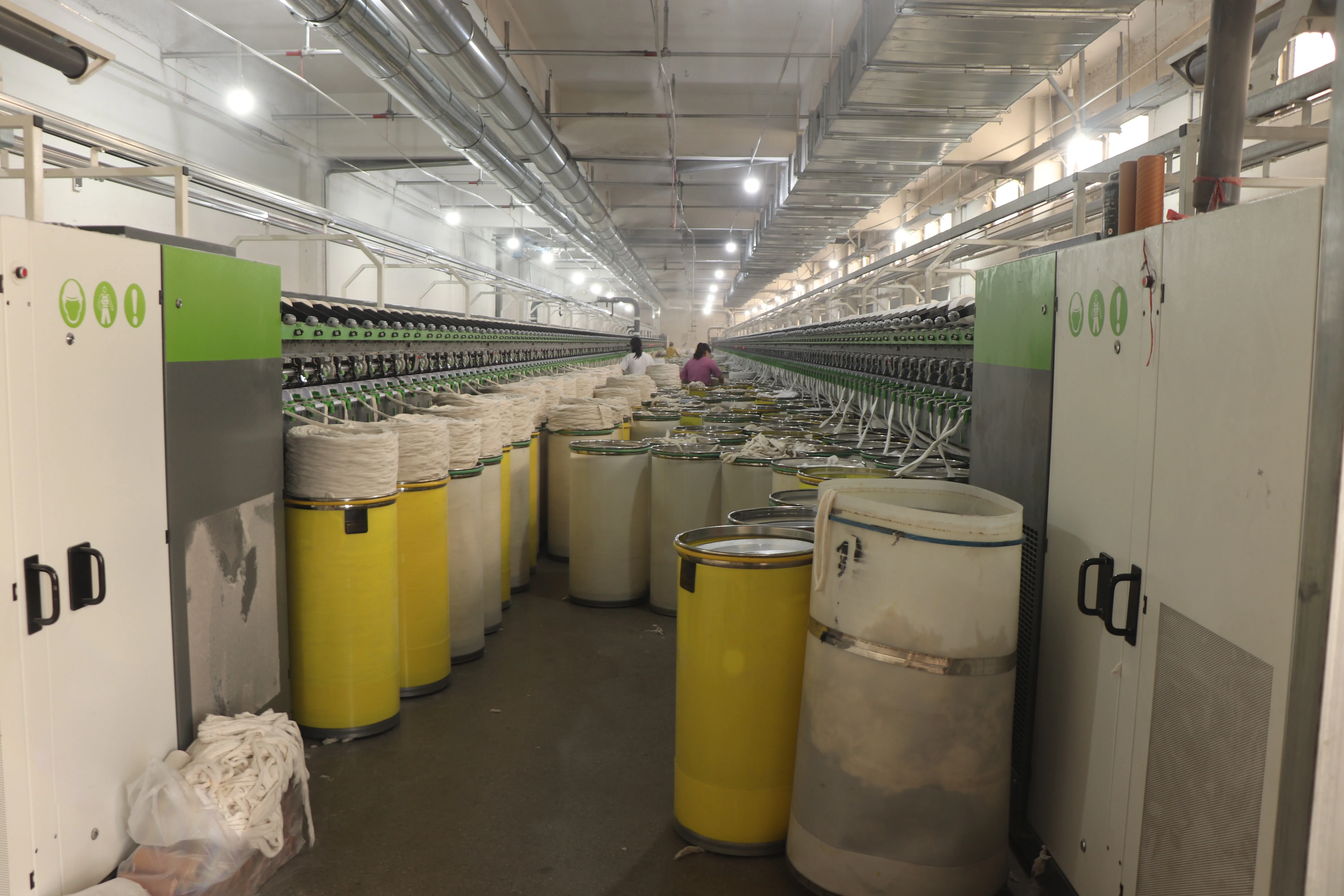
Sliver cans feeding the spinning frame on the MSJ spinning floor. Photograph, Wenzhou Meishijie.
Wenzhou Meishijie Household Products Co., Ltd. · 24 October 2026
WENZHOU, China, 24 October 2026 — Wenzhou Meishijie Household Products Co., Ltd. has opened its cotton mop yarn range, MSJ-MS, to buyers specifying count rather than weight, at a time when the two numbers are routinely confused in enquiries.
A mop head is ordered by weight. A mop yarn is ordered by count. The two are not the same measurement, and the gap between them is where disputes start: two heads that both weigh 450 g can contain very different amounts of yarn, depending on the count of the yarn they were made from.
The English cotton count, written Ne or simply “s”, is a measure of length per unit weight. One count means one 840-yard hank weighs one pound. Two count means two hanks of 840 yards weigh one pound, so each metre of 2s yarn is half the mass of a metre of 1s.
The consequence is counter-intuitive the first time it is worked through. A higher count is finer yarn, and finer yarn covers more metres per kilogram. Coarser yarn goes less far.
Start with one count. A hank is 840 yards, which is 768.1 metres. A pound is 453.6 grams. So one metre of 1s yarn weighs 453.6 divided by 768.1, or 0.591 grams. It follows that a kilogram of 1s cotton yields about 1,693 metres.
Now put a 450 g mop head on the other side of that figure. At 1s, a head contains roughly 762 metres of yarn. At 0.5s, the coarsest end of the range, the same 450 g holds about 381 metres. At 2s, the finest, it holds about 1,524 metres.
Four times the length, at the same weight. The head did not change size on the invoice. What changed is how many strands that 450 g was divided into, and how thick each one is.
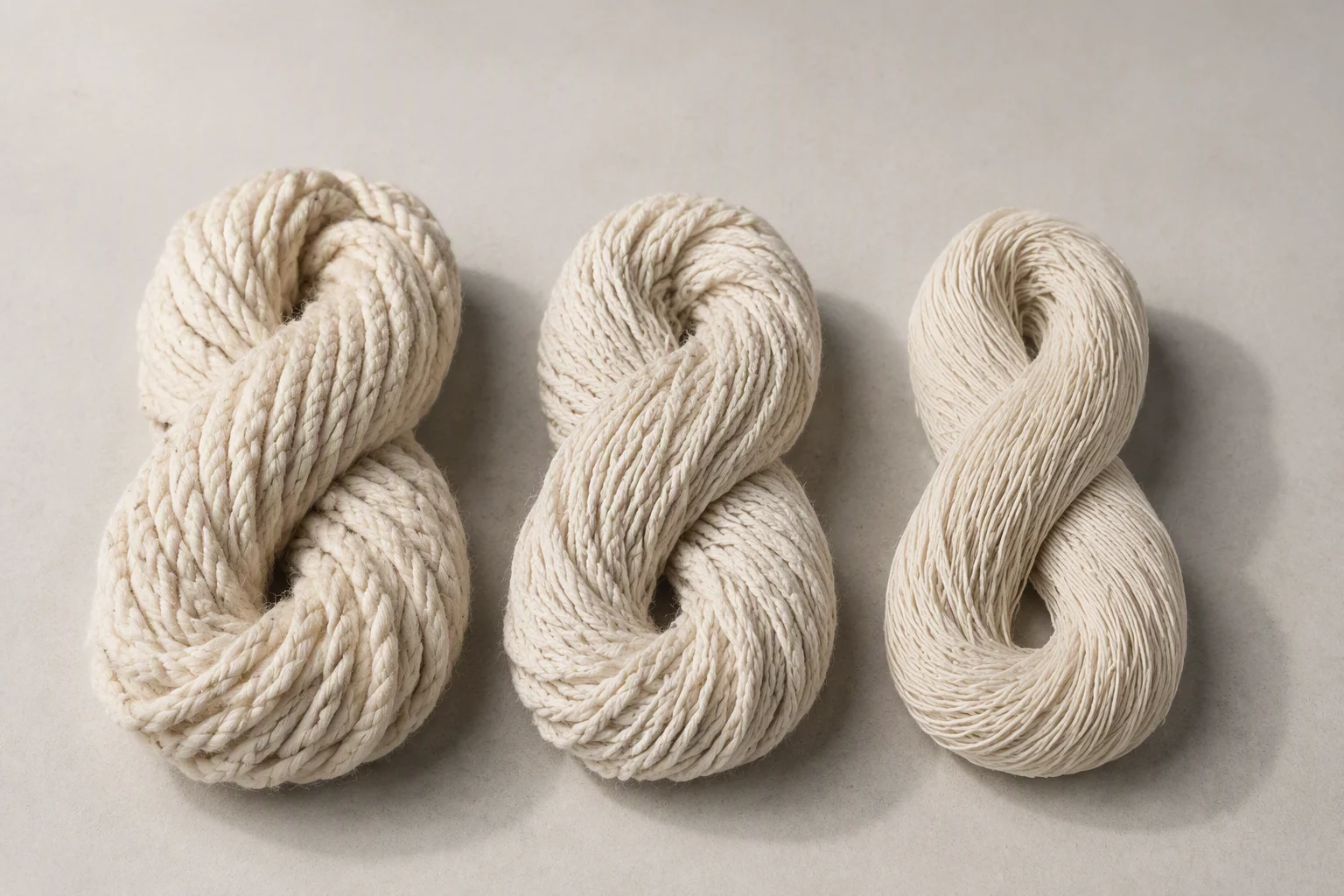
Illustration: the same cotton at three counts. Coarser yarn carries fewer metres per kilogram, so a fixed mass divides into fewer, thicker strands. This is an editorial illustration, not a photograph of MSJ products.
A 450 g head built from 0.5s yarn is made of fewer, thicker strands. One built from 2s is made of many finer strands. Both weigh the same, both are cotton, and both will be quoted as “450 g mop head” unless someone writes the count down.
The geometry is arithmetic and can be stated plainly: at half the count, each strand is twice the mass per metre, so a fixed mass divides into roughly half as many strands. What that does to absorption, to drying time and to how the head wears is a question for testing on the actual floor, not for an assertion in a press release. What can be said without testing is that a buyer comparing two quotations has no way to know which geometry they are being offered unless the count is on the paper.
Count is the number buyers ask for. Three others decide whether the yarn behaves as expected, and all three are usually missing from a quotation.
Twist is the number of turns per metre. It holds the fibres together and sets how the yarn feels in the hand. Two yarns of the same count with different twist are different products.
Ply is the number of single yarns twisted together. A two-ply mop yarn and a single yarn of the same resultant count behave differently under abrasion, because the plies rub against each other as well as against the floor.
Regain is the moisture the cotton is carrying. Cotton is hygroscopic, and its invoiced mass is normally settled at a commercial regain rather than at whatever the fibre happens to weigh on the day. ISO 6741 sets out the oven-drying method used to establish dry mass for exactly this purpose. A shipment weighed in a humid month and a shipment weighed in a dry one are not the same physical quantity of fibre, even when the scales agree.
The image at the top of this page is the company’s spinning floor. Cans of sliver, the rope-like intermediate that comes off the carding and drawing stages, stand in rows along the frame. Each can feeds a spinning position, where the sliver is drawn down to its final thickness and twisted into yarn. Extraction ducting runs overhead to carry away the fly and dust that the process throws off, and two operators work the frame in the distance.
Two things follow from that arrangement, and neither is a claim about quality.
The first is that sliver handling is visible. Sliver is fragile: it has almost no twist, and a can that is dragged or overfilled delivers an uneven feed. A buyer visiting a spinning floor learns more from how the cans are handled than from any certificate.
The second is that the mop and the yarn come off the same site. The yarn that goes into the heads described elsewhere on this catalogue is spun here, which means a specification question about a head can be answered by walking to the frame rather than by sending an email to a third-party spinner.
MSJ-MS is a twisted cotton mop yarn offered from 0.5s to 2s Ne, in white, black, and two-tone combinations including black-and-white and red-and-white. The two-tone construction exists for colour-coded cleaning programmes, where the assignment is carried by the yarn itself rather than by a tag that can be cut off.
Custom colour, custom twist and custom packing are available under OEM and ODM.
It is a mop yarn: coarse, absorbent, and built for a head that gets wrung and laundered. It suits mop manufacturers, contract cleaners who restring heads, and importers buying yarn and heads from one supplier.
It is not a knitting or weaving yarn. The count range starts where most textile yarns stop, and a buyer looking for 20s or 30s is in the wrong catalogue. It is also not a finished product: yarn is a raw material, and the performance of the head it becomes depends on how the head is constructed.
“Buyers send a weight and ask for a price, and the weight was never the specification. A 450 gram head at half count is a different object from a 450 gram head at two count, and the difference is invisible until someone puts the number on the enquiry. We quote the count now, whether or not it was asked for.”
Lin, Marketing Manager, Wenzhou Meishijie Household Products Co., Ltd.
MSJ-MS is offered at a minimum of 5,000 pieces per colour. Count, twist, ply, colour and packing are specified per order. OEM and ODM are available on all of them.
Prices are not published. Quotations are issued against a specified count, twist, colour and packing configuration.
Every metre figure in this article is arithmetic on the definition of the count, not a measurement of a particular shipment. The table shows the derivation so that a buyer can check it with a calculator.
| Figure | Value | Basis |
|---|---|---|
| Definition of one count | 840 yd per 1 lb | English cotton count (Ne) |
| Same, in metric | 768.1 m per 453.6 g | Conversion of the above |
| Mass per metre at 1s | 0.591 g/m | 453.6 ÷ 768.1 |
| Metres per kilogram at 1s | about 1,693 m | 1,000 ÷ 0.591 |
| Yarn in a 450 g head at 1s | about 762 m | 450 ÷ 0.591 |
| Yarn in a 450 g head at 0.5s | about 381 m | 450 ÷ 1.181 |
| Yarn in a 450 g head at 2s | about 1,524 m | 450 ÷ 0.295 |
| Count range offered | 0.5s to 2s Ne | MSJ specification, MSJ-MS |
| Dry mass method | oven drying at 105 °C | ISO 6741 |
| Minimum order | 5,000 pcs per colour | Company terms |
What does 1s Ne mean? One hank of 840 yards weighs one pound. In metric terms one metre of 1s cotton yarn weighs about 0.591 grams, so a kilogram yields roughly 1,693 metres.
Is a higher count better for a mop? It is finer, so it covers more metres per kilogram and divides a fixed mass into more strands. Whether that suits the job depends on the head design and the floor, not on the count alone.
How much yarn is in a 450 g mop head? About 762 metres at 1s, about 381 metres at 0.5s and about 1,524 metres at 2s. The weight is the same and the length is not.
Do you sell yarn and mop heads from the same factory? Yes. The yarn is spun on the company’s own spinning floor and is used in its own mop production, and it is also sold as a raw material.
What is the minimum order? Five thousand pieces per colour, with count, twist, ply, colour and packing specified per order.
Wenzhou Meishijie Household Products Co., Ltd. (MSJ) is a manufacturer of household and automotive cleaning products based in Wenzhou, Zhejiang Province, China. Founded in 2009, the company spins cotton mop yarn and produces mops, cleaning cloths, brushes, squeegees and yarn products, supplying importers, distributors and private-label brands. MSJ exhibits at the Canton Fair and works with buyers on OEM and ODM programmes.
Website: www.msjclean.com
Media enquiries: clean-msj@wzmsj.cn
Tel: +86-577-64422811 · Mobile: +86-13091907807
Address: Unit 2, Building 8, Wanyang Technology City, Qianku Town, Wenzhou, Zhejiang Province, China
Product images, factory footage and certification documentation are available on request.
### END ###