A mop head is bought as a weight and retired by a strip of tape. The 25 mm band across the yarn sets how wide the head spreads, and its stitching is what ends the service life.
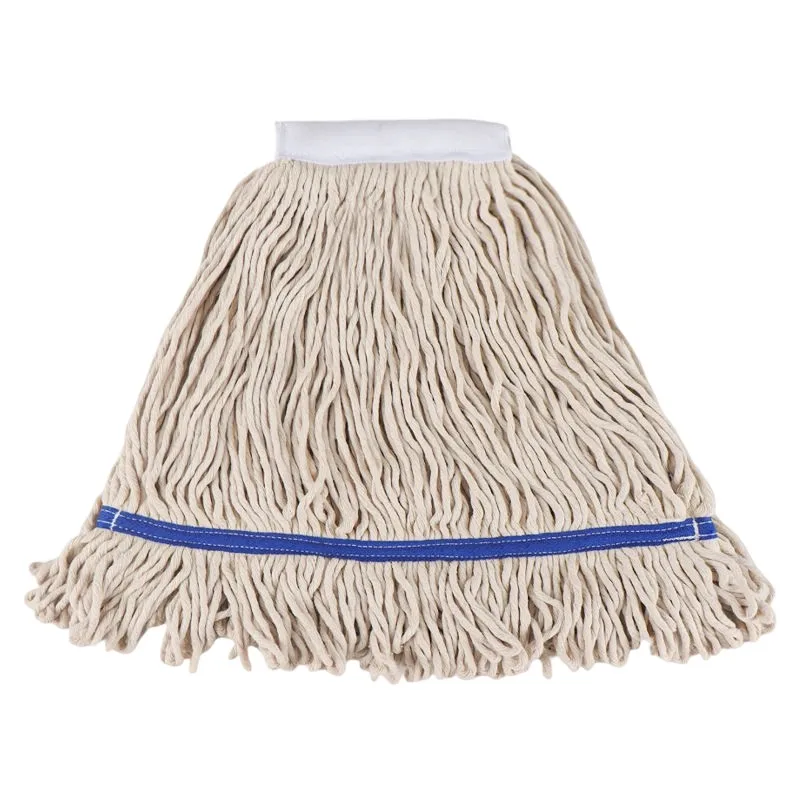
MSJ-STC023, a 450 g cotton looped-end head with a blue tail band. Product photograph, Wenzhou Meishijie.
Wenzhou Meishijie Household Products Co., Ltd. · 23 October 2026
WENZHOU, China, 23 October 2026 — Wenzhou Meishijie Household Products Co., Ltd. has released MSJ-STC023, a 450 g cotton looped-end mop head with a blue tail band, aimed at contract cleaners and distributors who buy heads by the carton and retire them by the laundry load.
A mop head gets discussed as a weight. Buyers compare 400 g against 450 g the way they compare paper against paper, and the arithmetic is easy because the number is printed on the carton. The part that decides how the head behaves on a floor, and how long it stays in service, is a 25 mm strip of woven tape stitched across the yarn a hand’s width above the ends.
Three components, not one. There is the yarn, which carries water and does the work. There is the headband at the top, which is what the clamp or the socket grips. And there is the tail band, the horizontal strip near the bottom that gathers every strand into one bundle and holds the head in shape.
Only the yarn is sold by weight. The other two are sold by description, and descriptions in trade catalogues tend to record colour and width rather than stitch count. That is a gap, because the stitching is what fails.
Loose cotton strands splay. A bundle of 450 g of yarn with nothing holding it fans out under its own weight and under the pressure of a wet pass, and a fanned head does three things badly: it spreads water unevenly, it wraps around chair legs and door stops, and it wears at the outer strands first because they carry the load while the middle strands barely touch the floor.
The band converts a bundle into a working surface. It sets the spread, which sets the width of the pass, which sets how many passes a corridor takes. It also keeps the strands aligned with the headband above, so the pull of a wringer is distributed across the whole head instead of concentrating on the strands nearest the clamp.
When the stitching gives way, the band does not disappear. It hangs, and the head gradually behaves like an unbanded one: the outer strands fan, the middle hollows, and the effective width of the pass narrows. Nothing about the cotton has changed. The head still weighs 450 g, still absorbs, still releases water when wrung.
This is why heads get retired early and why the retirement is hard to justify on a spreadsheet. The line item says “mop head, 450 g” and the replacement is a mop head, 450 g, at the same price. What changed is invisible in the accounts: the same labour now covers less floor per pass.
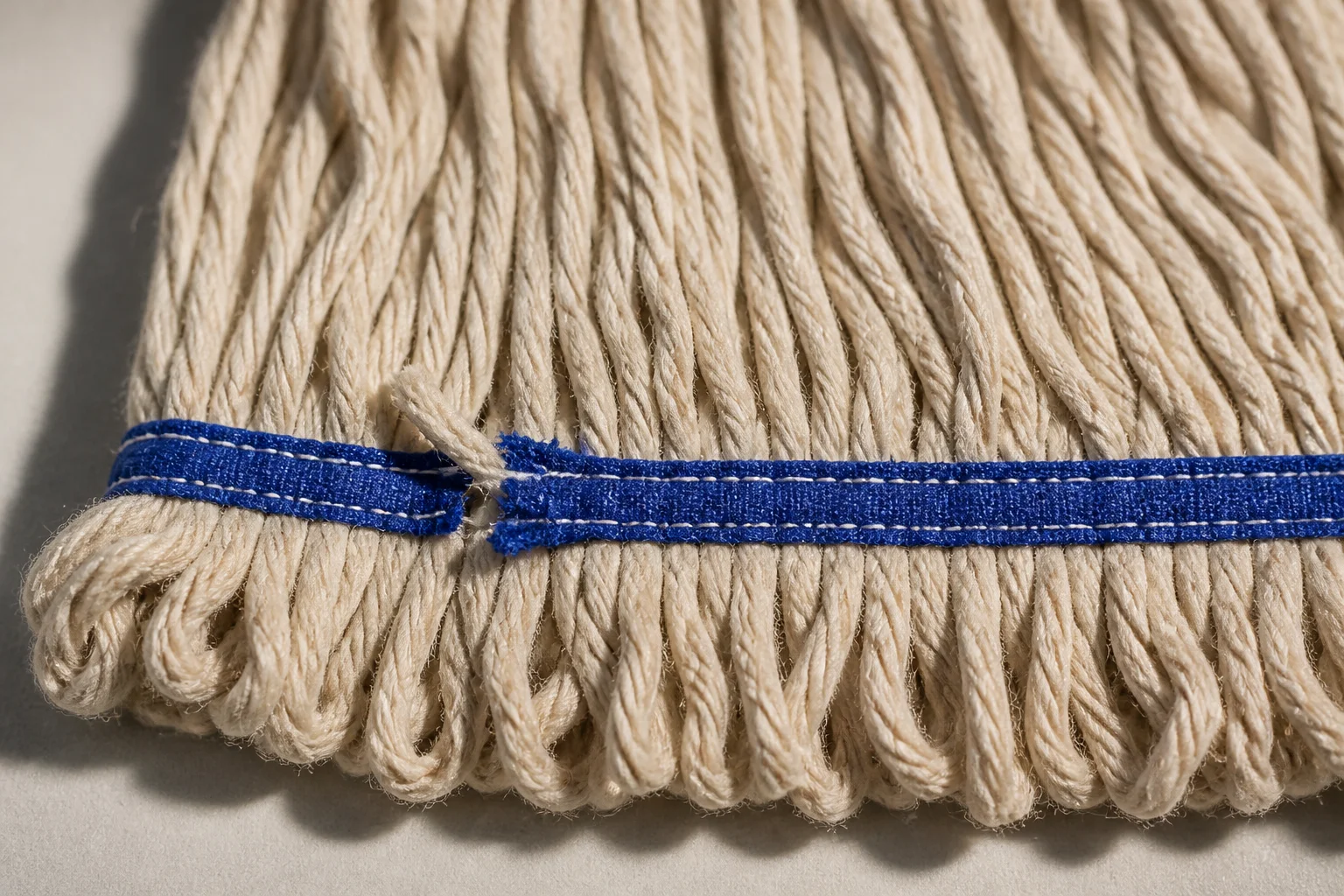
Illustration: a tail band where the stitching has given way, with cotton strands escaping over the tape. This is an editorial illustration, not a photograph of MSJ products.
Four hundred and fifty grams is not an arbitrary figure. It corresponds to the 16 oz designation that trade catalogues have used for the Kentucky-style head, and it is the weight most commonly listed by suppliers selling into contract cleaning.
Weight buys water per pass. It does not buy durability, and it does not buy a better band. A heavier head with a light stitch line will lose its band sooner than a lighter head with a reinforced one, because the load on the stitching scales with the mass of wet yarn it is holding. Buyers who specify weight and leave the band undescribed are specifying half a product.
The strands on this head are closed loops rather than cut tufts. A cut end presents the open cross-section of every fibre to the wash, and cotton at a cut end frays a little more with each cycle. A loop presents a continuous strand, so there is no open end to fray.
The difference shows up in a laundry, not on a floor. A looped head comes out of a wash cycle looking like the head that went in. A cut-end head sheds fibre into the machine, thins at the tips, and starts leaving lint on a wet floor long before the yarn has worn through.
What the loop does not fix is the band. The same wash cycle that leaves the cotton intact works on the stitching too, and a cotton tape stitched with a single row is the first thing to go.
Contract heads are laundered, not replaced after a single use. In a building that mops daily, one head can meet the machine several times a week, and the trade figure for a commercial head is around 250 wash cycles or better. Bob Croft, president of CBN Building Maintenance, put it that way in CleanLink’s report on mop maintenance: even the less expensive pads “are supposed to be able to stand up to 250 or better wash cycles.”
Two things shorten that number. Overdosing detergent leaves residue in the yarn, which holds soil and stiffens the fibre. Drying the head on a hot surface or in a hot tumbler shrinks cotton and stresses the band’s stitching at exactly the point where it is sewn through the thickest part of the bundle.
1. Weigh ten heads from the carton and write the spread down. A nominal 450 g head that arrives between 438 g and 462 g is a controlled process; one that swings by 40 g is not.
2. Turn the head over and look at the tail band’s stitching rather than its colour. Count the rows. One row of stitch on a 450 g head is a decision someone made.
3. Pull the band away from the yarn at three points along its length, firmly, with two fingers. The stitching should hold without the tape stretching into a wave.
4. Check that the band sits square to the headband. A band sewn on the skew gathers unevenly and will fan on one side before the other.
5. Wash one head ten times at the temperature the account will use, then look at the band again. Stitch failure is visible early, and ten cycles is enough to show a bad seam.
MSJ-STC023 is a 450 g cotton looped-end head with a blue tail band, supplied as a head: no handle, no clamp. It suits contract cleaning on hard floors, corridors, canteens and washrooms, and it suits any operation that launders heads rather than discarding them.
It is not the right head for a single bucket-and-wringer household, where 450 g of wet cotton is more weight than the job needs. It is not a microfiber head, so it does not carry the electrostatic behaviour that a dry-dusting programme relies on. And it is not a disposable: the point of the loop and the band is that the head survives the laundry, which only pays off if the head actually goes to the laundry.
“The band is the cheapest component on the head and the one that decides when it is thrown away. When a buyer sends us a head to match, the weight is always specified and the band almost never is. We ask for the stitch row count now, because that is the number that comes back after six months.”
Lin, Marketing Manager, Wenzhou Meishijie Household Products Co., Ltd.
MSJ-STC023 is offered at a minimum of 5,000 pieces per colour. OEM and ODM are available on head weight, yarn, band colour, band width, stitch pattern and packaging. Carton configuration and lead time are confirmed against the final specification.
Prices are not published. Quotations are issued against a specified quantity, weight, band colour and packing configuration.
| Claim | Figure or statement | Source |
|---|---|---|
| Head weight | 450 g | MSJ specification, MSJ-STC023 |
| 450 g corresponds to the 16 oz trade designation | 16 oz = 453.6 g | Trade listings for Kentucky-style heads |
| Commercial heads expected to survive 250+ wash cycles | Direct quotation | CleanLink, 2010; Bob Croft, CBN Building Maintenance |
| Household heads rated to about 100 washes | Used only as a contrast | Wirecutter, updated 13 July 2026 |
| Minimum order | 5,000 pcs per colour | Company terms |
The wash-cycle figure is dated 2010 and is quoted as the trade working number, not as a test result for this head. No wash-cycle test has been supplied for MSJ-STC023, and none is claimed.
What does the tail band actually do? It gathers the strands so the head keeps its width under load. Without it the yarn fans out, the pass narrows and the outer strands take most of the wear.
Is 450 g better than 400 g? It carries more water per pass, which matters on large floors. It also puts more load on the band, so the heavier head needs a better stitch line, not just more yarn.
Looped end or cut end? A looped end has no open fibre ends, so it frays less and sheds less in the wash. A cut end is cheaper to make and is the right choice for short-life or disposable programmes.
How many washes will this head take? No test has been run for this model. The trade working figure is around 250 cycles for a commercial head, and the laundry temperature and detergent dose move that number more than the yarn does.
What is the minimum order? Five thousand pieces per colour, with OEM and ODM available on weight, yarn, band colour, band width, stitch pattern and packaging.
Wenzhou Meishijie Household Products Co., Ltd. (MSJ) is a manufacturer of household and automotive cleaning products based in Wenzhou, Zhejiang Province, China. Founded in 2009, the company produces mops, cleaning cloths, brushes, squeegees and yarn products, and supplies importers, distributors and private-label brands. MSJ exhibits at the Canton Fair and works with buyers on OEM and ODM programmes.
Website: www.msjclean.com
Media enquiries: clean-msj@wzmsj.cn
Tel: +86-577-64422811 · Mobile: +86-13091907807
Address: Unit 2, Building 8, Wanyang Technology City, Qianku Town, Wenzhou, Zhejiang Province, China
Product images, factory footage and certification documentation are available on request.
### END ###