
Shoulder-muscle studies place the right mop handle height at shoulder to chin level. That makes handle length a specification measured against a person, and it is the one number a telescopic handle can actually change.
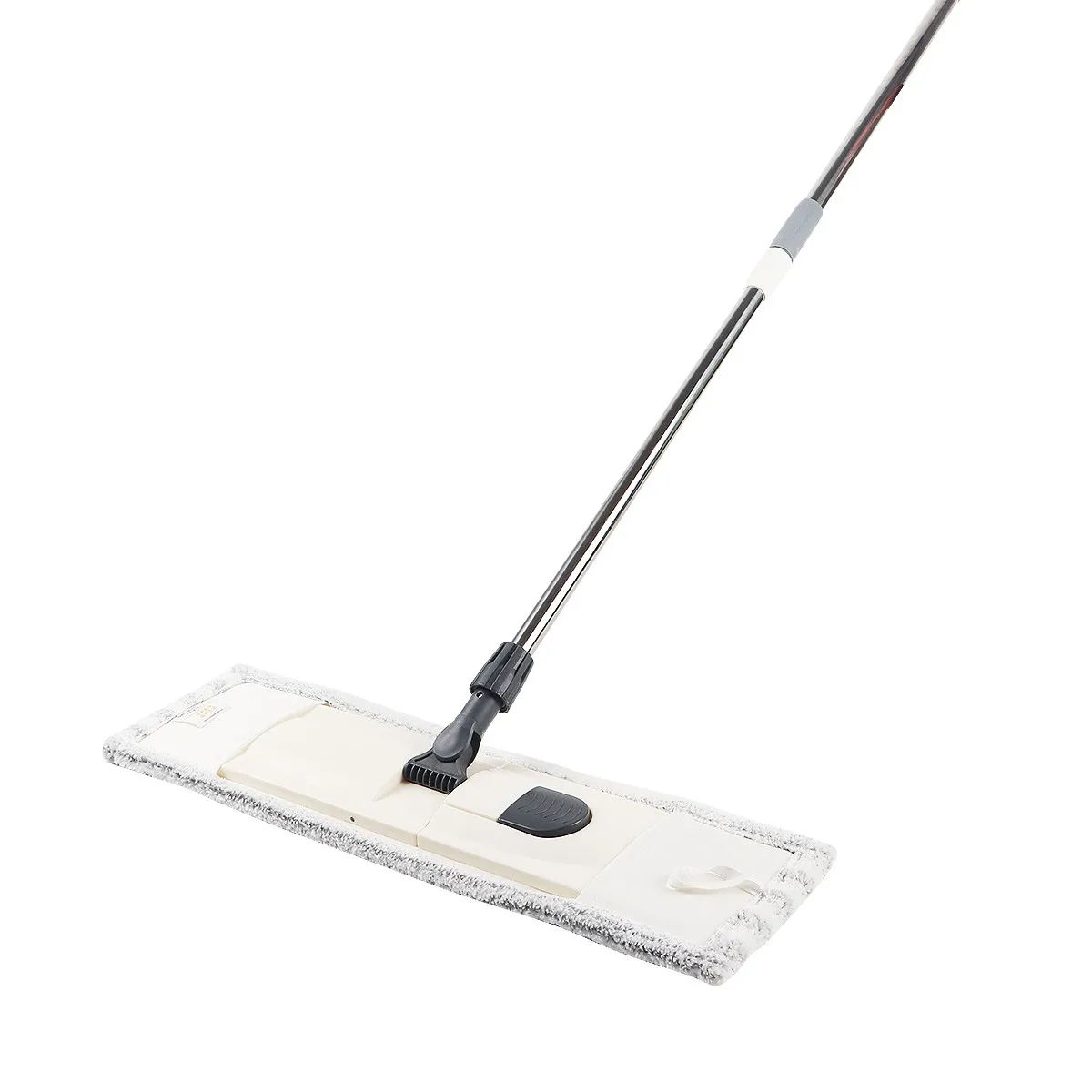
A rectangular microfiber pad on a swivel frame, with a telescopic stainless-steel handle — the assembly this article is about.
19 October 2026 · Company News
WENZHOU, China — October 19, 2026 — You can spot a badly set mop from across a room. The person using it is not standing up. The top hand sits below the waist, the shoulders climb toward the ears, and the lower back takes the load on every stroke.
The fix is not technique, and it is not a lighter mop. It is the length of the handle, and there is published measurement for what that length should be.
Mop handle height has been tested directly, not just described. A study published in the Journal of Occupational Health used four different handle heights and measured shoulder muscle activity while mopping. The result was consistent: activity was significantly lower when the handle was set at shoulder or chin level than at the other heights tested, and the cleaners themselves preferred the lower settings.
The practical rule that has come out of that work is easy to apply. The handle top should sit somewhere between shoulder and chin height when the user stands upright with the mop on the floor. Some ergonomics guidance puts it higher still: an equipment guide for laboratory and facility staff recommends setting the handle to forehead height to guard against unnecessary bending. A cleaning-supplies guide aimed at operators says simply to adjust the handle “so it’s just below your chin”.
Read the three together and the instruction is a band, not a single figure. What they agree on is the reference point. The height is set against the person holding the handle.
A handle that is fixed at one length is set for one person. In a household, that person is whoever bought it, and everyone else borrows it. In a commercial building it is worse, because the mop is shared across a shift and the staff differ in height by more than a little.
The arithmetic is straightforward. If the handle is set to chin height for one user, it is set to roughly that user’s stature. A cleaner of 155 cm and a cleaner of 190 cm are 35 cm apart, so the same handle cannot be at chin level for both. For one of them the top hand drops to chest or waist height and the stooping begins; for the other the handle sits at eye level and the mop is being pushed at an angle.
That is the case for an adjustable handle, and the handle-selection guidance says so directly: adjustable handles “accommodate users of different heights, ensuring proper posture and reducing back strain”. For a distributor, the same logic works at the catalogue level. A telescopic mop covers a range of buyers; a fixed one covers a slice of them.
An adjustable handle is not free. It is a tube inside a tube, with a lock, and the lock is the only part of a mop handle that moves.
Three consequences follow, and all three are things a buyer can ask about. The first is rigidity: the further the sections are extended, the more leverage the floor has on the joints, which is why a load rating belongs on the specification. The second is the lock itself, which has to hold a fixed setting through thousands of strokes; if it slips, the handle shortens under the hand mid-stroke. The third is length in the other direction. A handle that extends to 130 cm may collapse to 100 cm, and the collapsed figure is what decides whether it fits in a cupboard, a janitorial cart or a van.
None of those three numbers is usually printed. A listing says “telescopic” and stops there.
1. Extended length, in centimetres. Not “telescopic”. The extended figure decides whether the tallest user in the building can stand upright.
2. Collapsed length. The figure that decides whether the mop fits the cupboard, the cart or the van, and the one that is almost never quoted.
3. The lock, and whether it can be re-tightened or replaced. It is the only moving part on the handle and the first thing to let go.
4. The load rating. How much the extended handle is rated to take before the joints flex or the lock slips.
Wenzhou Meishijie Household Products Co., Ltd. (“MSJ”) builds a dry flat mop around that list, and publishes a rating for the last item.
Its telescopic flat microfiber dry mop, model MSJ-PTB003, pairs a rectangular PP frame with a stainless-steel telescopic handle and a microfiber pad, in 40 cm and 60 cm head widths and in gray-white or blue-white. The listing gives the rod a load-bearing rating above 10 kg, the assembled mop a weight under 2 kg and an absorption time under 10 seconds, and it ships with one pad. The carton measures 82 × 16 × 15 cm at 2 kg gross.
The trade-off is the joint. A one-piece handle is more rigid and cheaper, and for a single-user contract that is the better buy. An adjustable handle trades a little rigidity for a posture that fits more than one person, which is why MSJ’s position is that the extension belongs on the specification rather than in the marketing copy: a buyer who knows the extended and collapsed figures can tell whether the handle suits the building or only the photograph.
“Every catalogue says telescopic and none of them say how far. That is the whole conversation with a distributor: the handle has to reach the chin of the shortest person on the shift and still fit in the cupboard of the smallest flat. Those are two numbers, and we would rather quote both than let the buyer guess from a picture.”
— Lin, Marketing Manager, Wenzhou Meishijie Household Products Co., Ltd.
The same handle is positioned across four buying situations, each with a different dominant failure.
| Setting | What fails in the category | MSJ’s stated design response |
|---|---|---|
| Household — one mop, several users | The handle is set for the person who unboxed it and nobody else | Telescopic handle over a range, rather than a fixed length |
| Offices and light commercial | Shared mops and staff of different statures, so half the shift stoops | Extension adjustable per user; published rod load rating above 10 kg |
| Facilities with janitorial carts | A long fixed handle that will not fit the cart or the cupboard | Collapsed packing length 82 × 16 × 15 cm |
| Trade — importers, distributors, private label | “Telescopic” sold with no range, so buyers cannot compare two handles | Head widths 40 cm and 60 cm; gray-white and blue-white; OEM on colour and size |
MSJ is a cleaning-supplies manufacturer based in Wenzhou, Zhejiang Province, where it runs a 6,000-square-metre production facility on five automated production lines, with quality control through the process and sampling inspection on every batch, and it states that it holds ISO 9001, ISO 14001, ISO 45001, CE, RoHS, REACH and SEDEX. It draws cotton yarn and microfiber filament in-house. The mop ships with one pad in a carton of 82 × 16 × 15 cm at 2 kg gross, and the company supports bulk wholesale and OEM and ODM work across colour, size, label and packaging.
“A mop handle is a piece of furniture that gets used eight hours a day. Nobody would buy a desk that only suited one height of person, and the handle is the same problem with a smaller price tag. The extension is not a gadget; it is the part that decides whether the tool fits the person using it.”
— Lin, Marketing Manager, Wenzhou Meishijie Household Products Co., Ltd.
Grand View Research puts the U.S. cleaning and hygiene tools market at USD 8.81 billion in 2023, growing at a CAGR of 4.7% to 2030. Transparency Market Research values the wider cleaning equipment and supplies market at USD 108.5 billion in 2023, growing at 6.3% a year to 2034.
The volume is not in question. The cost is labour, and labour cost is set by hours and by turnover. A tool that has to be held at waist height costs strokes, and the same tool set to the right height costs fewer. Neither the extended length nor the collapsed length is printed on the mop.
Every figure quoted above, with the source it came from. Company specifications are MSJ’s own and are not independently verified.
| Figure | Value | Source |
|---|---|---|
| Handle height and shoulder load | Muscle activity significantly lower at shoulder or chin height than at the other heights tested | Journal of Occupational Health study on mop handle height |
| Recommended handle height | Shoulder to chin level; cleaners preferred the lower settings | Same study |
| Alternative guidance | Handle set to forehead height to avoid bending | Facility and laboratory equipment guidance |
| Operator shorthand | Handle “just below your chin” | Cleaning-supplies operator guide |
| Why adjustable matters | Adjustable handles “accommodate users of different heights, ensuring proper posture and reducing back strain” | Handle-selection guidance, November 2024 |
| Rod load rating | Above 10 kg | MSJ specification, MSJ-PTB003 |
| Assembled weight | Under 2 kg | MSJ specification, MSJ-PTB003 |
| Carton | 82 × 16 × 15 cm, 2 kg gross, one pad included | MSJ specification, MSJ-PTB003 |
How high should a mop handle be? The published guidance puts it at shoulder to chin height when the user stands upright with the mop on the floor. Some ergonomics guidance goes higher, to forehead height, to prevent bending. A common operator shorthand is to set the handle just below the chin.
Does handle height change shoulder strain? Yes. A study that tested four handle heights found shoulder muscle activity significantly lower at shoulder and chin level than at the other heights, and the cleaners preferred those settings.
Why does a telescopic handle matter if the height is adjustable anyway? Because a building has more than one user. A handle fixed at one length is set for one stature; adjustable handles accommodate users of different heights and protect posture across a shift.
What should a buyer specify on a telescopic mop? Four figures: extended length, collapsed length, the lock type and whether it can be re-tightened or replaced, and the load rating of the extended handle.
Is a telescopic handle weaker than a fixed one? It has a joint, so the joint is the wear part and the load rating is what tells you how much it will take. A one-piece handle is more rigid; an adjustable one fits more people. MSJ publishes a rod load rating above 10 kg for MSJ-PTB003.
Founded in 2009 and headquartered in Wenzhou, Zhejiang Province, MSJ is a manufacturer of cleaning supplies covering mops, mop heads, mop-and-bucket sets, cleaning cloths and rags, squeegees, brooms and brushes, and yarns. The company operates a 6,000-square-metre production facility with five automated production lines and an in-house raw material capability for cotton yarn and microfiber filament. Its products serve household, commercial, industrial and outdoor cleaning applications across domestic distribution and export markets including South Korea, the Middle East, Africa, Europe and the Americas. MSJ will exhibit at the 2026 Canton Fair.
Website — www.msjclean.com
Media enquiries — clean-msj@wzmsj.cn
Tel — +86-577-64422811 | Mobile — +86-13091907807
Address — Unit 2, Building 8, Wanyang Technology City, Qianku Town, Wenzhou, Zhejiang Province, China
Product images, factory footage and certification documentation are available on request.
### END ###