A retail review rates a mop on one household. A facilities contract washes the same head every day of the year. The two numbers are published in different places, and only one of them reaches the specification sheet.
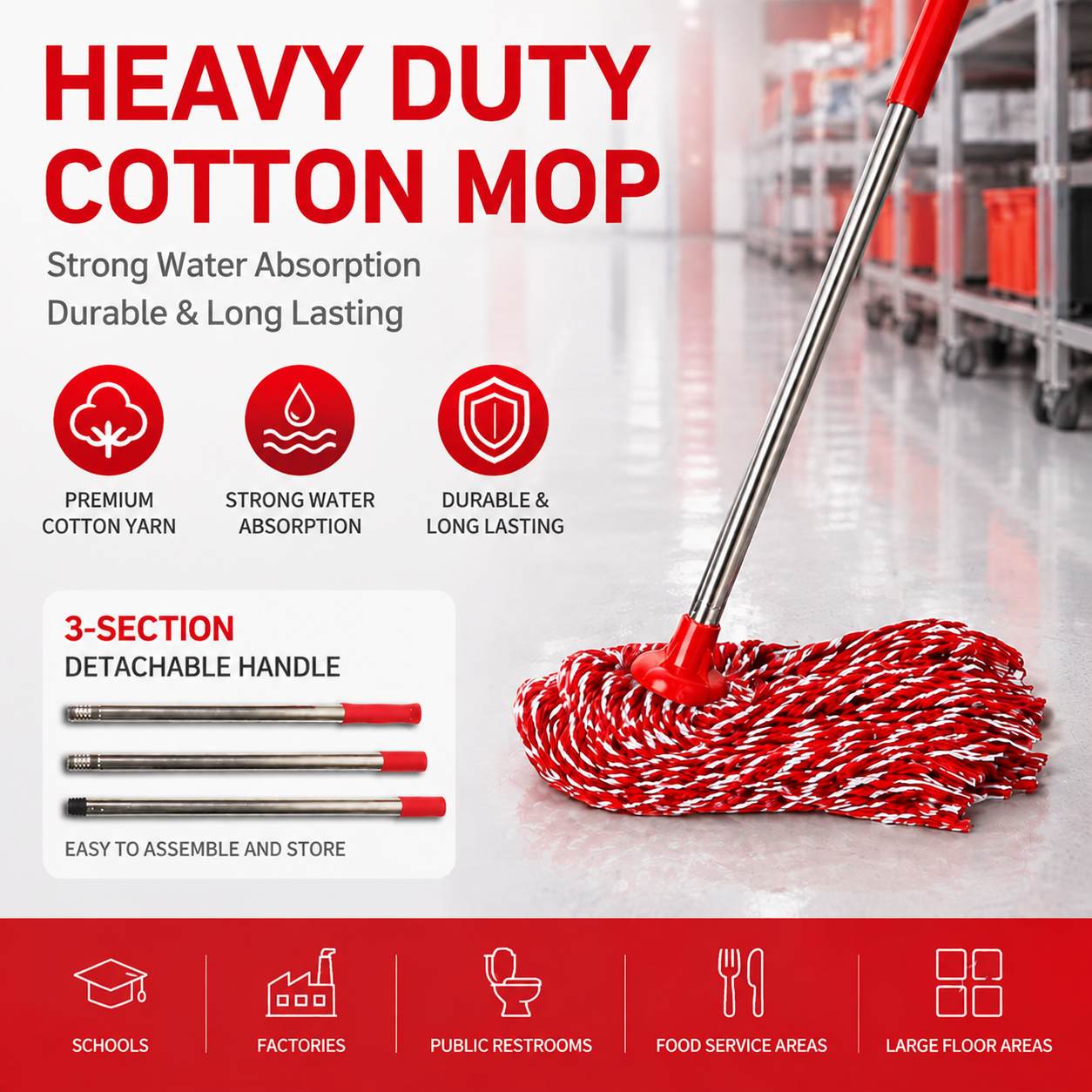
MSJ-STA032, a 350 g cotton yarn head on its three-section stainless-steel pole. Product photograph, Wenzhou Meishijie Household Products Co., Ltd.
20 October 2026 · Company News
WENZHOU, China — October 20, 2026 — Every wet mop review you can find online is written for one household, with one floor and one place to hang the mop to dry. A hotel buys the same object by the thousand and washes each head after every shift. Both buyers are shown the same product page, and the page is written for the first of them.
The gap between those two buyers is a single specification: how many wash cycles a head survives before the yarn gives out. It is the number that decides what a mop costs per year rather than per unit, and it is the number that almost never appears on a quotation.
The most careful consumer guide in the category, Wirecutter’s The Best Wet Mop, was last updated in July 2026. It rates its top pick partly on a replaceable head that is “machine-washable and -dryable up to 100 times”, and it uses that figure to work out a cost per cleanup.
That is the right test for a household. At two moppings a week, 100 cycles is about a year of use, and most people replace a mop long before that for other reasons. The same review also hung its test mops for 36 hours and checked which were dry, which is the question a household actually asks: will this thing smell in the cupboard.
Neither test is wrong. Both are calibrated to a building with one kitchen.
The trade works from a different number. In a mop-maintenance report published by CleanLink, Bob Croft, president of CBN Building Maintenance, put the floor this way: “Even the less expensive pads are supposed to be able to stand up to 250 or better wash cycles.”
Put the two figures side by side and the arithmetic is simple. A head washed once a day reaches 100 cycles in about 14 weeks. At 250 cycles the same daily washing gets it to about 36 weeks. That is two and a half times the service life, and it is the difference between replacing heads four times a year and replacing them once and a half.
Nothing here says a 100-cycle head is defective. It says the figure was measured against a different job. A buyer ordering for a building is buying the larger number, and the label that carries it is the one nobody puts on the carton.
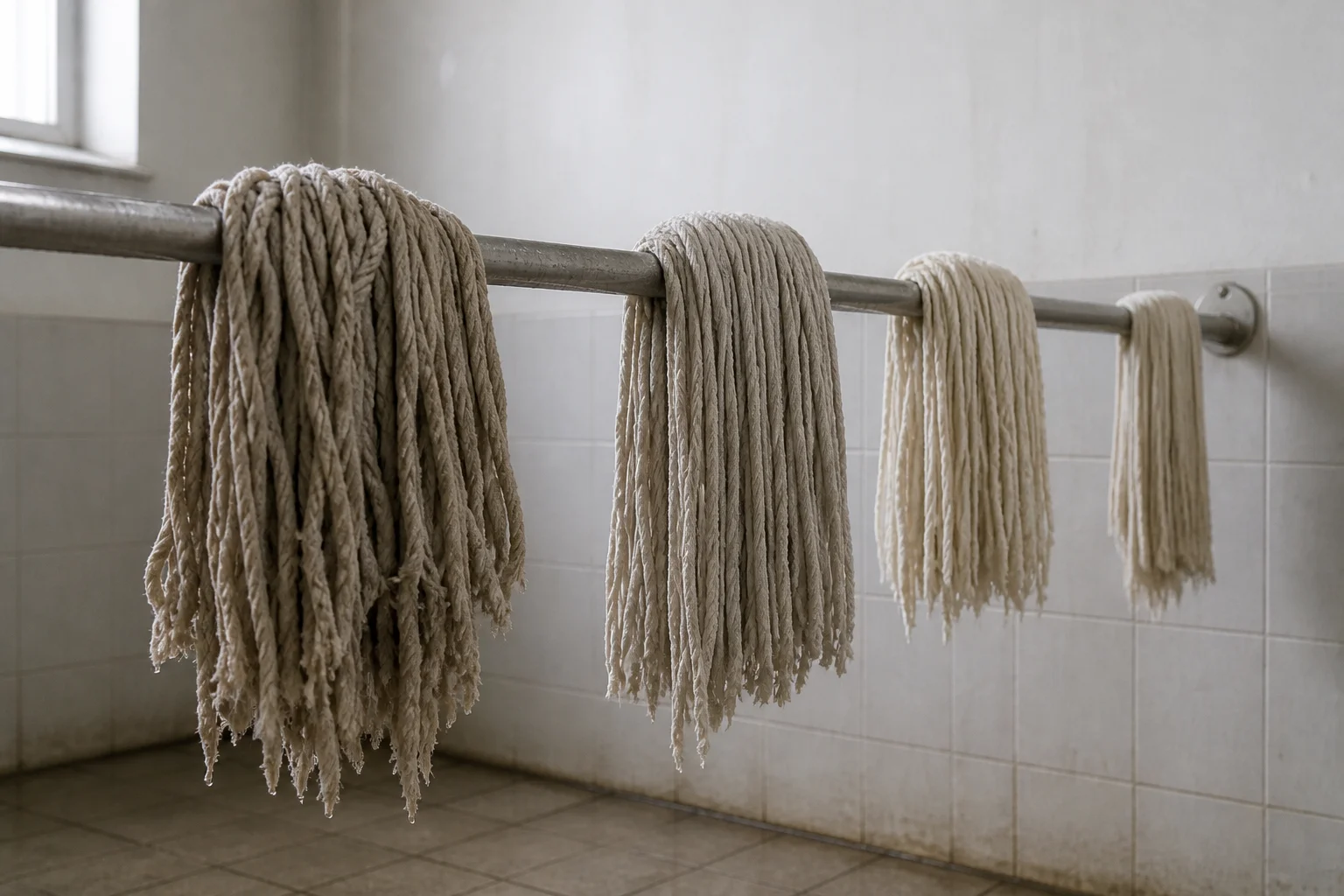
Illustration: cotton heads hung to dry after washing. This is an editorial illustration, not a photograph of MSJ products.
Meishijie makes the four heads below, so this is not a comparison between manufacturers and it is not a ranking. It is a comparison between jobs, using the five figures that actually vary between them: head weight in grams, end construction, socket type, handle, and carton quantity.
We have not tested these heads against other companies’ heads, and nothing below claims a score. What is claimed is smaller and more useful: that each of these four is built for a different duty cycle, and that a buyer who knows the duty cycle can pick between them in a minute.
Prices are not published. The minimum order is 5,000 pieces per colour, for standard and customised orders alike.
The Heavy-Duty Cotton Yarn Mop, model MSJ-STA032, is a 350 g head of thickened, twisted cotton yarn in cloth-strip construction, fixed to a reinforced plastic socket with an anti-shedding collar. The socket screws onto a three-section stainless-steel pole, which is the detail that decides how the mop travels: it unscrews into three threaded sections and packs down inside the carton, so it does not need a full-length slot in a janitorial cupboard.
That 350 g is the working weight. It is what carries water to the floor per pass, and it is what the person holding the handle feels at the end of a shift. It ships 24 pieces to a carton, in red and white as standard, with green, blue, yellow and white available so a building can assign heads to zones. Yarn can be cotton, microfiber or a blend.
Where it gives way: 350 g is lighter than the 450 g head that most Kentucky-style mops use, so on heavy soil it needs a second dip sooner than a heavier head would.
The looped-end cotton mop, model MSJ-STC021, is the 450 g head. In the trade that figure has a name attached to it: 16 ounces, the weight most catalogues list for a standard Kentucky mop, which is how a buyer can compare this head to a competitor’s without weighing anything.
The looped end matters more than the weight when the account is wash-heavy. Looped yarn is a closed loop rather than a cut tuft, so there are no loose fibre ends to unravel along the length of the strand, and the head holds its shape through repeated laundering. The head attaches with a clamp-style socket for quick changes, and the stainless-steel pole carries a colour-coded grip.
Where it gives way: 450 g of wet cotton is a heavy tool. It is the right head for a large soiled floor and the wrong one for a full shift of light mopping in a small clinic, where the weight costs more than the absorbency returns.
The Loop End Microfiber Socket Mop Head, model MSJ-STA030, is a 400 g head of looped microfiber on a blue plastic socket sized for standard handles. It is supplied as a head, 50 to a carton, in white or to a custom colour.
Microfiber behaves differently from cotton in two ways that a buyer can plan around. It releases water more readily on the wringer, so a head that goes back down damp rather than wet is easier to achieve; and it does not rot, which is why the reviews that recommend it for households cite odour as much as absorbency. Wirecutter’s guide puts it plainly: microfiber “won’t rot and stink, something that can happen with mops made from cotton.”
Where it gives way: microfiber loads up with soil and grease, and a loaded head stops absorbing. On heavy soil it needs rinsing more often than cotton, not less.
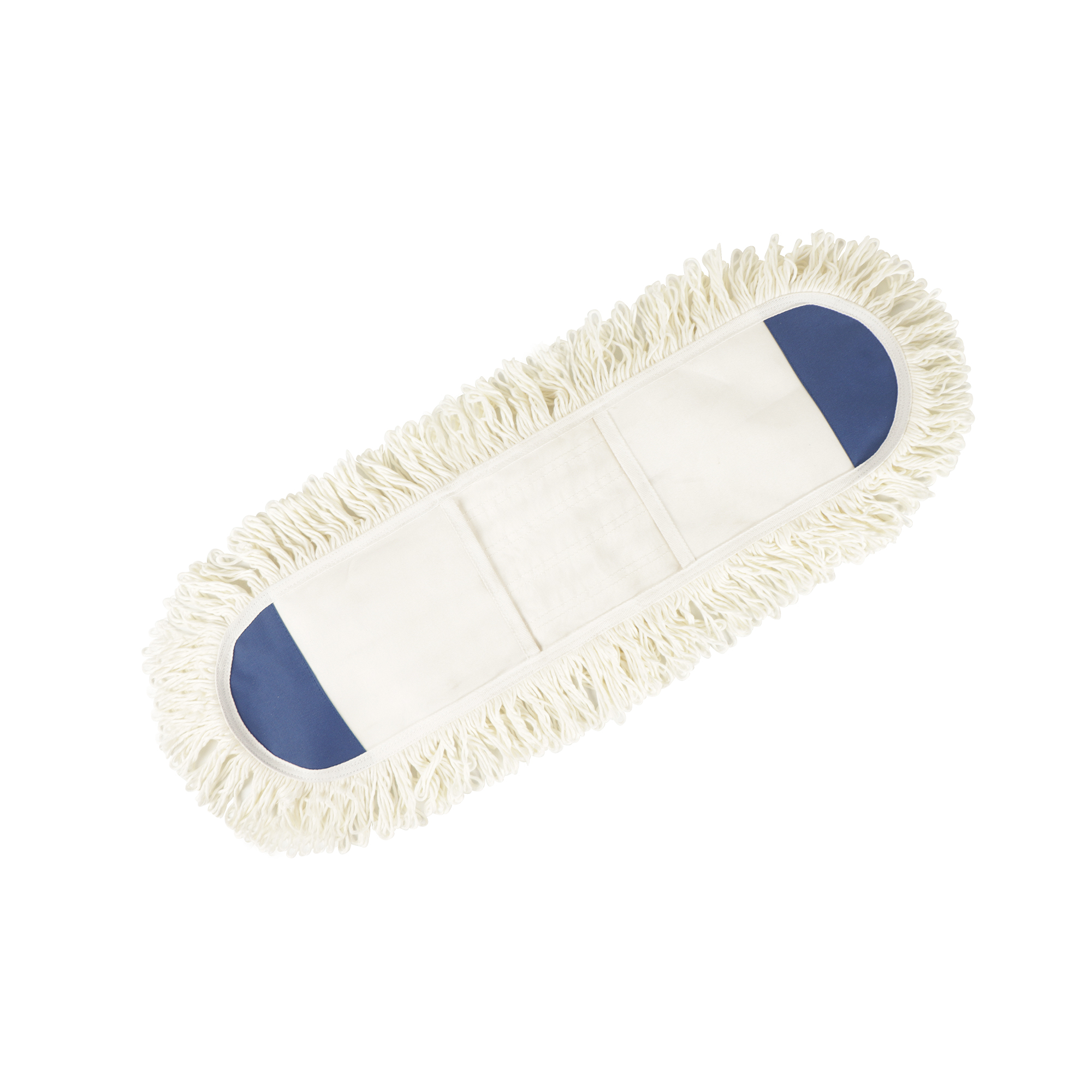
The Non-Woven Mop Head, model MSJ-STA015, is the light one: 160 g of non-woven strip on a PP base, 50 to a carton, in blue as standard with white and yellow available, and sold either as a head or on a long handle.
This is the head for the work that does not need 450 g of cotton: restrooms, canteens, entrances, the hundred small passes a shift makes between the jobs that matter. Its value is the colour system. A building that runs zone-based cleaning needs enough heads in enough colours that nobody carries a restroom head into a kitchen, and the cheapest way to do that is to make the light head the colour-coded one.
Where it gives way: 160 g carries much less water than the cotton heads above. It is not a substitute for a 350 g or 450 g head on a long run, and the copy should not pretend otherwise.
“Buyers send a photograph and a target price, and we can quote something from that in a day. It is not enough to quote the right thing. When the head weight, the end construction and the wash cycle are on the enquiry, the quotation comes back correct the first time, which is what a reorder should be.”
— Lin, Marketing Manager, Wenzhou Meishijie Household Products Co., Ltd.
None of the numbers above tells you what a shipment will actually be like, which is why the sample stage exists. Five checks, all of them done with a scale and a bucket, take about an hour:
1. Weigh ten heads out of the carton. Record each one. The average tells you whether the nominal weight is real; the spread tells you whether the line is controlling it.
2. Measure water retention. Weigh a head dry, soak it for a minute, hang it for a minute, wring it the way your staff will, and weigh it again. The difference divided by the dry weight is the retention figure. Compare suppliers on the same day, with the same water, using the same person to wring.
3. Wash ten cycles, then weigh again. Fibre that sheds shows up as lost mass and in the lint trap. A head that has lost weight has lost absorbency with it.
4. Fit the socket to the handles you already own. Before the order, not after. A universal socket is universal until it meets a handle it does not fit.
5. Load the joint, not the head. Extend the pole fully, put the head on the floor and push. On a three-section handle, watch the threads; on a telescopic one, watch the lock.
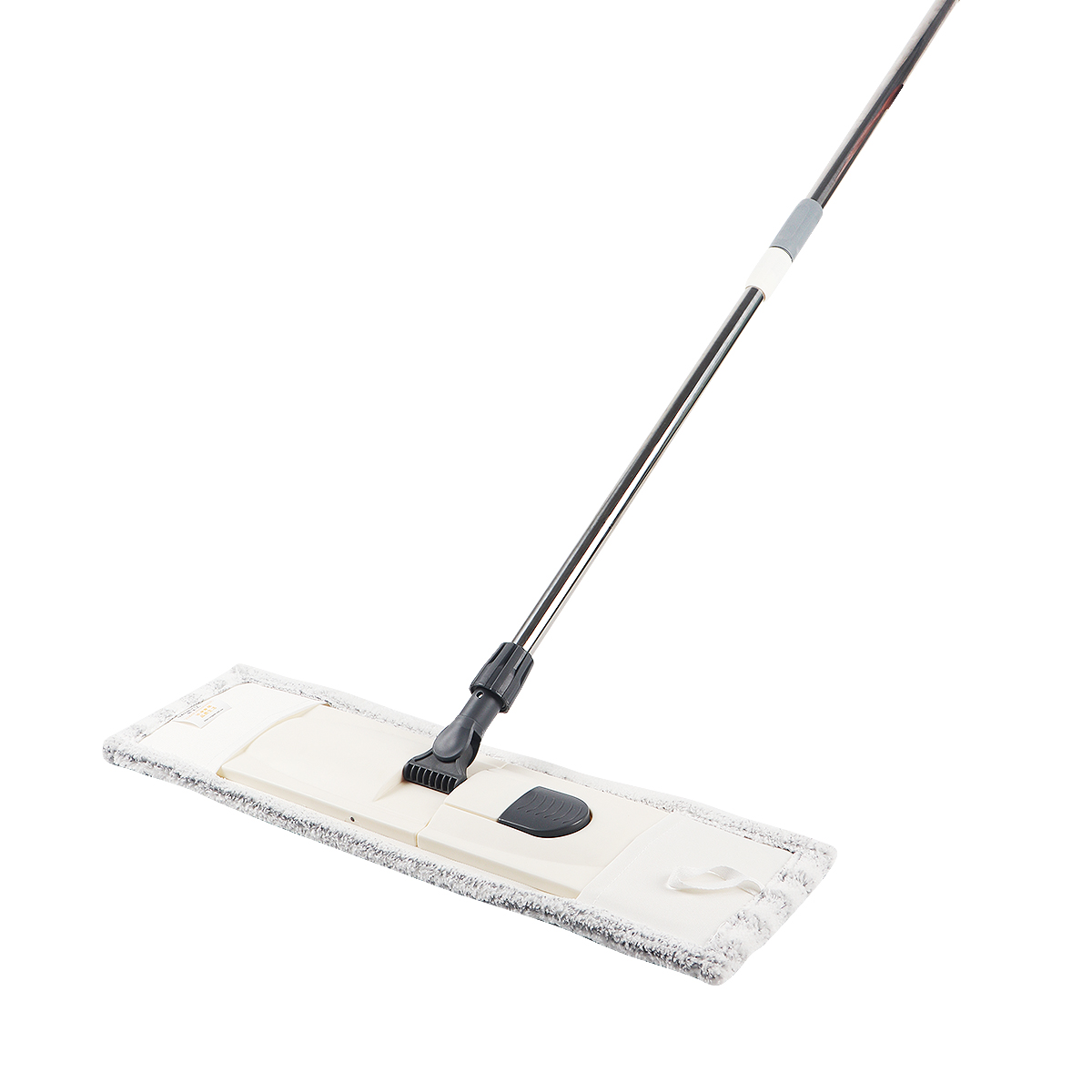
A flat mop is not in the four above, and the reason is mechanical rather than commercial: it cannot be wrung. That is why the consumer guides generally leave flat mops out of a wet-mop comparison and use them dry or barely damp.
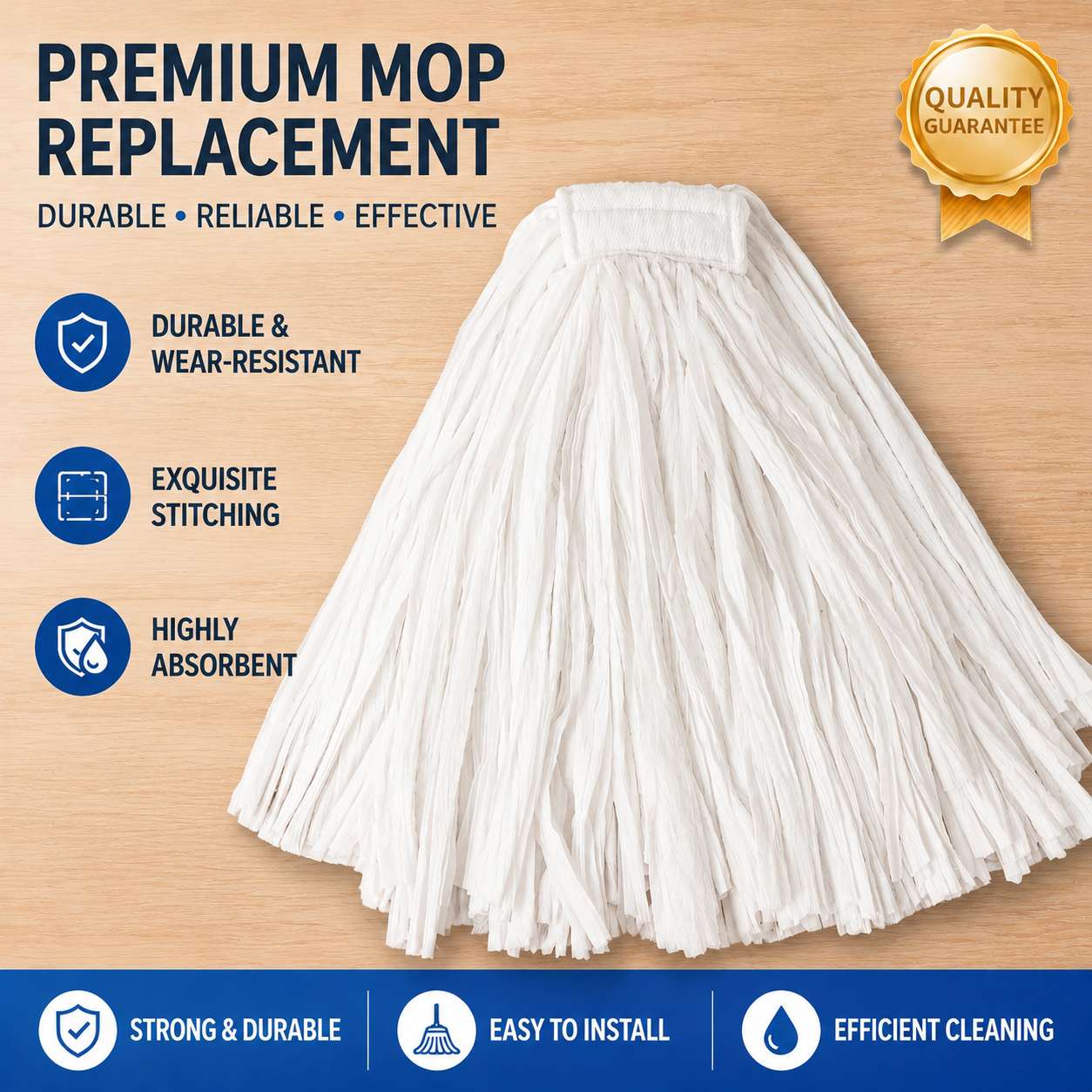
The Telescopic Coral Velvet Flat Mop, model PTA022, is built for that job. A PP frame with a 360-degree swivel joint, a stainless-steel telescopic pole, and coral-velvet pads in red, blue and green, in 40 cm and 60 cm widths. It goes under furniture that a string mop cannot reach, and it takes dust off a floor before a wet pass rather than instead of one. Pads are machine-washable on a gentle cycle, and fabric softener should be kept away from them because it coats the fibre.
This covers wring-able string and strip heads, plus one flat mop for dry and damp work. It does not cover spin-bucket systems with a centrifuge, disposable pad systems, or battery spray mops. If the job needs a bucket that spins the head dry, this page will not help, and a buyer should say so at the enquiry rather than order around it.
Two routes reach the same production line, and they are packed differently.
Trade buyers — importers, distributors, contract cleaners, private-label brands — order through the product pages linked above, from 5,000 pieces per colour, with OEM and ODM available on head weight, yarn type, colour, pole length, logo and carton artwork.
Single units and small quantities are handled through the company’s retail store on AliExpress, at aliexpress.com/store/1105841956, in retail packing and at retail order quantities, with no minimum. The head inside comes off the same line; what changes is the packing, the carton artwork and the document set.
The dividing line is the order rather than the product. A shop testing a head before it commits to a container buys one. A distributor buying the container buys the trade version.
Four things shorten a head’s life more than the floor does.
Detergent dosed too high leaves residue in the yarn, and residue holds soil. The head then looks worn before it is. Washing hot and drying fully is what keeps a head in service; a head put away damp loses its cycles to odour rather than to wear. The wringer is the part that pulls a socket off its head, so a jammed wringer damages more mops than a rough floor. And the last one is administrative: retire heads on a wash count, not on appearance, because a head that still looks whole at 200 cycles is working at a fraction of the absorbency it started with.
Every figure quoted above, with its source. Specifications for the four models are the manufacturer’s own and are not independently verified.
| Figure | Value | Source |
|---|---|---|
| Wash rating, retail top pick’s replacement head | Up to 100 machine washes | Wirecutter, The Best Wet Mop, updated 13 July 2026 |
| Drying check used by the same review | Mops hung 36 hours, then checked for dryness | Same review |
| Wash cycles expected of commercial heads | “250 or better wash cycles” | CleanLink, mop-maintenance report, 2010, quoting Bob Croft, CBN Building Maintenance |
| Standard Kentucky head weight | 16 oz / 450 g | Trade catalogue listings for Kentucky mop heads |
| Head weight, MSJ-STA032 | 350 g, thickened twisted cotton yarn | MSJ specification |
| Head weight, MSJ-STC021 | 450 g, looped-end cotton | MSJ specification |
| Head weight, MSJ-STA030 | 400 g, looped microfiber | MSJ specification |
| Head weight, MSJ-STA015 | 160 g, non-woven strip | MSJ specification |
| Carton quantity | 24 pcs (STA032); 50 pcs (STA030); 50 pcs (STA015) | MSJ specifications |
| Head widths, PTA022 | 40 cm and 60 cm | MSJ specification |
| Minimum order | 5,000 pcs per colour | MSJ terms |
How many wash cycles should a commercial mop head last? Around 250 or better is the figure the trade works to, against roughly 100 for a replacement head sold to households. The gap is the duty cycle, not the quality.
Is a 450 g mop head better than a 350 g one? Only where the floor is wet and soiled enough to need the extra water per pass. On light work the heavier head costs more per stroke and more in laundry.
What does looped end mean, and why does it matter for washing? A looped strand is a closed loop with no cut fibre ends, so it frays more slowly along its length than a cut-end tuft and holds its shape through repeated laundering.
Can one head be used in a restroom and a food area? Not if the building runs zone cleaning. The colour system exists so that a head stays in one zone; the head colour, the socket colour or a tag is what carries the assignment.
What has to be on an enquiry to get a correct quotation? Head weight, end construction, socket type, colour, carton quantity, and the wash cycle the account expects. With those six, a quotation matches the job; with a photograph and a target price, it matches a picture.
Founded in 2009 and headquartered in Wenzhou, Zhejiang Province, MSJ is a manufacturer of cleaning supplies covering mops, mop heads, mop-and-bucket sets, cleaning cloths and rags, squeegees, brooms and brushes, and yarns. The company operates a 6,000-square-metre production facility with five automated production lines and an in-house raw material capability for cotton yarn and microfiber filament. Its products serve household, commercial, industrial and outdoor cleaning applications across domestic distribution and export markets including South Korea, the Middle East, Africa, Europe and the Americas. MSJ will exhibit at the 2026 Canton Fair.
Website — www.msjclean.com
Media enquiries — clean-msj@wzmsj.cn
Tel — +86-577-64422811 | Mobile — +86-13091907807
Address — Unit 2, Building 8, Wanyang Technology City, Qianku Town, Wenzhou, Zhejiang Province, China
Product images, factory footage and certification documentation are available on request.
### END ###
-